Download
1 / 1
10 likes | 111 Vues
This study investigates the localization and antiresonance phenomena in disordered qubit chains, focusing on a quantum computer model based on an anisotropic spin-1/2 chain with defects. We explore how multiple localized many-excitation states arise next to defects and how these states influence the system's behavior. The effects of strong anisotropy and many-body interactions are analyzed, particularly how resonant and non-resonant defects affect localization length and the dynamics of bound and unbound magnons. This research provides insights into energy control in qubit systems.

E N D
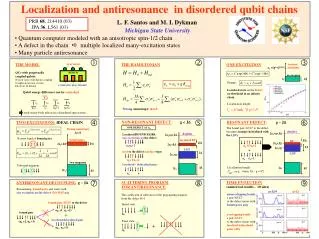
localized excitation e1 +(g2+J2)1/2 one magnon e1 2J doublet 2e1+g+JD J/D BP 2e1+JD n0 n0+1 2J 2e1+g LDP n0 +1n0+2 2e1 4J n0 n … Localization and antiresonance in disordered qubit chains PRB 68, 214410 (03) JPA 36, L561 (03) L. F. Santos and M. I. Dykman Michigan State University • Quantum computer modeled with an anisotropic spin-1/2 chain • A defect in the chain a multiple localized many-excitation states • Many particle antiresonance THE MODEL QCs with perpetually coupled qubits: Nuclear spins with dipolar coupling Josephson junction systems Electrons on helium ONE EXCITATION THE HAMILTONIAN ELECTRONS HELIUM Energy: CONFINING ELECTRODES Qubit energy difference can becontrolled Localized state on the defect: no threshold in an infinite chain. Localization length: g e0 e0 e0 e0 n0 n0+1 n0+2 n0-1 Stronganisotropy:D>>1 study many-body effects in a disordered spin system NON-RESONANT DEFECT : g < JD RESONANT DEFECT: g ~ JD TWO EXCITATIONS:IDEAL CHAIN ONE DEFECT AT n0 The bound pair NEXT to the defect becomes strongly hybridized with the LDPs Strong anisotropy D>>1 Localized BOUND PAIRS: one excitation on the defect next to the defect (surface-type) doublet 2e1+g+JD Narrow band of bound pairs bound pairs localized BP J/D 2e1+JD J/D 2e1+JD n0 +1n0+2 LDP + 2J 2e1+g n0 n0+2 two magnons Localized - delocalized pairs Unbound magnons Localization length: 4J 2e1 2e1 4J when JD –g = J/2 TIME EVOLUTION (numerical results - 10 sites) SCATTERING PROBLEM FOR ANTIRESONANCE ANTIRESONANT DECOUPLINGg ~ JD Resonanting bound pairs and states with one excitation on the defectDO NOT mix g=JD/4 g=JD nonoverlapping bands, a pairNEXT to the defect mixes with bound pairs only overlapping bands: a pairNEXT to the defect mixes with localized-delocalized pairsonly The coefficient of reflection of the propagating magnon from the defect R=1 bound pair NEXTto the defect Initial state: (n0 +1, n0 +2) … bound pair + n0 localized delocalized pair Final state: (n0 +2, n0 +3) + (n0 , n0 +3) n0