Download
1 / 23
230 likes | 333 Vues
This article delves into the essential nature of ionic compounds, focusing on what binds them together through ion pair energy and lattice energy. It covers significant concepts such as the Madelung constant, ion size trends, and the importance of charge in ionic interactions. By examining the lattice energy calculations for compounds like NaCl and exploring the Born-Haber cycle, the driving forces behind ionic compound formation are elucidated. Questions regarding electron transfer in NaCl formation and why specific compounds like MgF2 form over others are discussed.

E N D
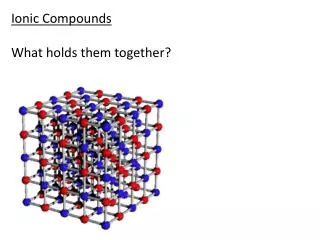
Ionic Compounds What holds them together?
Ion Pair Energy Attractions:
Ion Pair Energy The big picture:
Lattice Energy Energy released when gas phase ions combine to form the ionic solid. U = lattice energy N = Avogadro’s Number A = Madelung constant z = charges e = charge on electron = 1.602 x 10⁻¹⁹ C o = 8.854 x 10⁻¹² C2/mJ ro = sum of radii n = average Born exponent NaCl: ro = 283 pm = 2.83 x 10⁻¹⁰ m; A = 1.748
Lattice Energy Energy released when gas phase ions combine to form the ionic solid. U = lattice energy N = Avogadro’s Number A = Madelung constant z = charges e = charge on electron = 1.602 x 10⁻¹⁹ C o = 8.854 x 10⁻¹² C2/mJ ro = sum of radii n = average Born exponent NaCl: ro = 283 pm = 2.83 x 10⁻¹⁰ m; A = 1.748
Measuring Lattice Energies: Born-Haber Cycles Hf (NaCl) = -411 kJ/mol Hatomization(Na) = 108 kJ/mol Cl-Cl bond energy = 242 kJ/mol IE(Na) = 502 kJ/mol EA(Cl) = -349 kJ/mol
Question: Is the driving force for formation of NaCl the electron transfer from Na to Cl? That is, is it because Cl wants Na’s valence electron more than Na wants it?