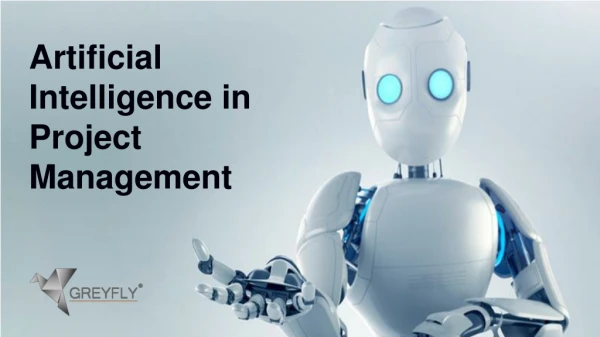
Artificial Intelligence in Project Management
0 likes | 62 Vues
<br>The human challenge in project management revolves around managing diverse teams with varying backgrounds, experiences, and sometimes conflicting agendas. Artificial intelligence in project management is an excellent approach to making project planning more realistic. But an AI always makes its decisions independently of human sensitivities - and for this very reason, it must be controlled by humans. AI tools can identify patterns, generate insights, and provide actionable recommendations, helping companies improve their services and make smarter business decisions.


Artificial Intelligence in Project Management
E N D
Presentation Transcript
Artificial Intelligence in Project Management 2 Artificial Intelligence (AI) enhances project management by Here are some key human-related challenges: Communication Poor communication can lead to misunderstandings and delays. It is crucial to establish clear communication annels and share regular updates to keep everyone on the same page. Team Dynamics Bringing together individuals from different functional areas can create friction. Building a cohesive team requires understanding and addressing individual needs and fostering a collaborative environment. • Optimizing resource allocation • Automating routine tasks Motivation and Engagement • Improving decision-making Keeping team members motivated and engaged can be challenging, especially when they are not directly reporting to the project manager. Utilizing emotional intelligence and understanding human needs can help in inspiring and leading the team effectively. • Scaling with project complexity • Facilitating better communication • Providing accurate forecasts This leads to more efficient and successful project outcomes. Conflict Resolution Conflicts are inevitable in any team setting. Having strategies in place for conflict resolution and promoting a culture of open dialog can help manage disputes constructively. The Human Challenge Why is human resource planning in projects so difficult and chaotic? After all, the daily routine in project management is often enough to make you tear your hair out. Resource Management Balancing the workload and ensuring that team members are not overburdened is essential for maintaining productivity and morale The human challenge in project management often revolves around managing diverse teams with varying backgrounds, experiences, and sometimes conflicting agendas.
Artificial Intelligence in Project Management 3 Hybrid Planning - The Optimal Environment for AI AI has several limitations in project management, despite its many advantages: Lack of Human Judgment and Intuition AI lacks the human touch needed for nuanced decision-making, problem-solving, and strategic thinking. High Costs Implementing AI solutions can be expensive, making it less accessible for smaller organizations. Hybrid planning combines different project management methodologies, such as waterfall, rolling, and agile planning, to create an optimal environment for AI. This approach allows AI to leverage its strengths in various planning stages, enhancing efficiency and adaptability. Technological Limitations AI systems may struggle with complex, unstructured data and can be limited by the quality and quantity of the data available. Integration Challenges Integrating AI with existing systems and processes can be difficult and time- consuming. Key aspects of hybrid planning include: Resistance to Change Rolling Planning Resistance to Change: There can be resistance from team members who are wary of new technologies or fear job displacement. This involves detailed short-term planning and rough long-term planning. It allows AI to adjust plans dynamically as new information becomes available. Ethical and Privacy Concerns AI systems can raise concerns about data privacy and ethical use, especially when handling sensitive project information. Agile Planning This method emphasizes flexibility and iterative progress, enabling AI to respond quickly to changes and deliver continuous improvements. While AI can significantly enhance project management, it is essential to balance its use with human expertise and oversight. By integrating these methodologies, hybrid planning creates a robust framework where AI can optimize project outcomes, manage uncertainties, and improve decision-making processes.
Artificial Intelligence in Project Management 4 Case Study: Insights on How AI is Transforming the BPO Industry Automation of Repetitive Tasks Scalability AI systems can easily scale to meet the changing demands of clients. Whether it is handling an increased volume of customer inquiries or processing more transactions, AI can quickly adapt without the need for additional human resources. AI-powered tools, such as Robotic Process Automation (RPA), are used to automate repetitive and mundane tasks. This includes data entry, processing transactions, and managing routine customer inquiries. Enhanced Customer Service Improved Data Management AI enhances the ability to manage and analyze large datasets. This capability is crucial for BPOs that handle vast amounts of customer information. AI tools can identify patterns, generate insights, and provide actionable recommendations, helping companies improve their services and make smarter business decisions. AI-driven chatbots and virtual assistants are revolutionizing customer service in the BPO sector. These AI systems can handle initial customer inquiries, provide real-time responses, and even perform sentiment analysis during interactions. This not only speeds up response times but also ensures a more personalized customer experience. Predictive Analytics and Decision-making Job Creation and Skill Enhancement Contrary to the fear that AI might replace human jobs, it is creating new opportunities and enhancing existing roles. AI integration requires skilled professionals to develop, manage, and maintain these systems. Machine learning (ML) models are employed to analyze vast amounts of data and generate predictive insights. This helps BPOs forecast trends, identify potential issues before they arise, and make data-driven decisions. Cost Reduction By automating processes and improving efficiency, AI helps BPOs reduce operational costs. This is particularly beneficial for tasks that are labor-intensive and time- consuming. The cost savings can then be passed on to clients, making BPO services more affordable and attractive.
Artificial Intelligence in Project Management 5 Conclusion AI can’t do everything, but it can do a lot. Artificial Intelligence in project management is an excellent approach to make project planning more realistic and competence management more practical. But: An AI always makes its decisions independently of human sensitivities - and for this very reason must be controlled by humans. Otherwise, the algorithm would, for example, postpone “further training of employees” by a year. Human solutions, which are characterised by the human interpretation of flexibility, creativity and pragmatism, are largely alien to it anyway. For example, it is up to humans to weigh up the extent to which deviations in time, costs or quality of a project are justifiable. References • PMI • Study of AI in project management by Sweden chapter • Internet articles
Disclaimer This document makes descriptive reference to trademarks that may be owned by others. The use of such trademarks herein is not an assertion of ownership of such trademarks by SG Analytics (SGA) and is not intended to represent or get commercially benefited from it or imply the existence of an association between SGA and the lawful owners of such trademarks. Information regarding third-party products, services, and organizations was obtained from publicly available sources, and SGA cannot confirm the accuracy or reliability of such sources or information. Its inclusion does not imply an endorsement by or of any third party. Copyright © 2024 SG Analytics Pvt. Ltd. www.sganalytics.com Pune | Hyderabad | Bengaluru | London | Zurich | New York | San Francisco | Amsterdam | Toronto | Wroclaw