Overcome Writer's Block
7 Ways to Get Over Writer's Block - wikiHow<br>3 Ways to Start a Writer's Notebook - wikiHow<br>How to Become a Writer<br>How to Look Like a Writer<br>How to Be a Good Writer<br>7 Home Remedies to Get Rid of a Writeru2019s Callus Painlessly<br>How to Grow As a Writer<br>How to Get an Idea for a Book (For Young Writers): 9 Steps<br>How to Become a TV Writer<br>3 Ways to Prevent a Writer's Bump Callus - wikiHow<br>

Overcome Writer's Block
E N D
Presentation Transcript
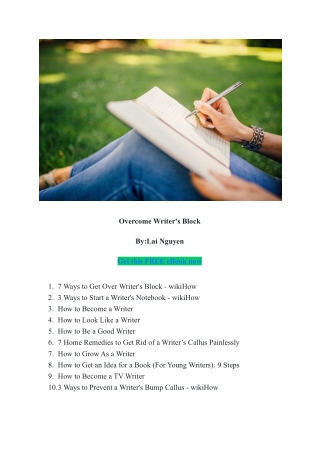
Overcome Writer's Block By:Lai Nguyen Get this FREE eBook now Table of content 1. 7 Ways to Get Over Writer's Block - wikiHow 2. 3 Ways to Start a Writer's Notebook - wikiHow 3. How to Become a Writer 4. How to Look Like a Writer 5. How to Be a Good Writer 6. 7 Home Remedies to Get Rid of a Writer’s Callus Painlessly 7. How to Grow As a Writer 8. How to Get an Idea for a Book (For Young Writers): 9 Steps 9. How to Become a TV Writer 10.3 Ways to Prevent a Writer's Bump Callus - wikiHow
7 Ways to Get Over Writer's Block - wikiHow Accept that you have writer's block. When you have writer's block, no ideas spring to mind when you are writing and you are stuck for what to write. Understand that writer's block is easy to overcome, and there are many ways to get over it. Do not stop to the idea that you will never write again. Write about anything. Anything in the world - even write about pineapples. It gets your brain to think more and be creative. This works best for many people. Once you've thought of a paragraph or a few sentences about your topic go back to your story. Get some ideas on paper without worrying about how they sound. The writing does not have to be polished; writers often have writer's block because they
worry about the quality of their writing. Remember that nobody has to see a word you've written except you. You can show it to the world when you're ready. Try a change of pace. For example, if you have a long, action-packed sequence, try going over to a reasoned conversation. Be sure that the changeover makes sense. You don't have to write in one speed or one tone all the time. Something completely different can really end up inspiring you to reach new depths. If you tend to write dramatic scenes, switch to something a bit more lighthearted, or vice versa. Decide when to give up on an idea. Look over what you have written and ask yourself, "Does this seem to be leading up to anything?" If you feel like it's going absolutely nowhere, then it may be time to move on from it. Decide whether the situation truly feels real. You may have writer's block because the situation doesn't seem realistic to you. Don't be afraid to rewrite parts of the story to make it more natural. Try starting from another part of your story. If you are having trouble with the beginning, write the middle or end. After you have written another part of the story, things may start to fall into place where you were before. ● Writing out of order may require more familiarity with the plot so that everything makes sense from start to finish. At the same time, it may help you think out the details when you cannot decide what to do with your story. Writing a good ending while you think of about the rest of your story will help structure it. Get this FREE eBook now
Write something totally different. It may surprise you how much you like it! A monologue, song, poem, or even taking a short amount of time to write a scene from a completely different story will get your writer's blood flowing again. Use prompts. Out of all writers block stoppers, using prompts is one of the most effective ones. Use any random word or sentence to help you come up with a plot and start writing your story. For example, if you asked a friend to give you a prompt and they said the words "Forever" and "Passion" you would most likely think of a romance. And if they were to give you the phrase "Bite me" then you would most likely think of a vampire or werewolf. (Twilight anybody?) Use the world around you. Use the people around you and their personalities. Use the nature, atmosphere, and scenes that surround you to build up your story/plot. The best possible way to do this is to use a diary. Jot down your daily life, random thoughts, and feelings. If you can't possibly think of something to write about, just name a bunch of objects or ideas. Even if you think one won't work. It's a simple way to cure writer's block. To make it easier, say everything you're thinking about out loud. You'll bump into something. Good luck! Get a paper and a pen or a pencil. Or use your computer, if that works better. This is the first thing you need to channel a character -- a blank canvas. Write down a name, the first name that comes to mind, at the top of the page. It can be the name of a person you know, a person you read about, or just something that randomly pops into your head. Ask questions about the person. Under the name, start making a list, ask yourself questions like: Who is this person? How does he/she look like? Does this person have any siblings, if yes then who? Let the character develop. Allow the character to form in your mind, see the character in your head, become the character. Try to visualize the life of the character. What is it like when the character wakes up in the morning? Does he/she go to work or school? How does he/she feel about his family? What does he/she like to have for lunch? All of these details add up to a life. Look over what you've written. When you are done with the list, read through it and hopefully, you will be able to place this character in a scenario, that might spark the idea for a story… maybe just one detail you came up with can spark your interest in an entire story.
Play the "and then" game. Surprisingly, this game is a great way to cut yourself out of writer's block. Start with any random sentence, for example, "One day there was a girl named Destiny" then you continue the story with "and then" after every sentence. "And then she met a guy named Daniel. And then she found out he was a vampire" etc. That might not be how you write a story, but, the deeper you get, you end up finding a plot. Write a backstory about your main character. Create tons of info about your main character -- why is her hair so short when all of the other girls have long plaits? Her hair was like that too, but an evil man tried to cut her neck in a chase and she ducked, her hair flying up, causing him to slice it, instead. Reading a novel. It could help with inspiration. Reread a book that you enjoy if you want to. You can even plot the book, or write down what it is about the characters or scenes that really inspires you. Try picking something in the genre you're writing in, whether it's Sci-Fi, Romance, or a Thriller, to get ideas about your subject matter. Read your previous work. If you reread your story or other previous stories, it might spark something in your brain. Inspiration is a mysterious thing; it can come back at any time. Read about a person you admire. Read a story about someone who you like or admire and make a character based on that person, include their personality traits and hobbies so if you do write a story on them it makes it easier when you're knowing almost everything about them. Get this FREE eBook now Read poetry. Poetry can also inspire you to write fiction -- or to write some poetry of your own! You may be surprised, but an image in a poem, whether it's the "Silken, sad, uncertain, rustling of each purple curtain" in Poe's "The Raven," or the line, "You, my father, there on the sad height," from Dylan Thomas' poem, "Rage, Rage Against the Dying of the Light," that brings an image or an idea to mind, soon enough, you'll be inspired by a completely new idea! Read non-fiction. Hey, picking up a book about a historical event, such at the Montgomery Bus Boycotts or the Siege of Leningrad, can also help you come up with a new vision or idea that took place during that time. Soon, you'll have new characters, plots, or lines of dialogue floating through your head. Rewrite an existing article. Find a newspaper and rewrite the article -- that murder last week was a ghost getting revenge on her evil grandson, and... (this can help get ideas flowing).
Take a break. Sometimes a nap helps (you never know what you'll dream about, plus sometimes, while you're lying in bed, you'll have a sudden flash of inspiration. You should write it down instantly, even if it's in the middle of the night.) or you can watch a movie or go for a walk. Seeing new things can help stimulate your brain and thus giving your imagination a boost. Cook a meal, clean the house, or play with your pets. Completely forget about your story for a while. Don't be hard on yourself if you can't think of anything. If you really can't write a word and would rather lie down and relax or do something else, don't punish yourself. Even the world's best writers can sometimes only write for an hour or a few hours a day. Gustave Flaubert, the author of the classic, Madame Bovary, was said to only write a single sentence per day! Don't edit while you write. You can obsess over every sentence or every line later. If you are telling yourself that each paragraph absolutely must be absolutely perfect then you'll never get to the next paragraph! Don't panic. Everyone gets writer's block at least once in their lives as it's perfectly normal. You can even say that going through writer's block and breaking through it, will help you be an even more imaginative and creative writer. Don't compare yourself to your favorite writers. Okay, so maybe you don't feel up to speed with Stephen King, Louis Sachar, Emily Bronte, or Dostoevsky. That doesn't mean you should feel inadequate or like you're the worst writer on the planet. Use these writers for inspiration, as a standard you'd like to achieve, one day, not as benchmarks for your own failure or success. Once you take the pressure off, you'll be able to write much more freely. Get a blank piece of paper. This works best if you're in a quiet place where you feel no judgment. For about five minutes, try to think of the craziest sentence possible. For example, "The flying turtle ate the talking pineapple, even though he knew it was the unicorn's best friend." You can generate several crazy sentences and pick the best one if you're really in the groove. Don't judge yourself or hold back. Just write whatever comes to mind. Take your crazy sentence and write it down. Repeat this until you have a list of three or more ideas. Repeat the process until you have a paragraph full of crazy sentences. Make it as crazy as possible. If you are typically a sensible and serious person, you should take a break and attempt to write the most boring story ever. Once you've
found at least 5-6 "good" crazy sentences, you should have something to work with. Read them over. They'll make you laugh, feel looser, and feel less restrained about always writing the most perfect sentence in the world. Pick one sentence that stands out and get inspired by it. Use that one sentence as the opening of a short story, or even a short short-story. Don't let it hold you back. Maybe even just pick one or two phrases or words from that sentence, and use them for inspiration. Keep writing until you feel relaxed and like you have something to work with! If none of the sentences inspire you to write a story, use the craziness itself as inspiration. Okay, so maybe all of your sentences were too crazy or ridiculous to work with. That's okay. Let the process itself inspire you and make see that it's easy to let loose and generate crazy sentences once in a while -- it's not about achieving perfection! After this exercise, you can just start trying to get back into the same writing you were doing before while feeling more confident about your ability to be creative! Get your preferred writing medium, pen, and paper, Microsoft Word, etc. Then go to Wikipedia.org and click on the link "Random Article" and based on that article write something, anything even if it is only a short six-word story. Repeat as often as you like, maybe try to do it once a day so you get into writing more often. 3 Ways to Start a Writer's Notebook - wikiHow
Decide what style and size of notebook you want. Notebooks come in a variety of sizes, from the small pocket-sized variety to large composition notebooks. Notebooks also come in both lined and unlined varieties—and lined notebooks can be found in both wide and college ruled. If you don’t want to use a paper notebook at all, you could opt to start a digital writer’s notebook by using documents or memos on your tablet, phone, or computer. ● If you’d like your notebook to be portable (in a shirt pocket or purse), a small notebook may be better. However, if you plan to be prolific and to fill every page with writing, a larger notebook may be more practical. ● If you’re notebook shopping on a budget, size will be the single factor that most determines the price—smaller notebooks, and notebooks with more flimsy covers are usually cheaper. ● If you plan to draw in your notebook, you may also want to find a notebook with graph-paper pages. Get this FREE eBook now Purchase a notebook. Visit a local office-supply store or bookstore, as these businesses will have the most variety in notebooks. Look through the selection,
and find a notebook that appeals to you. It can be a spiral notebook, a composition notebook, or whatever kind you like.[1] ● If you write a lot, and don’t want to constantly buy new notebooks, consider buying a three, four, or five subject notebook, so you have ample space to expand. ● Buying multiple notebooks will also be helpful if you want to categorize your writing into multiple subject categories. Personalize your notebook. To make your notebook unique to you and your writing, you may want to divide the notebook up into different sections. For example, if you’re planning to write different genres, you could have poetry in the front, fiction in the middle, and your creative brainstorming in the back.[2]If you like, these sections can be marked with adhesive tabs to make them easier to find. ● You can also personalize the notebook by writing your name in the front, doodling pictures when you’re bored, or taping in a couple pictures of you and your friends. ● Your personalization doesn’t have to be messy or showy; it just needs to make the journal feel like it’s yours. Get this FREE eBook now Decorate the notebook with craft supplies. This step is optional, but if you have something decorated, it often makes you more likely to use it more frequently. Visit a craft-supply store and purchase glue, and pick up some colorful items that appeal to you. ● Get pictures, gems, feathers, strings, whatever you want to create your own personal writing place to escape. ● You can also decorate the cover of your writer’s notebook with stickers. You don’t have to do this all at once; build up a collection of stickers over time (through visiting local businesses, for example) and use them to make an appealing collage on your notebook’s cover. Start writing something that you’ll enjoy. It’s important to have fun with your writing, especially when you’re just starting a notebook. Write some of your old story ideas, start a chapter of your novel, write dialogue, write down a funny conversation you heard at the store, etc.[3]
● Don’t worry whether or not your writing is “polished.” Just focus on writing something that’s interesting to you and that you can keep coming back to day after day. Remember to write in your notebook frequently. Although it’s exciting to start a new notebook, that excitement can quickly fade away. Set a schedule so that you remember to write—try writing every day, for example. If once a day is too often, plan to write two or three times during the week, or at least once a week. To get in the habit of writing frequently: ● Plan to sit down and write after you get home from school or work. ● Write first thing in the morning before you tackle responsibilities for the day. ● Write in bed at night, before you go to sleep. ● Find a time that works best for you when you are relaxed and undisturbed. This may vary on a day to day basis. Get this FREE eBook now Explore different genres and styles. Even if you already have a good idea of what you’d like to write, it’s still fun to try different types of writing. And who knows, maybe you’ll find a new style of writing that becomes your favorite. If you usually write fiction, try writing science fiction, fantasy, a detective story, or a comedic story. ● Give yourself some restrictions when you write to push you out of your comfort zone and try new things. ● Try writing poetry. In poems, you don’t need to have characters or plots; you can write about your feelings or observations of the world around you. ● Read a variety of works for ideas and inspiration. When deciding what to read, plan to focus on different genres so that you can see how well-known writers use descriptive language. Write multiple drafts of any project. No writer has a perfect first draft; it’s important to realize that writing is a process that often takes many drafts to perfect. Let your writing sit for a day or two, then return to it and re-read your own work. Figure out what the best parts of what you’ve written are, and then fix the parts that don’t seem to be as good.
● Always revise your work after you’ve finished a draft, a poem, or an essay. If you don’t like what you’ve written or you think it could be better, add or remove a section, change the genre or style, or change the point of view.[4] Get feedback on your writing. It can be tiring or feel pointless to write alone day after day; see if any of your friends or family members would like to read your work, and ask for their opinion. Although receiving helpful criticism can be tough, it will help you improve as a writer. ● You’ll also receive compliments on your writing, which are encouraging and can motivate you to continue writing or to try a new style of writing. ● However, if you would prefer your notebook and its contents to remain private—especially if you’ve written sensitive or personal information inside—that’s fine too. If someone asks to read your notebook, you can just say, “No thank you, I’d prefer that other people not read what I’m writing in my notebook.” ● Keep your notebook in a private spot in your room to prevent others from looking at it. Jot down notes, descriptions, or details. You can have an entire section of your writer’s notebook dedicated to quickly sketched notes. While these short impressions may not take up much room on the page at first, they will quickly accumulate as you find more things to describe day after day. These will make great details to use in a short story or essay. ● Write down the details right when you see them. It’s likely you’ll forget what you wanted to write the longer you wait. ● Note things like how a tree looks when it loses its leaves, how fresh baked foods smell, or how you feel at the end of a long day. ● Make notes of what you have seen in the past such as the author/artist and write any description of your inspiration in the start of the book. Listen to how people speak. Try listening in on someone’s conversation, write it down, and write your imaginary ending to the conversation.[5]This is a useful trick for learning to write dialogue in a story or novel—listen to the
conversations of family, friends, and strangers around you, then imitate how they speak in your own writing. ● You can also try this by listening to someone’s conversation on the phone. You won’t be able to hear the other side of the conversation, but that is the fun part because you can imagine what the other person is saying and incorporate that into your writing. Plan out your story or novel. You can do this by making character pages, where you map out things about a character for a book or story that you are going to write. To practice, take notes on a real person, or make up a character resembling one in an existing book. If you’re writing fiction or a personal essay, draw on real-life experiences that you’ve had with your friends and family.[6] Have fun with words when you write. Words are one of the most fun parts of writing and can be explored through synonyms and antonyms, rhymes, and other word tricks. Try making word pages, where you look up descriptive words in the dictionary, and write the definitions down in your writer’s notebook. ● Try taking words you’ve already used in your writing and looking up their synonyms in a thesaurus. ● This will help you to use more descriptive words in your writing, making it more interesting and more detailed. It will also help you to expand your vocabulary. Describe scenes that you see. Use all five of your senses, and watch an elaborate sunset, stare at the mountains, sit in a field of waving grass—or do something simple like describing a cafe as you sit down and drink your hot chocolate or munch on a muffin. Drawing from real-life observation is a powerful tool that many professional writers use to enhance their own descriptions and imagery.[7] ● If you take your journal with you everywhere you go, you’ll be able to jot down impressions, observations, or phrases that you see or overhear throughout the day. Get this FREE eBook now How to Become a Writer
Figure out what you want to write. The large field of creative writing splits into subcategories (fiction, poetry, creative-nonfiction) and there are even specialized genres (sci-fi, mysteries, experimental… the list goes on).[1]Figure out what you want to write. Write what you would want to read. Your best writing will spring forth from something that you, and maybe only you, are passionate about. No one can write the way you write. When your passion is injected into your writing, your readers will, in turn, be interested. Your passion for your individual writing project is a powerful tool that will serve well as a starting point. ● Remember that you don’t have to limit yourself to a single field. Many established writers spread out and explore—perhaps they write creative essays while publishing their creative non-fiction work. Maybe their short novels have poems inside of them. This field is so vast and interesting that you need to have a perfect taste for all of them. Don't stick to fiction, if you write fiction; you should also try non-fiction as well.
Set your own routine. Routine will definitely help you. Establish a particular time of day, location, and atmosphere for your writing sessions.[2]As you establish this routine, the creative side of your brain will become accustomed to working in these familiar conditions. Things to consider are… ● Noise: some writers enjoy absolute quiet. It's similar to a musician practising music in silence. Others will listen to music to jog their creative juices. Others will want the company of friends to bounce ideas. ● Time: Some writers jot down thoughts just before they sleep. Early mornings hours work well for others, as fewer people are awake to bother them. Other writers may enjoy being badgered, and therefore write in between coffee break or other work sessions. Other writers will like long periods of undisturbed writing time, and dedicate their weekends to writing. ● Location: establishing a particular building, room, or even a chair can help the writing process. This familiarity will train your brain to work creatively, or technically, to suit your goals. Some places give us the power to write; strange but true! Get this FREE eBook now Read and learn. Reread the things you have enjoyed and study them—figure out what makes them effective, what makes them work. Try to understand the structure of your favorite poem, or the evolution of the characters in your favorite novel. Find a sentence that you think is great, and wonder—why did that author choose that phrase? This word? What would you have done if you were in his place? ● Do not limit yourself single genres or fields. To truly enrich your writing experience, you must explore. You may not enjoy fantasy, but other people read and write fantasy for a reason. Read with this motto in mind: “I read to write. I read to learn. I read to be inspired.”[3] Be an explorer. Notice things. Pay attention to the world around you. Look for mysteries and try to solve them. If you have questions, pursue the answers with obsessive interest. Take special note of the quirky and unusual. When writing, having noticed things will help give you something to write about. Moreover, it can help make your writing more compelling, richer, and more realistic.
Observation is a necessary thing. Here are some pointers that will help you explore the world around you: ● Nothing is ordinary or boring. There’s something odd or special about everyone and everything. Find what it is. ● There’s a mystery in front of you: a TV that won’t turn on, a bird that won’t fly. Figure out how things work, don’t work, and why. ● Pay attention to details. The leaves are not only green: they've got long, thin veins, rigid stems, and are shaped like spades. Change perspectives, and you'll learn. Keep a journal. Write down things that you notice or that inspire you. Take it everywhere you go. Some famous writers even went as far as to sew extra pockets into their jackets in order to carry more scraps of paper. Use this journal to produce ideas, take note of things you see, hear, or read, and flesh out your writing material. When you get stuck on your project, you can revisit it for inspiration. Understand that everything can go in your notebook, because everything is a source of inspiration.[4]Some useful things are: ● Dreams: a major source of the weird and unusual. Write it down before it disappears! ● Pictures: photographs and doodles ● Quotes: things people say, sentences that surprise you, short poems, the insides of a fortune cookie Start your project. This is the most important part, and it can be very hard. Many of us stare blankly at the computer screen, with no words to write. Some call it “writer's block.” To help, here are some basic writing exercises that can help jog your creative juices and provide material for your project:[5] ● Go somewhere busy, preferably a place with lots of people. Imagine that your vision of the scene is a video camera, recording everything. Take out your notebook and write down exactly what is happening. Include all the senses—sight, smell, hearing, taste, and touch. ● Take a voice recorder, and spy on a conversation. Don’t let the speakers know! Eavesdrop their conversation. After you've recorded for an adequate amount of time, transcribe the conversation on paper. Play with the words—delete things, change things, add things. Create a new setting or a new situation.
● Create a character. What do they want? Fear? What is their secret? Who are they related to, and where do they live? What’s their last name…if they even have one? ● As early as you can, set writing goals and try your best to stick to them. Commit to finishing your project. There are a billion half-novels in the world and a trillion half-short stories. Setting a goal and sticking to it, however unpleasant the work gets, is essential to figuring out what you want to write. By the time you finish whatever you set out to write in the first place, you’ll have three things: ● a good idea what you really want to write about ● some skill with which to write about it ● the tenacity to finish the job Get this FREE eBook now Be a part of a community. Sharing ideas and getting feedback is one of the best ways to become inspired and to improve your work. This can be scary for beginner writers, for your work can be something incredibly personal, and you may be afraid of rejection. However, writing in isolation means that not only is no one reading your work, but you can also run the risk of compounding bad habits (being too wordy, redundant, or melodramatic, etc.). Instead of being scared, think that every person you share your work with is a potential person to give you new ideas and inspire you. Address financial issues. Being a writer is almost like being a superhero: awkward office job by day… dragon-riding, super sleuth, knight in armor WRITER by night. Some creative writers do not have day jobs—but this is very rare. However, having a day job is not a bad thing. In fact, a good day job can even be helpful to your goal in becoming a writer. When finding your dream day job, here are some things to consider: ● Does it pay the bills? A good day job should ease your financial burdens so you can write without worry. Stress is not conducive to your project. ● Does it leave you enough time and energy to write? A good day job should be easy enough on your energy level so that you’re not exhausted afterwards. ● Does it provide a good “distraction”? Having a space away from your writing work can be helpful. Spending too much time on a single project
can be overly immersive. It is good to take a step back, relax and stop overthinking. ● Does it have other creative people? A good day job should give you awesome coworkers. Creative people are everywhere! They are not just writers or artists. Arrest the reader. No, don’t literally put them in handcuffs! Immerse them in your work. Suck them into the writing so that they will read and read and never want to escape so that they will want you to handcuff them to your next book. To do this, here are some techniques you can use:[6] ● The senses. We perceive and experience the world through our senses. An immersive and convincing work will often have readers seeing, touching, tasting, hearing, and smelling. ● Concrete details. These types of details provide a specific sense of understanding of what is going on in the writing. Rather than generalizing an image—“she was pretty”—get specific: “She had long, golden braids, which were interwoven with daisies.” Write what you know more about. If you are more familiar with something, you can write about it in more detail, realism, and depth. If you don’t know a detail that is important for your project, do research. Google it. Ask someone who knows. The more information you know about a situation, a person, or setting, the more you will be able to render it realistically on the page. Consider structure. Sometimes, the best way to write a story is “Linear Structure”: Beginning, Climax, and Resolution. However, there are many, many other ways to write a story.[7]Consider “In Media Res”—when the story begins in the thick of things. Or, a story interspersed by multiple flashbacks. Choose your structure depending on your story’s progression. Consider Point of View: In total, there are 9 different points of view. The 3 main categories are 1st, 2nd, and 3rd Person.[8]When deciding point of view, think about what information you want your readers to have access to. ● 1st POV: uses "I" ○ involved – narrator is an active player and teller of the story ○ detached – narrator is not telling their own story specifically, but maybe the story of a central character ○ Plural (we) – a collective narrator, maybe a large group of people
● 2nd POV: uses "You" ○ inverted, the narrator is referring to him or herself as the writer and perhaps dissociating themselves from distasteful thoughts/traits/memories ○ You = a character, distinct with their own unique qualities ○ You = direct address to the reader ○ You = reader is an active character in the story ● 3rd POV: uses a character name ○ omniscient – narrator knows everything, has free reign in the story and complete authority and can hurl judgments ○ limited – this POV is missing something. It is like a window of vision that gets smaller and smaller as you become more limited ○ single characters’ thoughts and feelings -- Harry Potter is limited to Harry's thoughts and feelings ○ direct observer -- a narrator's telling of situation, but cannot explicitly discern the emotions of the characters ○ fly on the wall--the narrator is spy, watching the situation from a distant perspective, but is not privy to everything for information is limited by the narrator's location on the wall Get this FREE eBook now Write everyday using simple words. When you are starting out, try to write at least 300 words per day[9], so that you will improve your writing skill every single day. Moreover, simple is the best way to start. While you will undoubtedly need a well-stocked vocabulary (more on that later), too many big words will drive all but the most dedicated readers away. Start small. Don't hold onto a grandiose word just because it sounds fancy. Stick with short sentences in the beginning. Short sentences are easy to digest and are very readable. That's not to say that you can't, or shouldn't, write a long sentence every once in a while. It's just that simple sentences deliver information without stopping the reader in his or her tracks, stranding them on an island of befuddlement. ● Take a look at a notoriously long, overwrought sentence. The following sentence won the satirical Bad Writing Contest second-prize. It's no secret why it qualifies as "bad writing." The sentence is caked in jargon, riddled with imprecise catchphrases, and is way too long:
○ "If, for a while, the ruse of desire is calculable for the uses of discipline soon the repetition of guilt, justification, pseudo-scientific theories, superstition, spurious authorities, and classifications can be seen as the desperate effort to “normalize” formally the disturbance of a discourse of splitting that violates the rational, enlightened claims of its enunciatory modality."[10] Let your verbs do the real work. Verbs are the great drivers of sentences. They carry meaning from one thought to the next. On top of that, they help writers achieve dazzling degrees of precision. ● Pay close attention to certain problem verbs. Verbs such as "did," "went," "saw," "felt," and "had," while occasionally appropriate, don't really add any spice to your writing. Substitute a more specific word for problem verbs when appropriate: "accomplished," "skipped," "gazed," "experienced," and "secure" all communicate more specific ideas. ● Use the active voice instead of the passive voice, as a rule of thumb. ○ Active voice: "The cat found her master." Here, the cat is doing the work, so to speak. She is actively finding her master. ○ Passive voice: "The master is found by his cat." Here, the cat is more removed from the action. The master is being found; the cat isn't finding. Get this FREE eBook now Be careful not to overuse adjectives. The beginning writer will go crazy with adjectives. There's nothing wrong with adjectives, except that they can sometimes be redundant and are often more obscure — and therefore harder to understand — than other parts of speech. Don't feel like you need to include an adjective before every noun in order to describe the noun. ● Sometimes, adjectives are redundant. Take the sentence "I watched as he lifted the last pawn and set it down, checkmating the king, clinching his successful victory." What victory isn't successful? Here, the adjective simply restates what we already know. It doesn't add anything to to help the reader comprehend what's going on. ● Other times, the adjectives writers use can be pretty obscure. "He is a puissant adversary" is a sentence that is neither accessible nor fitting.
"Puissant" means powerful, and substituting "powerful" for "puissant" would have made the sentence both understandable and bearable. Be a student of vocabulary. Keep a dictionary and thesaurus by your side at all times. Whenever you come across a word that you don't know, look it up. It's hard to call yourself a writer if you're not at least marginally interested in etymology. At the same time, use your vocabulary sparingly. Just because you know the words "defenestrate," "pyknic," and "agnomen" doesn't mean you should be finding excuses to use them. ● Study roots of words. Word roots (especially Latin roots for the English language) will help you decipher the meanings of unknown words without a dictionary. Knowing the roots mal-, ben-, epi-, eu-, ag-, and con- is a good start. Say what you mean. It's tempting for people who use words for a living to use them a little loosely. Often, when we're stuck and we don't know which word to use, we wing it and write down a word that's "good enough." This strategy is useful and necessary in everyday conversation, but problematic in writing. ● For one, there's no social context. The writer can't use his or her hands to gesture, and can't rely on facial expressions to steer the conversation toward clarity. The reader is all alone, and must rely solely on the words to gather meaning. ● Second, the reader takes what the writer says at face value. The reader doesn't expect to have to ask the writer whether she meant what she wrote; the reader assumes that the writer meant what she wrote. The writer doesn't clarify confusing words, which means that if you write down a confusing word, the reader is left confused. ● For these reasons, take the time to say what you mean. Figure out what you want to say before you say it. Be dogged about sniffing out the right word, even if it takes you time. A lot of sub-par writing is the refusal to fit the right word with an idea, not issues with plot or stylistic concerns. Use figurative language for effect, not as a rule. Examples of figurative language are metaphor and simile. It's best to use metaphor and simile when you want to dramatize or draw the reader's attention to something specific. Like
saying "I love you," figurative language loses much of its power if used incessantly. Don't over- or under-use punctuation. Good punctuation is neither seen nor heard, but is powerful nonetheless. Underuse punctuation and your readers won't be able to understand the meaning of your sentences. "Let's eat, Mommy," and "Let's eat Mommy" have two very different meanings. Overuse punctuation and your readers will be distracted. No one wants to read a sentence in which colons, semicolons, and dashes make more appearances than actual words. ● Exclamation points. Use exclamation points sparingly. People don't often exclaim things; nor do sentences often merit exclamation. Elmore Leonard, the great crime writer, has this to say: "Keep your exclamation points under control. You are allowed no more than two or three per 100,000 words of prose." ● Semicolons. Semicolons act as hybrid periods, connecting two sentences that have a logical connection. Still, Kurt Vonnegut argues against them: "Do not use semicolons. They are transvestite hermaphrodites representing absolutely nothing. All they do is show you've been to college."[11]Although Vonnegut's assessment might be a little harsh, it's probably only good to use them from time to time. Get this FREE eBook now Once you've learned all the rules, break them. Don't be afraid to invert rules or play with them to achieve the sort of writing you want. Some of the greatest writers have successfully broken grammatical, stylistic, and semantic rules, making literature better by doing so. Know why you're breaking the rule in the first place, and understand its likely effect. But if you're not willing to take some risks, what are you doing calling yourself a writer? How to Look Like a Writer
Wear glasses. Writers tend to read a lot, and people who read a lot tend to wear glasses. Round rimmed, big, black and squared, thin tortoiseshell ones, whatever you find to your liking. Always smell of something slightly nostalgic. Choose older scents from the 1930s or use lotion that smells like pies. Have a very distinct scent though that makes people have no choice but to remember you. Have some sort of accessory, e.g. headphones (or earbuds), a book (always), a recycled notepad, unusual pen. Always carry some sort of bag, whether your style is a huge yellow messenger bag or a vintage Chanel purse. Be classy and elegant. Try to achieve a timeless and elegant look when out and about. At home or at the retreat, you can wear yoga pants to your heart's content.
Wear mysterious, artsy things. Look like you've 'just thrown something on.' Wear things like .. blazers, long scarves, enormous dark sunglasses, dark denim, gray and navy, baggy tops with wide belts, striped things, the whole romantic-gothic look works. ● Make sure it's flattering. ● If you're a female writer, wear red lipstick, smoky eyes, or just foundation and run. Get this FREE eBook now Reuse things like big duct tape rolls. When you get to the last strip, decorate it and wear it. Take whatever you have and just make jewelry that looks funky, stylish and original. What's more, it saves materials. Be seen reading books. You can see a writer's personality in their writing. Reading books also helps you gain knowledge. To look like a writer you need to be able to back it up. Be yourself and be original. Writers are very unconventional people. If someone doesn't like you, then don't take it too seriously. Writers have a booming personality, so some others are bound not to like you. Writers must be comfortable and confident in themselves; criticism of your work will be typical, and you need to know how to weather it and stay whole. Be a role model or at least have personality to back up what you lack in shining qualities. Everyone wants to look up to a writer... they're those people you admire for their style, charisma, attitude, and ability. Socialize and enjoy solitude. A good writer is a mixture of people-person and solitude seeker. People-watching is key to your craft, while finding time alone is essential for writing uninterrupted and unimpeded by other's opinions and views. Find a good balance between being around people and being in solitude. Carry a notebook and a pencil or pen. Most writers brainstorm by jotting things down such as what they see, hear, feel and think, and look for inspiration everywhere. Everything is inspiration to a writer. Even wear a pencil behind your ear. Put your soul into your work. Show your passion for what you write about. Wear a kurta/kurti. Carry a jhola or a sling bag.
Carry a notebook or a book in your hand. Wear Kolhapuri chappals. Sport the messy bun. Don't forget to sport the no-make up look. But a small pair of earrings as a part of the accessory would do. How to Be a Good Writer Use simple, clear sentences to make your point. Good writers use clear, concise language. They don't bog down sentences with extra words and long, winding sections. They cut to the chase and make their point in the simplest language possible. Sometimes it's best to break longer sentences into 2-3 smaller ones. ● Original Sentence: "The philosophy of Existentialism resists descending into the lofty, theoretical arguments that plagued many early philosophies, and thus gains its power." ○ "Existentialism became powerful because, unlike earlier, more theoretical philosophies, it is grounded and practical."
● Original Sentence: "Was the bomb not to ever come to being, America might never have overcome the long, drawn out war in the Pacific." ○ "Who knows how long the US would have had to fight in the Pacific without the bomb." ● Original Sentence: "Wandering in the desolate wilderness, Dave sat on a dusty, crepuscular rock and thought about his past while drinking from his almost empty canteen." ○ "Tired of aimless wandering, Dave sat on a dusty boulder to rest. He opened his canteen, but there were only a few drops left. Tired and thirsty, his mind drifted to his past." Be as specific as possible. People are visual animals - we see things when we read and orient ourselves with images. Give your reader enough specifics to visualize your writing whether you're writing stories, scripts, or speeches. Use 1-2 powerful images or senses to put the reader in your scene, paragraph, or shoes. ● I felt tired → "My arms and muscles trembled, and my eyelids fluttered shut no matter how hard I tried to stay awake."[1] ● Gina is a nice woman. → "Gina was the kind of woman who baked you a plate of cookies (hot, gooey, smelling like home), just because you said you had a rough day." ● To him, the city was terrible. → "He couldn't stand the city - the endless lights, the clatter of cars and pavement, the way all eyes turned downward when you looked at them as if you were the ugliest man in Manhattan and not just another stranger." Make connections to help your reader understand your ideas. Comparing two things, either with a metaphor, simile, or direct comparison, helps your reader make connections and deepens your writing. It gives them something to hold onto that they already understand, which helps them understand your writing. You can even make connections to your own stories, like in the third example here:[2] ● "In many ways he was like America itself, big and strong, full of good intentions, a roll of fat jiggling at his belly, slow of foot but always plodding along, always there when you needed him, a believer in the
virtues of simplicity and directness and hard labor" (The Things They Carried, Tim O'Brien). ● "Like the waters of the river, like the motorists on the highway, and like the yellow trains streaking down the Santa Fe tracks, drama, in the shape of exceptional happenings, had never stopped there" (In Cold Blood, Truman Capote). ● "Many years later, as he faced the firing squad, Colonel Aureliano Buendia was to remember that distant afternoon when his father took him to discover ice" (One-Hundred Years of Solitude, Gabriel Garcia Marquez). ● “For poems are like rainbows; they escape you quickly" (The Big Sea, Langston Hughes). Get this FREE eBook now Use adverbs and "fillers" sparingly. Adverbs, the words that end in -ly and modify actions, are the bane of many great writers. They give a sing-song feel to writing and bog down the meaning of a sentence in useless little modifications. Notice how, in most cases, the adverbs and filler words (like "really" or "very") don't add a lot to the sentences. ● "Jaime was really sorry, and ran quickly over to his friend's house just to apologize." ● "What's up?" She asked, happily. "Nothing much," he answered tiredly. She picked her face absently and said, "I wanted to talk about something." "I don't have time," he responded curtly. Treat every paragraph, scene, and chapter like its own small argument. Great paragraphs should be self-contained. They have a beginning, middle, and end. Otherwise, they don't actually move the story or essay along. Thought of another way, every paragraph and scene should end in a different place than where it started.[3] ● Ernest Hemingway was the master of economy. It is hard to find an extra paragraph or scene in any of his short stories or books. ● Great journalism is a good way to see how each smaller part pushes the story forward. Read your favorite newspaper, but stop after every paragraph -- what did it accomplish?
● Though not strictly a paragraph, Shakespearean monologues are a masterclass in growth and power in a short span. Listen to Hamlet's famous first monologue -- note how different he is in beginning and end. Break all of the previous rules when it feels right. Sometimes, the best way to get your point across is a long, winding sentence that packs in a multitude of meaning. Occasionally, you really do need adverbs and silly filler words to make a point perfectly. A direct point can be better than an indirect comparison. Sometimes a paragraph is there to provide tone, to slow down the pacing, or pause on a beautiful description, even if it "accomplishes" nothing. Write every day. Writing every day is the best way to improve your writing! You may prefer to write a new short scene every day, or work on a long-term, writing project. You might have a daily minimum of one paragraph, or an entire page. It doesn't matter what you write, just that you do it. ● When you're a beginner writer, it's best to establish a set time to write each day so you can get in the habit. As you become accustomed to writing every day, you might vary your writing schedule according to your needs. ● If you can't find room in your schedule, try getting up early or going to bed late, even if you can only spare fifteen minutes. ● It's wise to set writing goals early when starting a new piece and try your best to stick to them. Write your way through writer's block. Don't be so afraid to write something "bad" that you end up staring at a blank document.[4]Getting anything on the page at all can help you get started. Write about how you're stuck and can't think of something to write, or describe an object in the room in painfully exhaustive detail, or rant about something that irritates you. A few minutes of this will often put you in "writing mode" and lead you to another idea. ● Look online, in bookstores, or in libraries for collections of writing prompts. These are designed to give you a starting point to work from, and are often ridiculous to spark your imagination and get you started. Get this FREE eBook now Challenge yourself. If you've been writing for a while, chances are good that you keep getting drawn back to a particular style, topic, or format. Practicing a
favorite type of writing is a great way to keep yourself motivated, but make an effort to vary your writing exercises once in a while. Deliberately tackling new and difficult challenges is vital for improvement in any field.[5]Try these challenges as exercises, whether or not you're interested in polishing the end result: ● If your writing projects or your narrators all sound similar, try a different style. Imitate another author, or combine the styles of two authors.[6] ● If most of your writing is for a blog, or for one long project, take a break from it. Think of a topic that could never fit into your usual writing project, and write about it. (For a followup challenge, rewrite the piece so it could fit into your project.) Trade feedback with a group of supportive writers. Invite feedback on your writing, and offer to read other writers' drafts. Welcome honest criticism offered as advice for improvement, but keep your writing away from friends who act dismissive or negative.[7][8]There's a big difference between useful critique, and disheartening negativity. ● Look for online communities such as Scribophile or WritersCafe, or search for a more niche community on a specific type of writing. ● Check your local library and community centers for information on local writing clubs. ● You could even practice writing on a wiki, such as wikiHow or Wikipedia. This lets you help people as you practice, and might be one of the largest communal writing projects you ever undertake. Commit yourself to a writing schedule with other people. If you have trouble getting around to your writing projects, make a commitment to other people to give yourself external motivation. Get a pen pal to write letters to on a regular schedule, or start a blog with weekly updates. Find a writing contest a few weeks in the future, and promise to submit an entry. Join a writing challenge, whether that's a single writing session with a group of friends, or NaNoWriMo's annual "novel in a month" extravaganza. Rewrite the pieces you care about. The first draft of a story always has room for improvement, and often ends up looking quite different after a few revisions.[9] Once you've written a piece that attracts your attention, go through the "finished" piece of writing and find sentences, paragraphs, or whole pages
you're dissatisfied with. Rewrite a scene from a different character's perspective, try out alternative plot developments, or change the order of events. If you're not sure why you dislike a passage, rewrite it without referring to the original, then see what you like best in each version. ● Scrapping a beloved passage and starting again can be incredibly tough, so much so that writers have been phrasing this advice as "murder your darlings" for over a century.[10] Find inspiration in yourself and in your daily life. You want to write a story and you are out of ideas for making a unique character? What is more unique than your own personality and your life! Stand in front of the mirror and stare at your reflection. What do you look like? What about your personality? You will have better ideas when you include a character similar to yourself in your writing unless you're writing a biography and have no relationship to the person you are writing about. Also, make sure to look at the lives of the people who are close to you and be inspired by them. Surround yourself with nature. Take a walk to the park, forest, beach, or anywhere outside of the house that you think will be inspirational. Lay down on the grass and listen to birds singing or listen to music and let yourself inhale the smell of fresh grass. Free your mind from everything and let it find inspiration by listening to the world around you. Spend time around children. Since you don't remember every single part of your childhood, this it's a great way to inspire yourself. Try looking at a child's behavior and life. Remember that the presence of a child can be really positive for your mind. Read as much as you can. Writers have a passion for the written word, and there's no better way to stoke that passion than to read. Read as widely as possible, from magazines to young adult novels to history dissertations, although you don't need to feel pressure to finish everything you pick up.[11] Reading builds vocabulary, teaches grammar, provides inspiration, and shows you what can be done with language. For the beginning writer, reading may be just as important as the actual writing.[12] ● As you read, pay attention to how the writer constructs their sentences and paragraphs, particularly in sections you really like. Additionally, observe how they craft their opening line, as well as the openings and closings of each chapter.
● If you're not sure what to read, ask for recommendations from friends, or visit a library and pick a couple books from each section. Expand your vocabulary. While you're reading, keep a dictionary and thesaurus on hand, or write down unfamiliar words to look up later. World class writers have argued over whether to use simple words, or employ sesquipedalian verbiage. That's something for you to decide in your own writing, but not before you learn which tools are available. ● Dictionary definitions often don't provide an intuitive sense of how to use a word. Search for the word online and read it in context to get a better understanding. Learn the rules of grammar. Sure, there are plenty of famous, excellent books written in non-standard grammar, but learning grammar isn't just about memorizing a set of rules. Studying how a sentence is put together, and how punctuation is used to structure it, gives you the knowledge you need to express yourself the way you intend. If you think this may be a weak point for you, study an English textbook, or find a writing tutor. ● Learn how to write without informal grammar if you are not used to formal, written English. ● If you have a question about grammar, refer to a grammar book, such as The American Heritage Book of English Usage or Strunk and White's The Elements of Style. Tailor your writing to your purpose and your audience. Just as you change your clothing for the weather and the occasion, you should also change your writing for your audience and your message. Flowery writing, for example, might fit better in a poem than in a status report. Make sure that your word choice and sentence length is not too difficult (or too simplistic) for your audience, if you are addressing a specific group. Avoid specialized jargon when speaking to someone unfamiliar with the topic. ● You can learn how to do this by reading good examples by established writers. Pay attention to how they use the specific register, format, and purpose of that type of writing so you can do it yourself.
Get this FREE eBook now Brainstorm before starting to write. While thinking about what to write, put down any idea that comes to you, even if it seems far-fetched or unlikely to be successful. One mediocre idea may lead to a better one. Choose a topic you would like to read about. Find a topic that grabs your attention and thrills you. Your excitement and interest will make it easier for you to keep the project going and keep it to a high standard, and hopefully it will rub off on the reader as well. Decide on a rough form for your project. A serious writing project doesn't need to be a full-length book. Crafting a short story can be a difficult and rewarding challenge, and may be a more time-effective way to practice your skills. Write down ideas. Keep a notebook for writing down observations, overheard conversations, and sudden ideas encountered in your daily life. When you read or hear something that makes you laugh, think, or want to repeat it to someone else, write it down and think about what makes it effective. ● You may prefer to keep your ideas in a digital file, such as a Word document or Google Doc. This makes it easier to develop your ideas or insert them into other documents. If you use Google Docs, you can also access your work from several devices. ● You may use this notebook or file to collect unfamiliar words as well. Plan your writing. Use whatever technique works best for you, or try out several if you don't have an established process yet. You can make an outline, put a collection of notes on cards and arrange them until they are in order, or draw a tree or map. Your outline may have nothing but a rough order of the events or topics covered, or it may be a more detailed scene-by-scene summary. Building some kind of structure in advance can help keep you going on days when you're feeling low on creativity. ● There are many types of organizational software for writers, such as Scrivener or TheSage. You could also use a simple Word document or Google Docs. With Google Docs, you can access your writing from any device. ● It's fine to deviate from your plan, but if you abandon it entirely, stop and consider the reasons behind the chance. Build a new plan to guide you through the altered work, and keep you thinking consciously about how you want to get through it.
Research your subject. While a work of nonfiction requires you to know your subject, even a fiction book will benefit from research. If your main character is a glassblower, read a book on glassblowing and use the right terminology. If you are writing a book set before you were born, interview people who lived during that time, or who spoke to parents and grandparents who did. ● In the case of fiction writing, you may be able to dive in to the first draft before you start your research. Write the first draft quickly. Try writing without pause for as long as you can. Do not stop to change your word choice or correct your grammar, spelling, or punctuation. This is one of the most common recommendations for making sure that you actually finish what you start. Rewrite. Once you have a first draft, reread it and rewrite it. You are looking for errors in grammar and spelling as well as style, content, organization, and coherence. If there are any passages you dislike, get rid of them and write them again from scratch. Critiquing your own work is an important skill, and it takes plenty of practice, just like writing itself.. ● Give yourself time between writing and editing, if at all possible. It is better to wait a good length of time, but even a short break can give you some of the necessary distance and detachment to edit well. Share your work with an audience. Get feedback on your work in progress from interested readers, whether they are friends, fellow writers, or readers of your writing blog. Try to accept criticism without getting angry or upset; even if you don't agree with the specifics, knowing what parts of your work people dislike can be valuable for focusing your editing. Rewrite, rewrite, rewrite. Don't be afraid to make drastic changes, even cutting whole sections of the project or rewriting it from a different character's perspective. Continue the cycle of feedback and editing as you explore how to perfect your work. If it feels like running in place, remember you are practicing skills that will help you in all your future writing. You can always take a break to write something fun and ridiculous, just to remind yourself that writing can be a blast.
7 Home Remedies to Get Rid of a Writer’s Callus Painlessly Reduce the amount of stress you put on your fingers when you write. Because calluses are your body's defense mechanism for preventing irritation to sensitive skin, you may be able to get rid of your callus by simply reducing the friction when you write. ● Relax your grip on the pen or pencil when you write. If you are squeezing too hard, it is likely that the pen or pencil is digging into your skin and rubbing. Take short breaks while you write and stretch your hands to remind yourself not to cramp up and grip the pen or pencil too tightly. Get this FREE eBook now Provide extra protection for your hand by wearing a soft glove or using moleskin as padding. This will cushion the skin and prevent the pen or pencil from rubbing directly on your skin. ● If it is too warm to comfortably wear a thin glove, protect just the area with the callus by wearing a Band-Aid or moleskin over the callus when you write.
● You can create a donut-shaped pad by folding the moleskin in half and cutting a half circle out of it. Then apply the moleskin donut around the callus. This will reduce the pressure on the callus.[2] ● Or alternatively, you can put the moleskin on the pen or pencil to make it softer. Take a bath and soak your hand in the warm soapy water to help soften the thick protective layer of dead skin. ● Keep your hand submerged until the skin around the callus becomes wrinkled and then gently massage the callus. Use natural remedies to soak your hand. These methods will help soften and exfoliate the callus. You can try them all until you find the one that works the best for you. Soak for at least 10 minutes to get the best results. ● Soak your callus in warm water with Epsom salt dissolved into it. Follow the directions on the box to adjust the concentration of salt to water.[3] ● Create a solution of warm water and baking soda. Baking soda is a natural exfoliant. ● Or alternatively, soak your hand in warm chamomile tea. Chamomile has anti-inflammatory properties which will soothe irritation from the pen or pencil rubbing. ● You can also try a warm mixture of castor oil and apple cider vinegar. The oil will have a moisturizing effect and the acid in the vinegar will help soften the skin and promote healing. Get this FREE eBook now Rub the dead skin away with a nail file, emery board, pumice stone, or washcloth. This should not cause pain because the skin is already dead. Do not grind down so deeply that you hit sensitive, live skin underneath. You may need to do this repeatedly over several days. ● Do not use a pumice stone if you have diabetes because it increases your risk of infection. ● Do not cut or clip the callus away as this increases your chances of going too deep and injuring yourself.[4]
Apply moisturizers to soften the callus. Gently massage the moisturizer into the callus and surrounding skin. You can use commercially manufactured moisturizers or various home-remedies including: ● Vitamin E oil ● Coconut oil ● Olive Oil ● Aloe. Aloe can be applied using either a commercially prepared mixture, or if you have a plant in your house, you can split open a leaf and apply the soothing, gooey gel directly onto the callus. Use naturally acidic household substances to soften the callus and loosen the dead skin. These substances can be held in place against the callus with a bandage. Leave them on for at least a few hours or even overnight to give them time to work. Some things you can try include: ● Lemon juice, soaked into a cotton ball ● Vinegar, soaked into a cotton ball ● A slice of raw onion, soaked in lemon juice and salt or vinegar Try over-the-counter medications for removing calluses. Patches containing salicylic acid are available which you can put on the callus.[5] ● Follow the manufacturer's instructions and your doctor's recommendations for how often to change the patch.[6]These medications must be applied carefully, because if they come in contact with the healthy, live skin around the callus, they may cause chemical burns.[7] ● Do not use these methods if you have diabetes, poor circulation, or are prone to numbness. In this case, consult your doctor.[8] Apply aspirin as an alternative source of salicylic acid. By crushing up aspirin tablets, you can make your own topical medicine and apply it.[9] ● Grind five aspirin tablets into a powder and add a half teaspoon lemon juice and a half teaspoon water. Mix until a paste forms. ● Apply the paste to the callus, not to the healthy, live skin surrounding it. ● Wrap it in plastic wrap and put a warm towel on it for 10 minutes. Afterwards scrub away the paste and any loose dead skin.
See a doctor if these methods do not help. The doctor will be able to examine it to confirm that it is a callus. ● The doctor may prescribe a stronger medication to get rid of the callus. ● In extreme cases, the doctor may remove it with a scalpel.[10] Get this FREE eBook now Contact a medical professional if your callus shows signs of being infected. Calluses generally are not associated with infection, so if yours shows any of these symptoms, it should be examined by a doctor:[11] ● Redness ● Pain ● Inflammation ● Discharging blood or pus How to Grow As a Writer
Expand your vocabulary. You can grow as a writer by taking the time to expand your vocabulary and learn new words. Try to learn one new word a day and use it somewhere in your writing, whether it’s in a poem, a short story, or a novel chapter. Adding one new word to your vocabulary each day can help you strengthen and deepen your writing. It also allows you to use words that may be unique or surprising to your reader.[1] ● You will need to get a good dictionary and a good thesaurus to expand your vocabulary. You may look up one new word a day and use it in a sentence. Or you may look up words that you notice in published writing so you can add it to your mental vocabulary bank. Read more. Great writers are often avid readers. Reading the works of others can help you improve your writing skills and determine what makes a “great work of literature” so great. Try to read a book a week or a week every other week, as your schedule allows.[2] ● You should read a variety of genres and styles so you have a better understanding of the stand-out works in each genre. Reading different
genres and styles can also help you broaden your own writing style. You may decide to include elements of science-fiction after reading a sci-fi novel in your work. Or you may find yourself inspired to create a character based on a non-fiction character in a book. ● Reading a lot of books will also help you get a sense of what is being published and by which publishing houses. This may be beneficial if you plan to submit your writing for publication one day, as you want to be knowledgeable about what is currently on the market and which books are popular with readers. Look at literary criticism. You should also take the time to read literary criticism in print magazines and publications as well as online. Reading literary criticism can expand your vocabulary and give you a sense of what critics are talking about in the writing world.[3] ● Literary criticism can come in the form of book reviews, opinion pieces of published works, or even blog posts by respected book critics. You may subscribe to magazines that print book reviews and literary opinion pieces or look at websites online that have a “Books” section. Get this FREE eBook now Find a new writing setting. You can shake up your writing habits and your writing style by choosing a new setting for writing. If you tend to go to the same coffee shop on the corner, head to a nearby park bench instead. Or, if you often write in your office at home you may try writing in a local bar to place yourself in a new environment. Sometimes, changing your writing setting can help to shift your writing so it feels new or different.[4] ● You may also want to consider writing with a partner if you have become tired of writing by yourself. You may ask a writer friend to sit with you in a cafe so you can write on your separate laptops. Or you may write with a friend and ask them for feedback on your writing as you go to change up your normal writing habits. Try different writing prompts. You can expand your literary horizons by focusing on experimentation. One way to do this is to try different writing prompts, which will force you to experiment and take a unique approach to your writing. Avoid writing prompts that you tend to use often or that feel familiar to
you. Instead, push yourself to try writing prompts that might be strange or challenge for you.[5] ● If you tend to use the same writing prompt, pick a different writing prompt for your next freewrite or create your own prompt. Go for a prompt that you find disturbing or unsettling and push yourself to try it. Take on a new writing form. Let go of your usual writing style and take on a new writing form instead. You may challenge yourself to write in a genre or form that you find intimidating or difficult to do, or you may opt for a form that you have always wanted to try.[6] ● For example, if you tend to write contemporary fiction, you may try writing science fiction or if you often write non-fiction, you may try your hand at historical fiction. Mixing up your genres can help you grow as a writer and experiment with your style. ● You may try a new form to get you out of your comfort zone, such as trying your hand at poetry if you often write fiction. Or you may try writing a specific type of poetry, such as rhyming poems, if you usually write free verse poetry. Improve one element of your writing. You may have one element of your writing that you often struggle with or find challenging to do well. Hone in on this element and work hard on it for a specific period of time. Work on improving this element so you feel confident and proficient at doing it well.[7] ● For example, you may struggle with writing dialogue well in your short stories. You may then set aside time everyday to improve your approach to dialogue. You may read published short stories that are dialogue heavy and work well on the page. You may also do exercises where you write a story only using dialogue or focus on improving dialogue in an existing draft of a story. Dedicate time in your day to writing. To grow as a writer, you will need to spend a lot of time sitting in a chair, writing. It seems simple but it is one of the most important things you can do to grow as a writer. Try to dedicate a set period of time each day or several times a week to writing. You may focus on specific stories or ideas during your writing time or use this time to do
freewrites and experiment with your style. Whatever you decide to do, make sure it connects back to writing somehow.[8] ● If you are currently writing something, you may set a certain page count or word count that you need to hit each time you sit down to write. You may then challenge yourself to reach this goal as a way to grow as a writer. Get this FREE eBook now Create a writing schedule. It may also help to create a set writing schedule with milestones and goals. Make the schedule clear and easy to follow. Then, commit to doing it so you can grow and get better as a writer. ● You may create the writing schedule by hand or by using a spreadsheet in Excel. You should include a word count or page count in your writing schedule as well as dates of when you are going to complete the story or novel. ● You should also note when you have hit a certain milestone or goal on your schedule. This can give you a sense of accomplishment and push you to stick to your schedule. Participate in a writing challenge. You can improve your writing pace by signing up for a local or national writing challenge. This could be a writing contest where you write a set number of pages or words within a period of time, such as a 30 day writing challenge. Doing a writing challenge can push you to write more often and complete a piece of writing within a set period of time.[9] ● You may also create your own writing challenge, where you give yourself a deadline for a certain piece of writing. You may then submit the finished draft to a writing contest or a call for submissions by a publication. Take a writing class. You can improve your writing and get more involved in the writing community by taking a writing class in your area. You may sign up for a class at your local community center or through your local university. Attending a writing class will allow you to meet other writers and improve your craft.[10] ● You may choose a writing class that focuses on a writing element that you would like to improve on. For example, if you struggle with story structure, you may take a class on story structure and plot.
Join a writing workshop group. You can also get involved by joining a writing workshop group in your area. Workshopping your writing with others can push you to get better and learn how to take constructive feedback. It will also allow you to meet other writers in your area and connect with them.[11] ● You may also consider joining an online writing workshop group, especially if there are not many writing groups available in your area. Regardless of whether you do an in person workshop or an online workshop, you will need to feel comfortable with sharing your working drafts with others and be able to handle getting feedback. Participate in live readings. Another good way to get involved in your writing community is to sign up for live readings at local venues in your area. You may notice a standing open mic night at your local bar and sign up as a reader or apply to be part of a reading at your local university.[12] ● Take advantage of any opportunities to read your work, as it will help you improve as a writer and allow you to get more comfortable with sharing your work with an audience. Get this FREE eBook now How to Get an Idea for a Book (For Young Writers): 9 Steps
Write a book with just about anything. You can observe while swimming in a river or pool, at a friend’s house, or when something really fishy is going on - just don’t get into anyone’s personal business. For example, you can write about your Aunt Edna: Aunt Edna was always acting private. She wouldn’t let her daughter into her workroom, her dog in the house- she won’t even let her own husband in her room! That’s when Harry McCoy found out: his sweet, mysterious, secretive Aunt Edna was a CIA agent. Maybe you don’t want to investigate. You could maybe just relax, do everyday stuff, and just let the idea pop up in your mind one day. Do the first step if you need to write right away. Brainstorm. How do you think your favorite author gets her/his ideas? Become a detective looking for clues, a shopper searching for ham, or an old lady trying to find her glasses. Use your imagination and let your creativity flow. If you are
writing a fantasy book, you can think of a character like a dragon named Mongo, or a creature’s species is a Grumaton- a creature with five tails, six fangs, eleven arms, and twenty-one legs! Be creative, that’s the whole point![1] Write about something that you love. If you love to swim, you could go for a swim, and while you are swimming, you could think about how to incorporate your love of swimming into a story. Maybe the main character of the book loves to swim, or the story could take place at a swimming pool . . . Try it out, and be creative! You never know what you can come up with![2] If you start to have an idea of what you would like to write, ask yourself questions! What if...? How would this happen? Does that make sense? Where would that happen? Write down lots of answers and choose your favorite! Gather your ideas together in your head. Write them down on paper in dot point form if that helps you to visualize them and play around with them. Start writing without having a plan. Simply write whatever comes to your mind, being inspired by the ideas.[3] Keep writing until you don't feel much like it. Then stop. Take a break from the work.[4] Come back later. Read through the work. Now get to editing it and shaping it into a real piece of writing. From the first tidy-up, things should start getting a lot easier and you'll soon be in the flow. How to Become a TV Writer
Major in entertainment writing. Look for colleges that offer writing degrees in screenwriting, film and television, or cinema and media production. TV writing is a specific type of writing and majoring in English or creative writing may be too broad. Be specific when choosing a writing program and make sure it includes classes specific to television production.[1] ● Film classes will help you understand characters, plot, and what translates well from the page to the screen. These classes will also give you an understanding of how films are made. ● Theater classes will give you an in depth look at working with actors on a script. These classes often require you to work with others and teach you
how to work within a team. This will help prepare you for the larger project of TV writing. ● Television writing and production classes will be some of the most beneficial you can take. These classes will cover how to create scripts, what to expect in your job search, and career options. Get this FREE eBook now Take Writing for TV classes. You do not have to seek a degree to take these classes. Classes are offered online or in person, depending on where you are. Look in your area for TV writing classes sponsored by colleges, writing groups, or media companies. If you live in an area without access to in person classes, online classes are just as beneficial. Either option will allow you to meet new people who share your interest and make connections for the future.[2] Read books about TV writing. Reference books will help you understand formatting as well as the creative aspect of TV writing. The Screenwriter's Bible by David Trottier or Crafty TV: Thinking Inside the Box by Alex Epstein are good books to start with. TV scripts are not formatted the same way as books or essays so researching is essential.[3] Study TV shows. Watch current TV shows with the purpose of educating yourself. Ask yourself what in the writing makes the show work.[4] ● How does the dialogue convey (or not) what the characters are trying to communicate? ● What role does non-verbal communication play in the show? ● How is the plot moving forward in this specific show as well as the rest of the season? ● How does the writing convey character development? Research screenwriters you admire. Use the Internet to find out who writes the shows you enjoy and research them. Watch or read interviews with screenwriters to find out how their career began and grew. ● If comedy is an area that interests you, Carol Leifer has written for Saturday Night Live, Seinfeld, and Devious Maids among other shows. She describes her experiences in her memoirs How to Succeed in Business Without Really Crying: Lessons From A Life in Comedy as well as in numerous interviews.[5]
● If you are a fan of Grey's Anatomy, Scandal, or How to Get Away With Murder, Shonda Rhimes has given several interviews discussing her career. She discusses her transition from film to television and often has advice for aspiring writers. Choose a network TV show you love to watch. Writing for a show and characters you are connected to will come across as more authentic than writing for a show just because it is popular. Do not write an original show idea. Show executives want to know if you can write in a preexisting world without drastically changing the show's dynamic or losing your unique voice. An established show is better than a brand new one since it will likely still be on the air when your script is ready to send out.[6] Write a typical episode. This is not the time to drastically change the path of the show or showcase your new ideas. Stay true to the characters and storyline to prove that you can work within the established world of the show. ● Think about the storyline the show revolves around. If it is a mystery, do not solve the mystery in your episode. Similarly do not write an episode in which two characters finally become a couple if the show revolves around their romantic tension. It is also best to not kill off any characters in your spec script. ● Do not revisit or rewrite the show's history. You should keep your script within the confines of present day for the show. Your script should be free of flashbacks and mythology. Refine your writing. Edit your script, then edit it again. Watch the TV show you are writing an episode for and then go back to your script to make sure the writing stays true to the show. Is the dialogue believable for the show? Are your stage directions realistic within the confines of the series? Seek out editors. Family and friends are not ideal as they are often too close to you to be honest. Look for writer's groups, either online or in person, to exchange ideas and editing services with. These groups will help you hone your craft. They will also help you learn to accept rejection gracefully. Begin a second script. You will need at least two speculative (spec) scripts to break into the entertainment writing business. For television this will be two episodic screenplays of a TV show. This is how you will show executives and showrunners your writing ability and it is essentially your resume. You also
want to make sure you have one ready to send in immediately if it is requested.[7] Get an agent. An agent can help get your script into the right hands. Agents will list on their website specific instructions on how to submit your writing. The Writer's Guild of America is a reputable resource for finding agencies.[8] ● Almost all agents will require a query letter. This is a letter in which you sell your writing and yourself to the agent. Some require a specific format so check their website. All are looking for something that stands out so make sure your letter highlights the best parts of you and your writing. ● An agent shouldn't charge upfront to represent you. Most agents' fees are 10-12 percent after they broker your deal. If an agent asks you to pay a fee just for representation, move on to another agency. Send your script to TV showrunners and executive producers. You can look up information online about how to submit your script to them as they have specific, individual instructions. Many do not accept scripts, depending on legal issues with their current shows. The ones that will accept them usually have instructions on their company site for submitting episode manuscripts.[9] Apply for a job as an assistant. Becoming a writer's or producer's assistant is an excellent way to get your foot in the door of TV writing. You will not make much money, but you will be exposed to a TV show from the off camera point of view. This will allow you to read scripts, see how writers and producers work in real time, and make numerous connections within the industry. Check out the job opportunities section on the home page of the production company you are interested in joining.[10] Network as often as possible. Search online for workshops, conventions, or meet and greets in your field. Join media groups online and follow them on social media. The more connections you make, the better your chance of getting a foot in the door. 3 Ways to Prevent a Writer's Bump Callus - wikiHow
Assess your grip. Grab the type of utensil that you normally use for writing, then get some paper. Write a few sentences, focusing on the way that the pen/pencil feels in your hand. Think about how much pressure that you’re putting on your finger and the callus itself. Then, look at the fingers that you use to hold and stabilize the pencil, noting where your callus and the pencil meet.[1] Loosen your grip. If you feel that your grip is overly tight, or if pressure from the pencil causes pain in your fingers, loosen up your grasp on the pencil. Practice writing with a more relaxed grip, then observe over a week or so whether the callus gets any smaller. Loosening your grip will take active effort: make sure to keep your goal in mind when you write, or you may fall back into your old habits.[2] Write with less pressure on your pen or pencil. Sometimes, calluses aren’t caused by a bad grip: they’re caused by a writer pushing the pencil too hard into
the paper. If you find that you exert a lot of downward force when you write, try lightening up the pressure. Practice writing in a lighter, softer script. ● One way to tell you're pressing too hard is to see if you make indentations on the paper. Flip the paper over and see if you can feel the marks you made on the other side. ● Another way to tell is if you break your pencil lead fairly often. Everyone breaks a lead sometimes, but if you're doing it several times a day, you may be pressing too hard. ● Also, just see what happens if you don't press as hard. If your writing is still dark, you were likely pressing too hard. Get this FREE eBook now Change your grip entirely. There are many ways to hold a pencil. Most people who suffer from writer’s calluses find that they build up on their middle fingers at the knuckle right below the nail, because they hold their pencils in a “tripod pencil grasp” with the middle finger supporting the pencil. While this is the most common grip, you can try other grip styles: try resting your pencil on your ring finger, or hold the pencil between your thumb and first two fingertips.[3] Use a pencil grip. Pencil grips are often used to help young children develop good writing habits, but they can also cushion your grip. Look for soft, foam or rubber grips. Try shopping for grips at a school or office supply store, where you’ll be able to try them out. Also, if you use mechanical pencils or ballpoint pens, consider switching to a brand with a built-in soft grip. Try new pencils or pens. If you find that you press the pencil too hard into the paper, look for a writing utensil that creates smoother lines. With a smoother writing utensil, you won’t have to apply as much pressure to make dark, legible lines. Less friction may help reduce the size of your callus. ● Try out different pencils. While most pencils come with standard #2 lead, some write smooth lines better than others. Shop around and try out different brands of wood-case pencils or mechanical pencils to see which leads you prefer. If none improve the pressure you need to apply, consider buying artist pencils with even softer lead than a #2: just remember you won’t be able to use them on standardized tests.[4] ● Switch from pencils to pens. The choice between pencils and pens comes down to preference and the requirements of your school or office.
However, pens often write with smoother, more legible lines, so you’ll be able to lighten up your grip. ● Buy gel pens. While brightly colored gel pens may be frowned upon at school, black or navy blue gel pens may help heal your callus. Gel pens come in a variety of types, and many art stores will let you test out pens before you buy. Try some out and pick one that improves your grip the most.[5] Use smoother paper. Different brands of notebooks use different kinds of paper, and they all have different textures. Some papers are soft and slick, while others are coarse and create a lot of friction. The more friction between your pen/pencil and the paper, the more pressure you use to hold your pencil, and the bigger your callus gets. Look at different types of notebooks at an office or hobby store, then choose one with slick, smooth paper.[6] Cover the callus area with gel caps or callus pads. You can buy small callus pads or caps at most pharmacies and drug stores. Use these to cover the areas on your fingers that hold your pen. They should help prevent the pressure from making the callus worse.[7] Type instead of write. If you’re able to, substitute a laptop for a pen and paper. Typing can be much faster and easier than writing, and you’ll be able to give your callus a break. If you’re in school and laptops aren’t allowed, try only to write in class when you really need to, then type all of your homework.[8] Write on a hard surface. Writing on a hard surface can make your marks darker with less effort. In turn, that means you can loosen your grip. You can also use a clipboard or other hard, flat surface to go under pages in a notebook. Record lectures or classes. If endless note-taking is causing your writer’s callus, take fewer notes. Use a laptop, smart-phone, or digital recorder to capture the audio from a lecture, then replay it later instead of having to reread notes. Calluses go away on their own after a few weeks of rest, so you should see a huge change after a semester of recording lectures. ● You can also use a dictation software that automatically types out what a speaker is saying. This gives you the added benefit of having both typed and recorded notes in a single step without having to write anything. Get this FREE eBook now