Taper Roller Bearing
E N D
Presentation Transcript
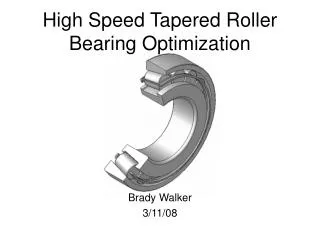
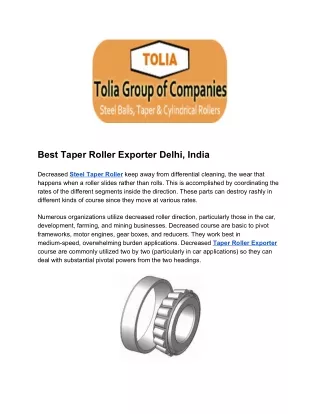
Taper Roller Bearing: Understand the Components and Specifications Tapered roller bearings, also referred to as rolling element bearings, are engineered to withstand both axial and radial forces, offering a valuable solution for reducing friction and preventing heat- related failures in various industrial applications. These bearings excel under heavy loads, making it crucial to source them from certified suppliers to ensure product reliability. Let's delve deeper into the components and specifications of these bearings: Components of Taper Roller Bearing: Tapered roller bearings possess distinctive design features setting them apart from other bearing types. Notably, their rollers have end diameters of varying sizes. Here's an overview of their key components: Axial and Radial Loads: The angle formed by the contact line between the bearing cup, rollers, and the axis of the bearing bore determines the bearing's suitability for different types of loads. A greater angle enhances thrust load support capability but reduces radial load support proportionally. Axial-Only Loads: Tapered roller bearings can also be manufactured in thrust form. In this configuration, the rollers are oriented perpendicular to the bearing bore axis, making them suitable for axial-only loads. Multiple Roller Rows: While single-row tapered roller bearings exclusively support axial forces in one direction, manufacturers often incorporate adjacent roller rows to enable thrust support in both axial directions. Bearings with two or four rows of tapered rollers are common. Lubrication:
Effective lubrication is crucial for all bearing types, including tapered roller bearings. Although the risk of roller slippage and friction is lower in these bearings, lubrication remains essential to reduce friction between rollers and raceways, dissipate heat, and minimize operating noise. Some bearings feature an annular groove around the bearing cup for efficient lubrication. Seals: Bearing seals are essential for shielding the bearing from environmental contaminants and moisture. However, it's important to note that contact seals can increase friction, while polyurethane seal components may experience sliding against the rotating bearing. Specifications of Taper Roller Bearings: Temperature: Taper roller bearings inevitably experience thermal expansion. The bearing's construction, materials, lubrication, and raceways are designed to dissipate excessive heat. Careful consideration of bearing selection is necessary, especially for precision equipment, as short operating conditions can lead to temperature spikes. Lifespan: The bearing's lifespan depends on various factors such as material quality, structural integrity, load type, operating conditions, lubrication, and contamination. Bearings showing signs of chipping or metal flaking should be replaced promptly. Typically, bearing lifespan is based on a 90% reliability rate for all rolling bearings. Speed: The operational speed of a bearing is largely determined by its temperature. The reference speed indicates the rate at which heat is generated and dissipated in the bearing, while the limiting speed represents the highest expected rotational speed. It's important to note that the limiting speed may not always be as high as the reference speed. Understanding these components and specifications is essential when procuring taper roller bearings from suppliers for industrial applications, ensuring optimal performance and longevity.