API Testing Expert_ A Comprehensive Guide
API testing plays a crucial role in ensuring that applications communicate with each other seamlessly.


API Testing Expert_ A Comprehensive Guide
E N D
Presentation Transcript
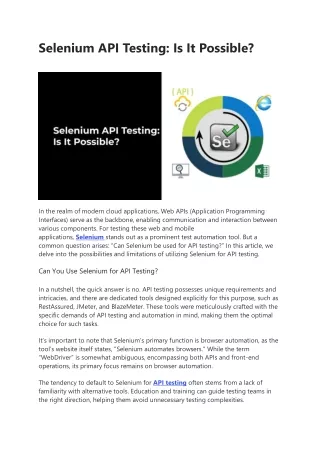
API Testing Expert: A Comprehensive Guide API testing plays a crucial role in ensuring that applications communicate with each other seamlessly. As businesses increasingly rely on APIs to integrate systems and services, having a skilled API testing expert becomes vital. This guide will cover what API testing is, the role of an API testing expert, the types of API testing, and the tools commonly used in the field. What is API Testing? API testing is a type of software testing that focuses on verifying that an application programming interface (API) functions as expected. Unlike traditional user interface testing, which focuses on how users interact with the system, API testing ensures that the backend services, which are typically invisible to users, perform correctly. This includes validating the correctness, security, and performance of the API. The Role of an API Testing Expert API testing experts play a pivotal role in ensuring the quality of APIs. Their primary responsibility is to verify that APIs work as expected under di?erent conditions. The role involves: ● Designing and executing test cases for various API endpoints. ● Automating tests to ensure repeatability and faster execution. ● Ensuring the security of the API against vulnerabilities. ● Conducting performance and load testing to determine the API’s scalability. ● Identifying and reporting bugs, and working with development teams to resolve them. Types of API Testing
There are several di?erent types of API testing that API testing experts specialize in. These include: 1. Functional Testing: This ensures that the API functions as expected by validating the correct output for given inputs. 2. Security Testing: Focuses on identifying vulnerabilities in the API that could lead to security breaches. 3. Load Testing: Tests the API's ability to handle a large number of requests and users. 4. Performance Testing: Assesses how the API performs in terms of response time and reliability under di?erent loads. 5. Regression Testing: Ensures that new updates or changes to the API do not negatively impact existing functionality. Tools for API Testing There are various tools available to facilitate API testing, and the selection often depends on the type of API and the project requirements. Some of the most popular tools include: ● Postman: A user-friendly tool for testing REST APIs and automating workflows. ● SoapUI: Useful for testing both SOAP and REST APIs with advanced features. ● JMeter: Known for load testing and performance testing APIs. ● RestAssured: A Java-based tool that simplifies REST API testing. Conclusion API testing is a critical aspect of modern software development, ensuring that the APIs function correctly and securely. As businesses continue to integrate more APIs into their systems, the need for experienced API testing experts grows. Whether it's functional testing, security, or performance, API testing experts ensure that the back-end communication in applications remains robust, secure, and scalable.
By mastering the art of API testing and familiarizing themselves with the right tools, API testing experts can significantly enhance the quality of applications, ensuring they meet the high standards required for today’s interconnected world.