Download

1 / 4
0 likes | 0 Vues
https://ambaniandassociates.com/

E N D
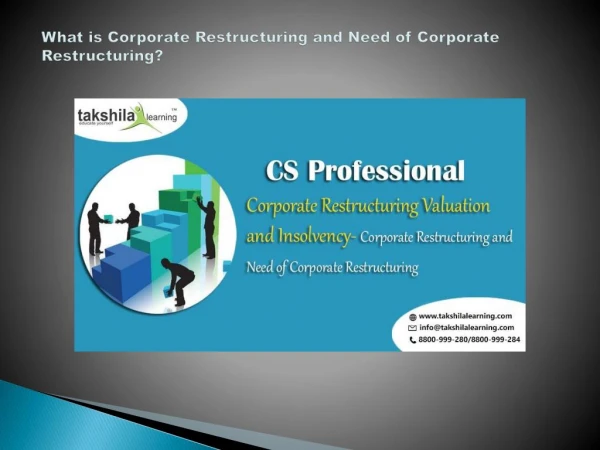
Corporate restructuring has become an essential strategic tool for businesses that aim to remain competitive, agile, and financially sustainable in an ever-changing market. Growth is no longer driven only by expansion and revenue acquisition — businesses must also constantly evaluate their internal operations, capital structure, resource utilization, and market positioning to ensure continued success. Corporate restructuring involves making fundamental changes to the organisation’s processes, ownership patterns, financial structure, management hierarchy, or operational model to improve efficiency, profitability, and long-term value creation. Whether a business is facing financial difficulty or looking to unlock new growth opportunities, restructuring provides the framework to optimise performance and align strategic goals with market realities. It is a proactive initiative to future-proof the organisation rather than a reactive measure during a crisis. 1. What Corporate Restructuring Really Means Corporate restructuring is not merely cost cutting or downsizing — it is a holistic approach to reinventing the company for profitable and sustainable growth. It includes multiple dimensions such as organisational restructuring, financial restructuring, strategic restructuring, portfolio restructuring, and operational restructuring. Organisations often adopt restructuring when their existing processes limit their ability to scale or when external market factors demand a shift in business models. For example, a company that depends heavily on a declining product line may pivot to a high-growth category through restructuring. Likewise, a business that has accumulated excessive debt may undertake financial restructuring to stabilise cash flow and strengthen its balance sheet. The core principle behind restructuring is to build a leaner, highly adaptive, and performance-oriented organisation without compromising long-term value creation. 2. How Restructuring Unlocks Growth Potential Growth is not only about expansion — it is about improving the ability to operate profitably, efficiently, and strategically. Corporate restructuring ensures that inefficient business units, poor resource allocation, redundant costs, and outdated work models do not obstruct progress. For example, a company with scattered operations across multiple divisions may restructure by consolidating teams to enhance productivity and reduce overheads. Similarly, implementing department-wise KPIs and performance-driven leadership roles can help the business adopt a growth mindset. Another major way restructuring drives growth is through business model innovation — shifting from low-margin to high-margin segments, adopting subscription-based models, entering digital markets, or forming strategic alliances. When done correctly,
restructuring helps a business become more customer-centric, tech-enabled, and financially resilient. 3. Financial Restructuring: Key to Stability and Expansion One of the most crucial components of corporate restructuring is financial restructuring, which focuses on creating a sustainable capital structure. Businesses experiencing rising debt, shrinking margins, or poor cash flow often find growth hindered because too much revenue is absorbed by interest payments and liabilities. Financial restructuring may include debt refinancing, equity infusion, investor onboarding, debt-equity swaps, asset monetization, working capital redesigning, and expense prioritization. For high-growth companies, restructuring also facilitates investor confidence and higher valuations by improving leverage ratios, liquidity position, and financial discipline. When the balance sheet becomes healthier, the organisation becomes more attractive for banks, lenders, venture capitalists, and private equity — enabling greater growth opportunities. 4. Operational Restructuring Enhances Efficiency Operational restructuring is designed to make business processes sharper, faster, and more cost-effective. Many businesses experience inefficiencies due to outdated systems, duplicated activities, manual processes, or poor interdepartmental coordination. Through restructuring, companies adopt process automation, digital ERP systems, performance-tracking dashboards, centralized decision-making, and lean management practices. This reduces cost leakages and increases productivity without increasing workforce stress. For manufacturing and supply-chain-driven businesses, operational restructuring can drastically reduce turnaround time, procurement cost, wastage, and logistics losses. For service-based organisations, restructuring improves project delivery efficiency, client satisfaction, and revenue per employee. Strong operational restructuring helps the business scale optimally instead of chaotically. 5. Strategic Restructuring for Sustainable Competitiveness Corporate restructuring also plays a key role in realigning business strategy with evolving market demands. Consumer expectations, technology shifts, geopolitical scenarios, and economic cycles can make existing strategies outdated. Strategic restructuring helps businesses recalibrate their priorities, divest non-profitable segments, explore high-potential
verticals, and expand through mergers, acquisitions, or strategic partnerships. It is particularly critical when a business wants to dominate a new geography, change its product mix, or enter a high-growth digital ecosystem. Without timely strategic restructuring, businesses risk losing relevance and market share to more innovative and responsive competitors. It ensures that growth initiatives are based on real market opportunities rather than assumptions. 6. HR and Workforce Restructuring Creates Agile Teams A high-growth business requires strong leadership, performance-driven culture, and the right mix of skills. Workforce restructuring doesn’t mean replacing employees; rather, it means transforming the human capital structure based on current and future needs. It may include redefining roles, removing redundant hierarchies, strengthening leadership tiers, implementing employee development plans, or hiring specialised talent for new business streams. Empowering high performers with decision-making powers and reducing bureaucratic barriers creates an agile workforce capable of driving innovation. When employees operate in clear roles with measurable KPIs and goals aligned with business priorities, the organisation becomes more cohesive and growth-focused. 7. Corporate Restructuring During Crisis vs Growth Expansion A major misconception is that restructuring is required only when a business is failing. In reality, successful corporations across the world restructure frequently to stay ahead of competition. Growth-phase restructuring prepares businesses for larger operations by upgrading their governance structure, risk controls, investment strategy, reporting systems, and operational model. Crisis-driven restructuring, meanwhile, focuses on survival, rehabilitation, and recovery. While both serve different purposes, the outcome is similar — a stronger and more adaptive business. Companies that restructure proactively are less likely to face future crises and more likely to scale sustainably. 8. Role of Professional Advisors in Corporate Restructuring Corporate restructuring demands strong financial expertise, legal understanding, management planning, and risk review. Chartered accountants, financial advisors, and restructuring specialists provide valuable guidance by preparing feasibility studies, improving capital
structure, analysing cost efficiencies, supporting investor negotiations, drafting reorganizational plans, and advising on tax and compliance implications. Businesses that work with restructuring experts experience smoother transition, faster implementation, and maximum value creation during and after restructuring. Many organisations choose professional advisory firms such as https://ambaniandassociates.com/ to guide restructuring decisions because professional involvement reduces risk and ensures compliance with regulatory frameworks. 9. Long-Term Benefits of Corporate Restructuring The long-term benefits of restructuring extend far beyond immediate profitability. Businesses emerge more future-ready, technology-driven, and risk-controlled. Leadership accountability improves, departments function in sync, debt levels remain manageable, and financial reporting becomes more transparent. Restructuring also builds investor trust, enhances brand credibility, and enables businesses to seize new opportunities quickly. Most importantly, it promotes innovation, encourages strategic thinking, and helps companies continuously reinvent themselves without waiting for external market pressure. Conclusion Corporate restructuring is not just a business decision — it is a strategic evolution necessary for sustained growth. In today’s competitive landscape, businesses that fail to restructure risk stagnation, inefficiency, and loss of market relevance. Restructuring allows organisations to sharpen operations, optimise financial architecture, embrace innovation, realign strategy, and prepare for future disruptions. Whether a business is scaling, diversifying, or recovering, restructuring serves as the backbone for long-term success. For enterprises seeking expert financial and strategic support during restructuring, partnering with experienced professionals like https://ambaniandassociates.com/ ensures a guided, compliant, and value-maximizing transformation.