Common Challenges in Microservices Migration Explained
Explore common challenges in microservices migration, including service decomposition, data consistency, DevOps complexity, and security risks.

Common Challenges in Microservices Migration Explained
E N D
Presentation Transcript
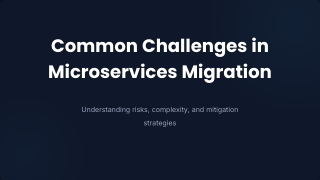
Common Challenges inMicroservices Migration Understanding risks, complexity, and mitigation strategies
What Is Microservices Migration? Microservices migration is the process of transforming a monolithic or legacy application into a distributed microservices architecture. Independent services Decentralized data management API-driven communication Scalability and resilience
Why Organizations Adopt Microservices Despite challenges, enterprises migrate to microservices for long-term agility. Faster Time to Market Independent Scaling Reduced delivery cycles through parallelized feature development and deployment. Optimize resources by scaling only the specific components under high load. Improved Fault Isolation Technology Flexibility Prevent system-wide outages by containing failures within individual service boundaries. Choose the best tech stack for each service rather than a one-size-fits-all monolith.
Challenge 1: Service Decomposition Breaking a monolith into meaningful services is complex. Common Issues Critical Impact Poor decomposition leads to performance bottlenecks and operational complexity, often resulting in a "distributed monolith." Incorrect service boundaries High coupling between services Data ownership conflicts
Challenge 2: Data Management Each microservice should own its data, which introduces complexity. Key Problems Distributed transactions, eventual consistency models, and data duplication/synchronization. Solution Direction Implement Event-driven architecture and Domain-Driven Design (DDD).
Challenge 3: Communication Microservices rely heavily on network communication. Increased network latency API versioning complexities Handling cascading service failures Best Practices API gateways, asynchronous messaging, and circuit breaker patterns.
Challenge 4: Infrastructure Complexity Microservices significantly increase operational complexity and require mature DevOps practices. 5x CI/CD pipeline complexity at scale Container orchestration (Kubernetes) management Operational Overhead Environment configuration management
Organizational & Cultural Challenges Technology alone doesn’t guarantee migration success. Skill gaps in distributed systems Key Takeaway Inherent resistance to architectural change Successful migration requires organizational readiness and continuous training. Misalignment between Dev and Ops teams
Conclusion While microservices enable scalability and agility, the migration process introduces architectural, operational, and organizational complexity. A trustedMicroservices Development Company ensures these challenges are addressed with proven frameworks and best practices. Gradual Planning Strong Principles Expert Guidance Migration must be gradual and well-planned. DevOps, governance, and design are critical. Expert-led services accelerate transformation. Questions? Let's discuss your migration journey.