Scalable Smart Contract Development_ Solutions for High-Performance Blockchains
A smart contract development company builds secure, automated blockchain contracts that enable transparent, efficient, and trustless digital transactions across industries.<br>
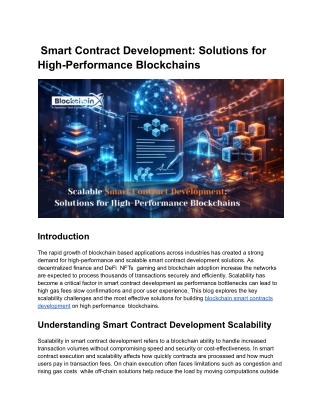

Scalable Smart Contract Development_ Solutions for High-Performance Blockchains
E N D
Presentation Transcript
Smart Contract Development: Solutions for High-Performance Blockchains Introduction The rapid growth of blockchain based applications across industries has created a strong demand for high-performance and scalable smart contract development solutions. As decentralized finance and DeFi NFTs gaming and blockchain adoption increase the networks are expected to process thousands of transactions securely and efficiently. Scalability has become a critical factor in smart contract development as performance bottlenecks can lead to high gas fees slow confirmations and poor user experience. This blog explores the key scalability challenges and the most effective solutions for building blockchain smart contracts development on high performance blockchains. Understanding Smart Contract Development Scalability Scalability in smart contract development refers to a blockchain ability to handle increased transaction volumes without compromising speed and security or cost-effectiveness. In smart contract execution and scalability affects how quickly contracts are processed and how much users pay in transaction fees. On chain execution often faces limitations such as congestion and rising gas costs while off-chain solutions help reduce the load by moving computations outside
the main blockchain. Key performance metrics such as transactions and second network latency gas fees and throughput are important indicators to evaluate smart contract scalability. High-Performance Blockchain Architectures High-performance blockchains adopt both Layer-1 and Layer-2 scalability approaches to improve smart contract efficiency. Layer-1 solutions focus on improving the core blockchain protocol through techniques such as sharing to which divides the network into smaller segments to process to transactions in parallel. Optimized consensus mechanisms such as Proof of Stake and Delegated Proof of Stake to further improve transaction speed and energy efficiency. Layer-2 solutions including Optimistic Rollups and Zero-Knowledge Rollups to perform off-chain transactions while maintaining main chain security. State channels and sidechains also help reduce congestion and improve smart contract performance. Smart Contract Design for Scalability Scalable smart contract development starts with effective contract design. Modular and upgradable architectures allow developers to change contract logic without redeploying the entire system to reduce the cost and complexity. Gas efficient coding practices such as minimizing storage usage and optimizing loops, significantly improve performance. Event-driven execution models help reduce unnecessary computations, while optimized data storage strategies reduce transaction costs. Thoughtful smart contract design ensures long-term scalability and smoother blockchain operations. Cross Chain and Interoperable Smart Contracts Interoperability plays a crucial role in building scalable on blockchain ecosystems. Cross chain smart contracts enable communication between different blockchain networks to allow applications to leverage multiple chains for better performance and flexibility. Bridges across chains and messaging protocols facilitate secure asset transfers and data exchange across networks. By adopting multi-chain deployment strategies to developers can deploy workloads efficiently to reduce congestion and improve the scalability of smart contract applications. Real-World Use Cases Scalable smart contracts drive more efficient real-world applications. DeFi platforms rely on scalable contracts to process high transaction volumes manage liquidity pools and execute automated trading strategies. NFT marketplaces and blockchain based gaming ecosystems require fast transaction processing to deliver seamless user experiences. Enterprises and
Real-World Asset (RWA) tokenization platforms use scalable smart contracts to manage digital ownership and automate compliance and support global investment opportunities efficiently. Best Practices for Scalable Smart Contract Development Choosing the right blockchain network is critical to scalability as different platforms offer varying performance capabilities. A performance-first development lifecycle focused on testing and optimization to monitoring helps identify bottlenecks early. Continuous optimization regular upgrades and smart contract revisions ensure sustained performance as user demand increases. Following best practices to allow developers to build future ready smart contracts that scale with business needs. Future Trends in Smart Contract Scalability Smart contract development is driven by rapid advances in new technologies that aim to deliver higher scalability and security to efficiency. AI-assisted smart contract optimization transforms the development process by automatically analyzing contract logic identifying vulnerabilities, reducing gas consumption and improving performance through predictive insights and automated testing. Zero-knowledge computing is becoming widespread as it enables complex transactions and off-chain validations to be performed while maintaining on-chain security and privacy to trust making it ideal for scalable DeFi enterprise and compliance-driven applications. At the same time modular blockchain ecosystems are reshaping how smart contracts are built by allowing developers to separate layers of execution consensus and data availability and resulting in flexible to customizable and high-performance blockchain infrastructures. Together these innovations are redefining smart contract development by enabling faster deployments lower costs, improved privacy and scalable architectures capable of supporting next generation enterprise-class decentralized applications. Conclusion Scalable smart contract development is essential to support the growing demands of modern blockchain applications across DeFi and NFTs gaming and enterprise use. By leveraging high performance blockchain architectures to efficiently contract design Layer-2 scaling solutions and cross-chain interoperability developers can overcome limitations such as high gas fees network congestion and slow transaction speeds. As new technologies such as AI driven optimization and zero knowledge computing and modular blockchain ecosystems continue to evolve smart contracts will become more secure
and efficient and adaptable. Ultimately prioritizing scalability to enable businesses and developers to build future to ready blockchain solutions that deliver long term performance and seamless user experiences and sustainable growth in an increasingly decentralized digital economy.