Download
1 / 5
0 likes | 1 Vues
Artificial intelligence has made it possible to analyze large amounts of data, reveal latent trends, and adjust to emerging fraud techniques, and it has become the backbone of the current fraud prevention systems. To acquire those skills, a professional should enroll in the best data science course in Bangalore, which could be used to gain practical exposure to the use cases of fraud detection and AI-based classification models.

E N D
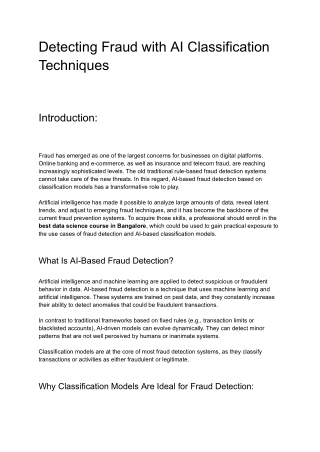
Detecting Fraud with AI Classification Techniques Introduction: Fraud has emerged as one of the largest concerns for businesses on digital platforms. Online banking and e-commerce, as well as insurance and telecom fraud, are reaching increasingly sophisticated levels. The old traditional rule-based fraud detection systems cannot take care of the new threats. In this regard, AI-based fraud detection based on classification models has a transformative role to play. Artificial intelligence has made it possible to analyze large amounts of data, reveal latent trends, and adjust to emerging fraud techniques, and it has become the backbone of the current fraud prevention systems. To acquire those skills, a professional should enroll in the best data science course in Bangalore, which could be used to gain practical exposure to the use cases of fraud detection and AI-based classification models. What Is AI-Based Fraud Detection? Artificial intelligence and machine learning are applied to detect suspicious or fraudulent behavior in data. AI-based fraud detection is a technique that uses machine learning and artificial intelligence. These systems are trained on past data, and they constantly increase their ability to detect anomalies that could be fraudulent transactions. In contrast to traditional frameworks based on fixed rules (e.g., transaction limits or blacklisted accounts), AI-driven models can evolve dynamically. They can detect minor patterns that are not well perceived by humans or inanimate systems. Classification models are at the core of most fraud detection systems, as they classify transactions or activities as either fraudulent or legitimate. Why Classification Models Are Ideal for Fraud Detection:
Binary classification (fraud or not fraud) is commonly used in fraud detection. This is the kind of task that classification models are meant to accomplish. Key reasons classification models work well ● They are very efficient at processing large volumes of transactional data. ● They can acquire complicated patterns and correlations. ● They enhance precision over time as new data arrive. ● They eliminate false recognitions, enhancing the customer experience. The key subject of the best data science course in Bangalore is to learn how to develop and optimize these models, and the student should consider that they are likely to be employed in fintech, cybersecurity, or risk analytics. Common Types of Fraud Detected Using AI: The application of AI-based classification models spans across numerous industries to identify all forms of fraud, such as: ● Credit card fraud ● Online payment fraud ● Insurance claim fraud ● Banking and loan fraud ● E-commerce return fraud ● Stealing identity and stealing an account. All these applications are based on transactional trends, behavioral information, and historical fraud trends to train efficient AI models. How Classification Models Work in Fraud Detection: The AI classification model-based method of detecting fraud in the workflow generally involves the following steps: 1. Data Collection Various sources of data are used to collect information, including transaction logs, user behavior data, device information, and past fraud.
2. Data Preprocessing This step involves handling missing data, addressing unbalanced data, encoding nominal data, and scaling numerical data. 3. Feature Engineering The primary features, such as transaction frequency, location discrepancies, abnormal spending habits, and time series, are derived. 4. Model Training Classification algorithms are trained with the use of known data in which transactions are labeled as either fraud or non-fraud. 5. Model Evaluation Model performance is measured using such metrics as precision, recall, F1-score, and ROC-AUC. 6. Deployment and Monitoring The model is rolled out to production systems and is continuously monitored to adapt to changing fraud patterns. In general, this end-to-end process is typically taught in-depth in a practical data science course in Bangalore, but not only theory. Popular Classification Models Used in Fraud Detection: The classification algorithms vary depending on data size, complexity, and business requirements. a. Logistic Regression A baseline model is a simple but efficient approach applied in fraud detection. It is suitable when dealing with interpretable outputs and well-defined data. b. Decision Trees Decision trees can clearly visualize the rules of fraud and patterns, hence useful in explainable AI systems. c. Random Forest A combination of several decision trees is used to improve accuracy and reduce overfitting.
d. Gradient Boosting Models XGBoost and LightGBM are algorithms that are commonly deployed in massive fraud detection systems due to their high performance and efficiency. e. Support Vector Machines (SVM) SVMs can be used in high-dimensional spaces, particularly when fraud patterns are complex. f. Neural Networks Deep learning models can model highly non-linear patterns, making them applicable to sophisticated fraud detection solutions that use large datasets. Students who complete the best data science course in Bangalore tend to gain practical experience in applying these models with Python and industry-grade tools. Handling Imbalanced Data in Fraud Detection: Class imbalance is one of the greatest problems in fraud detection because fraudulent transactions tend to constitute less than 1% of the total data. To solve this, data scientists apply methods that include: ● Sampling techniques such as SMOTE. ● Under sampling majority class data. ● Cost-sensitive learning ● Varying classification levels. These are all techniques that should be understood and applied, making it a necessary learning outcome in a quality best data science course in Bangalore. Real-World Applications of AI Fraud Detection: a. Bank and Financial Services AI classification models help banks detect and prevent fraud losses in real time by tracking operations and increasing customer confidence. b. E-Commerce Platforms AI is used to identify fraudulent accounts and payment fraud, as well as suspicious returns.
c. Insurance Industry Best practice Classification models are used to detect the presence of a fraudulent claim based upon claim history, policy information, and behavioural indicators. d. Telecom Sector AI helps telecom companies to deter SIM swapping, subscription fraud, and billing manipulation. These applications explain why the ability to detect fraud is one of the most sought-after AI skills in the labor market. Conclusion: The use of AI in the form of classification models to identify fraud has become an essential tool for companies in the present digital economy. From banking to e-commerce, the models are applied by businesses to remain one step above the fraudsters without losing trust and security. Having the knowledge on how to commit fraud using an existing data science course in Bangalore would be an opening into the world of high-impact careers as a data scientist and practitioner with AI and approaches involving analytics. You may be an instrumental part in making digital systems smarter with the abilities, tools, and field knowledge that you can bring to the table once you possess the right things.









![get [PDF] Download Metal Detecting Log Book: Metal Detecting Journal for Metal Detectorists to Log and Keep Track of The](https://cdn7.slideserve.com/12356273/slide1-dt.jpg)