Optimizing Warehouse Space with Straddle Carriers
0 likes | 18 Vues
Straddle carriers maximize warehouse efficiency by enabling vertical storage and precise handling of heavy goods. Their versatility and compact design make them essential for optimizing space and streamlining operations.<br><br><br><br><br><br><br>


Optimizing Warehouse Space with Straddle Carriers
E N D
Presentation Transcript
Today's fast-paced supply chain and logistics industry necessitates efficient usage of warehouse space. The increased volume of goods has significantly created the demand for advanced equipment to streamline operations, maximize storage capacity, and optimize workflow. One of the most effective tools to improve warehouse space utilization is the straddle carrier with its unique design and functionality. These versatile machines enhance productivity, improve safety, and allow for better handling of bulky or heavy materials, making them a valuable asset for modern warehousing.
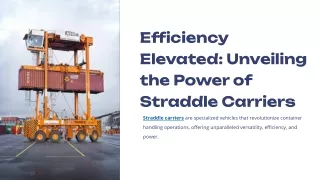
Understanding Straddle Carriers and Their Functionality Straddle carriers are material-handling machines that are designed to lift, transport, and stack heavy loads. Unlike traditional forklifts or cranes, Straddle Carriers are built to "straddle" their load, thus allowing them to lift objects directly from the ground without the need for additional lifting mechanisms. This design makes them particularly useful for handling large containers, heavy pallets, or oversized items, which are often challenging to maneuver in tight or crowded warehouse environments.
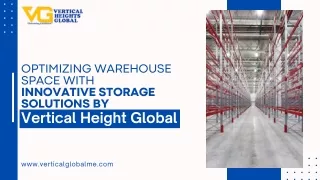
Maximizing Vertical Storage Space Probably, the greatest advantage of using this equipment is maximizing the vertical storage space. It allows warehouses to stock more goods in the same footprint by lifting and stacking heavy goods into high layers. This type of optimization is highly important for high-density storage systems because every cubic meter of space must be effectively utilized. Vertical stacking is not only a way to expand storage capacity but also helps with organization. With clear systems of stacking, the inventory can be arranged in a way that makes retrieval easier and faster. For instance, goods can be stacked by categories, sizes, or shipment schedules, which makes the management of inventory much smoother and reduces downtime in fulfilling orders.
Enhancing Accessibility in Tight Spaces This equipment is high on maneuverability and compactly designed to handle the issue of large equipment maneuvering in narrow aisles or confined spaces. The fact that loads can be lifted from above rather than having side-access forklifts reduces the space needed to operate. This means warehouses can reduce aisle widths and free up more space for storage. This technology also optimizes aisle layouts and allows the use of otherwise inaccessible corners in warehouses to improve the flow of goods. Such machines also provide easy movement, which reduces the chance of damaging goods or infrastructure and ensures safer and smoother operations.
Boosting Productivity with Faster Handling Speed and efficiency are essential for a warehouse, and this equipment is excellent in these regards. These machines are designed for the rapid loading, unloading, and transport of loads. That is why operators can deal with more loads in less time as compared to traditional lifting equipment. Quickly lifting and repositioning heavy goods helps to avoid bottlenecks in busy warehouses at peak times. In addition, many modern designs come with advanced control systems, which allow for the accurate handling and positioning of loads. This reduces errors, minimizes time spent adjusting loads, and ensures a smooth workflow. Faster handling times translate into higher productivity, allowing warehouses to process more goods in shorter time frames.
Improving Safety Standards Safety is the major aspect of warehouse operations, especially with heavy or oversized loads. This equipment reduces risks from manual handling and traditional lifting. It is designed in such a way that an operator can lift loads without depending on chains, hooks, or other external devices to do so, thus limiting the chances of accidents or equipment failure. Additionally, several models possess innovative features that provide safety benefits like load sensors, an automatic braking system, and a highly visible cabin for operators. It would also be useful in maintaining the security of goods and operators during transportation.
Versatility for Various Applications This equipment can be used for a wide variety of applications besides traditional warehousing. For example, it could be used for the handling of shipping containers, industrial equipment, and oversized materials at ports, construction sites, and manufacturing facilities. It is a good investment for companies requiring adaptability with their material-handling processes. In a warehouse, it can be used for stacking, loading, unloading, and transporting freight across several zones. Its ability to handle various types of cargo and operate in different types of environments ensures that it is a reliable solution for a wide range of logistical challenges.
Cost-Effective Space Optimization In the long run, investing in this equipment saves a great deal of money. Optimizing warehouse space saves businesses from expensive expansions or additional storage facilities. With the added storage capacity from these machines, warehouses can increase their goods volumes without the extra cost. The efficiency and productivity improvements realized with this technology result in lower operational costs. Faster handling times require less labor to accomplish the same volume of work, and the improved organization reduces the potential for inventory loss or damage. These factors combine to create a more cost-effective and streamlined operation.
Supporting Sustainable Practices Sustainability is emerging as an increasingly important aspect that warehouses must incorporate to lower their carbon footprint. A significant part of this effort is enabled through this equipment, which helps maximize the use of existing capacity. New construction or buying additional land becomes minimal. With hybrid and electric power, modern versions perform well in energy consumption and are more environmentally friendly compared to using conventional fuels. Additionally, their accuracy and effectiveness minimize waste as there are fewer errors from handling damage and possible breakages. These green approaches align with the objectives of environmentally friendly warehousing and logistics operations.
Conclusion This equipment has proven to be an essential tool for optimizing warehouse space and improving overall efficiency, allowing for maximum vertical storage, easy navigation of confined spaces, and the easy transfer of heavy loads. Indeed, it helps a warehouse enhance productivity and streamline all its operations while reducing costs, as well as improving safety through the support of sustainable practices. As the demand on the logistics industry grows, investments in versatile and efficient equipment like this, including solutions for ISO Container Lifting, will ensure that warehouses remain competitive and capable of meeting the challenges of a dynamic and ever-changing market. With unique capabilities and practical advantages, this technology is sure to play a crucial role in the future of warehousing.