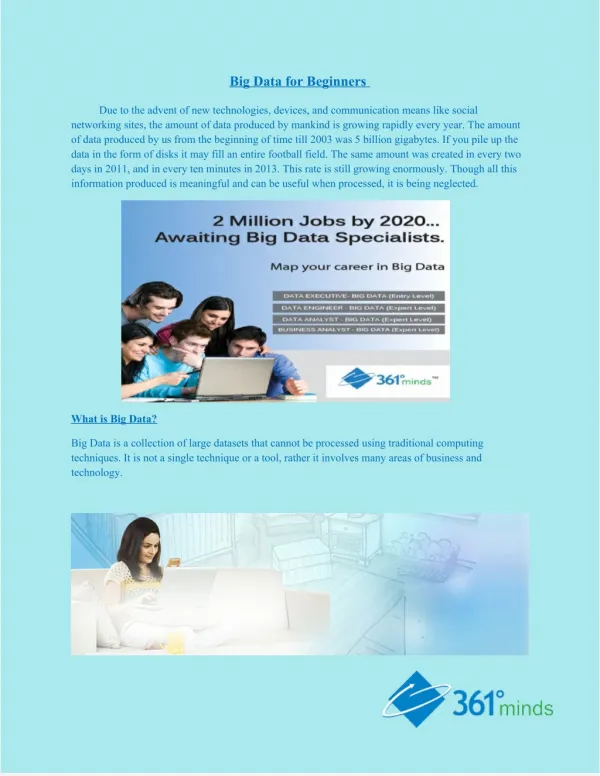
Big Data Guide for beginners
A perfect guide for beginners who want to start their career in Big Data.

Big Data Guide for beginners
E N D
Presentation Transcript
Contents: > Introduction > What is Big Data? > Big Data as a technology > 5 V’s of Big Data > Big Data Technology > Benefits of Big Data 2
Introduction “Data is the new science, Big Data holds the answers” 4 petabytes of data are created on Facebook 500 million tweets are sent everyday 4 terabytes of data are created from each connected car 294 billion emails are sent 65 billion messages are sent on WhatsApp 5 billion searches are made 3
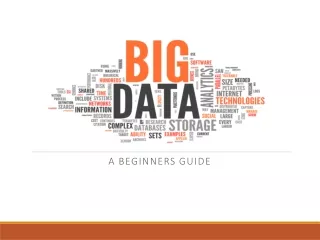
What is BIG DATA? A Collection of large and complex datasets which are difficult to store and process using the traditional database and data processing tools is considered as big data. Big data is collected from traditional and digital sources which, when refined properly can be used for research and analysis. Everything around us generates big data continuously. Social media websites and digital sources are responsible for producing such huge amount of data. 4
Where does BIG DATA come from? The bulk of big data generated comes from three primary sources: social data, machine data and transactional data. Social data Transactional data comes from the Likes, Tweets & Retweets, Comments, Uploads, and general media that are uploaded and shared via the world’s favorite platforms. is generated from all the daily transactions that take place both online and offline. payment orders, storage records, delivery receipts characterized as data Video Invoices, social media – transactional all are Machine data information which is generated by industrial equipment, that are installed in machinery, and even web logs which track user behavior. sensors 5
What are the different types of BIG DATA? >Data which has a defined format and is organized in a predefined schema is called structured data >Example - Data coming from traditional databases and repositories like Mainframes, SQL server, Oracle, DB2, Sybase, Access, Excel, Teradata, etc.. Structured Data >Data which is unorganized and it is not easy to interpret such data using traditional databases or data models >Data coming from social media like Chatter, text analytics, blogs, Tweets, comments, clicks, tags etc.. Unstructured Data >Data is un-modelled and needs to be organized, although there might be a schema. >Data coming from emerging market data, e-commerce, and other third party data like weather, currency conversion, demographic, panel etc. Multi-Structured Data 6
What are the 5V’s of BIG DATA? VALUE VERACITY VOLUME Characteristics of BIG DATA VELOCITY VARIETY 7
What is VOLUME in BIG DATA? It refers to the size of Big Data. Data can be considered Big Data or not is based on the volume. The rapidly increasing volume data is due to cloud-computing traffic, IoT, mobile traffic etc. 8
What is VELOCITY in BIG DATA? It refers to the speed at which the data is getting accumulated. This is mainly due to IoTs, mobile data, social media etc. 9
What is VARIETY in BIG DATA? It refers to collecting data from multiple sources to understand a problem and make smarter, more uncomplicated access to an extensive variety of data is also the key to creating platforms that boost innovation and efficiency. informed decisions. Clear, 10
What is VERACITY in BIG DATA? It is the level of precision or honesty of data collection. With regards to the veracity of big data, it’s not simply the nature of the data that is significant, yet how dependable the processing, type, and source of the data are. 11
What is VALUE in BIG DATA? This is indeed the holy grail of Big Data and what we are all looking for. One has to demonstrate value that can be extracted from big or small data in order to justify the investments, whether on Big Data or on traditional analytics, data warehouse or business intelligence tools. 12
What is BIG DATA TECHNOLOGY? Big data technology is primarily designed to analyze, process and extract information from a large data set and a huge set of extremely complex structures. This is very difficult for traditional data processing software to deal with. Big data technology is broadly integrated with many other technologies such as deep learning, machine learning, artificial intelligence (AI), and the Internet of Things (IoT), which are expanding at scale. Combined with these technologies, big data technology focuses on the analysis and processing of large amounts of real-time and batch- related data. We can categorize the leading big data technologies into the following four sections: > Data Storage > Data Mining > Data Analytics > Data Visualization 13
What are the types of BIG DATA Technology? DATA STORAGE DATA MINING BIG DATA TECHNOLOGIES 14
What are the benefits of BIG DATA? Fraud Detection Increases Website Optimization Increasing Brand Loyalty BENEFITS Helps predict Future Trends Helps in Decision Making Financial Risk Analysis 15
THANK YOU https://www.cetpainfotech.com/ 9212172602 QUERY@CETPAINFOTECH.COM 16