Jordan has been a long-time host for refugees, mainly for those fleeing the Syrian crisis. The figure of Syrian refugees in the country has exceeded 1.3 million, which puts more strain on the already difficult situation of providing them with protection, legal support, and basic services.
However, in these challenging times, the Arab Renaissance for Democracy and Development (ARDD) has established itself as a leading civil society organization whose mission is to protect the rights of refugees while allowing the localization of humanitarian work and political participation in decision-making processes.
ARDD and Refugee Protection: A Decade of Commitment
Since 2010, ARDD has been the sole legal implementing partner of the United Nations High Commissioner for Refugees (UNHCR) in Jordan. The cooperation implied a phase that gave foundation to a long-term strategic partnership, thus allowing ARDD to gain extraordinary knowledge in refugee protection, international refugee law, and humanitarian principles.
Throughout the years, ARDD has broadened its activities from providing direct legal assistance to a comprehensive protection model that combines legal aid with access to justice, social protection, and empowerment of the vulnerable groups. ARDD, through its legal aid programs, works on a wide range of cases that impact both refugees and the local communities.
The range of cases includes criminal and juvenile cases, dealings related to administrative detention and deportation, matters concerning personal status such as marriage and custody, disputes in labor law, landlord–tenant conflicts, and difficulties with civil documentation. By offering free legal services all over the country, including inside Zaatari and Azraq refugee camps.
ARDD assists the groups in need, particularly women and children, to access justice and protection irrespective of their economic status.
Legal Aid as a Pathway to Political Participation and Inclusion
Access to justice is not just a human right but a necessary condition for political participation. The programs of ARDD are directed towards enlightening the refugees and the host communities by allowing them to claim their rights in the legal and social structures of Jordan. Through engagement with local authorities, civil society, and international stakeholders, ARDD ensures that the refugees are provided with the rights and the knowledge that they require to be part of the discussions that impact their lives, thereby promoting governance and accountability in the areas of humanitarian and development efforts.
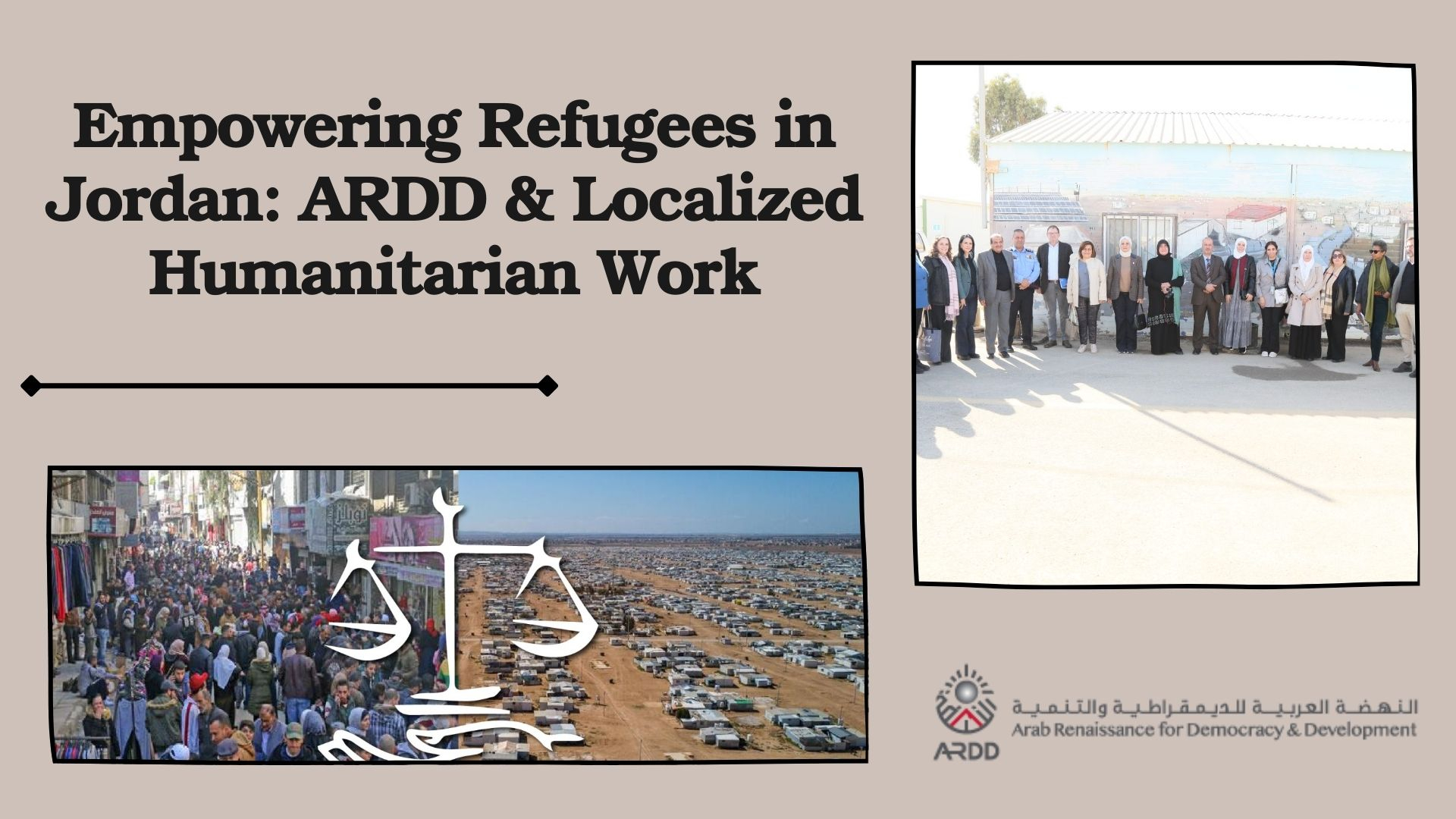
A notable example of fostering political participation occurred when ARDD facilitated a visit of the delegation to Zaatari camp involving members of the Jordanian Parliament, the Ministry of Justice, UN agencies, and civil society representatives. This visit underlined the significance of the collaboration of many stakeholders in meeting refugees' needs and in making sure that the parliamentarians and decision-makers acquire a direct understanding of the problems that the displaced populations are facing.
Such initiatives improve the communication between policymakers, civil society, and the communities that are most affected and thus, the participatory governance is reinforced further.
Localization of Humanitarian Work: Empowering Local Actors
One of the primary strategies of ARDD is to push the localization of humanitarian work to the forefront. By giving priority to national actors, ARDD is showing that in the long run, refugee protection is most successful when local organizations are at the front of the line providing the services, coordinating the efforts, and devising the context-specific interventions.
The coordination of ARDD with UNHCR, governmental institutions, and local civil society assures that the refugee support is included in the Jordanian institutional framework, which in turn enhances efficiency, sustainability, and community trust. The example of ARDD's coordination with the Jordanian Register of Associations and the Ministry of Social Development is indicative of this approach.
By integrating civil society organizations into national systems through platforms such as the Takamul Digital Platform, ARDD promotes transparency, accountability, and accessibility of services. The platform allows for detailed mapping of civil society capacities, supports knowledge exchange, and aligns humanitarian interventions with local needs without causing any overlap.
Responding to Crises: Legal Aid and Social Protection in Action
The humanitarian landscape in Jordan has experienced major challenges, especially with the foreign aid cut-off. The programs by ARDD highlight the essential relationship between social protection and economic resilience. The layoffs that occurred in the humanitarian sector, the interruptions to essential services, and the disruptions in support for women, children, and persons with disabilities are proof of the vulnerability of refugee protection systems.
Through continuous legal aid, advocacy, and coordination efforts, ARDD guarantees that the displaced populations are still able to access the justice system, social services, and empowerment opportunities, even in times of crisis.
Conclusion: Strengthening Refugee Protection in Jordan
In the midst of the complicated regional situation, Jordan has not only provided asylum to refugees but also organizations like ARDD that have been pivotal in protecting the vulnerable while lobbying for reforms. Through the prioritization of refugees, the promotion of humanitarian work localization, and the granting of political participation, ARDD makes it stronger for Jordan to dispense justice, social protection, and empowerment for all.
One of the most important messages coming from the ARDD’s activities is that the durable solutions to the refugee protection problem demand a combination of local and international actors, constant advocacy, and a rights-based approach that puts communities at the core of humanitarian and development initiatives.
https://ardd-jo.org/