asbgrowthventures.com-Latest Lock-In Rule Changes Explained (1)
0 likes | 0 Vues
Planning an IPO is no longer just for large corporations. Today, many Small and Medium Enterprises (SMEs) are seriously exploring the public markets to raise capital, improve credibility, and scale faster, with 2026 approaching, regulatory expectations are evolving, and SMEs must be well-prepared before taking the IPO route.


asbgrowthventures.com-Latest Lock-In Rule Changes Explained (1)
E N D
Presentation Transcript
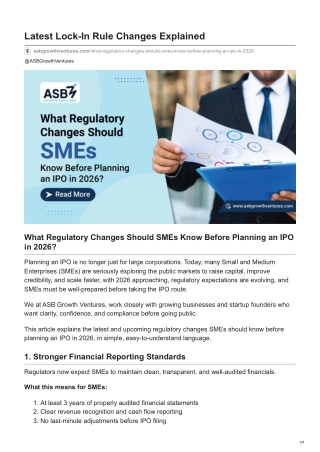
Latest Lock-In Rule Changes Explained asbgrowthventures.com/what-regulatory-changes-should-smes-know-before-planning-an-ipo-in-2026 @ASBGrowthVentures What Regulatory Changes Should SMEs Know Before Planning an IPO in 2026? Planning an IPO is no longer just for large corporations. Today, many Small and Medium Enterprises (SMEs) are seriously exploring the public markets to raise capital, improve credibility, and scale faster, with 2026 approaching, regulatory expectations are evolving, and SMEs must be well-prepared before taking the IPO route. We at ASB Growth Ventures, work closely with growing businesses and startup founders who want clarity, confidence, and compliance before going public. This article explains the latest and upcoming regulatory changes SMEs should know before planning an IPO in 2026, in simple, easy-to-understand language. 1. Stronger Financial Reporting Standards Regulators now expect SMEs to maintain clean, transparent, and well-audited financials. What this means for SMEs: 1. At least 3 years of properly audited financial statements 2. Clear revenue recognition and cash flow reporting 3. No last-minute adjustments before IPO filing 1/4
Early financial discipline is one of the most important IPO success factors. ASB Growth Ventures helps SMEs build IPO-ready financial systems well in advance. 2. Improved Corporate Governance Requirements Corporate governance is no longer optional for SME IPOs. Key expectations include: 1. Appointment of independent directors 2. Defined roles for promoters and management 3. Basic internal control and compliance frameworks Regulators want SMEs to operate like responsible listed companies before they list. 3. Promoter and Management Due Diligence In 2026, regulators will closely review the background and compliance history of promoters. This includes: 1. Tax and regulatory compliance 2. Legal cases, if any 3. Transparency in promoter shareholding We at ASB Growth Ventures, we strongly recommend a pre-IPO due diligence review to identify and fix risks early. 2/4
4. Clear and Honest IPO Disclosures IPO documents must now be simple, truthful, and investor-friendly. SMEs must clearly explain: 1. Business model and growth plans 2. Key risks 3. How IPO funds will be used Strong disclosure builds trust—and trust drives investor confidence. 5. Tighter Monitoring of IPO Fund Usage Regulators are paying close attention to how IPO funds are used. SMEs must: 1. Use funds only for declared purposes 2. Maintain proper tracking and reporting 3. Avoid fund diversion ASB Growth Ventures helps companies set up strong post-IPO fund governance. 6. Compliance Culture Is Essential SMEs planning an IPO in 2026 must show a consistent compliance track record, including: 3/4
1. Timely tax filings 2. Labour and statutory compliance 3. Industry-specific regulatory adherence A strong compliance culture reduces regulatory risk and improves market reputation. How ASB Growth Ventures Supports SME IPO Readiness We at ASB Growth Ventures, focus on making SMEs IPO-ready, not just IPO-listed. Our support includes: 1. IPO readiness assessment 2. Financial and compliance structuring 3. Governance and promoter advisory 4. End-to-end IPO planning support Regulatory changes in 2026 are designed to make SME IPOs stronger, safer, and more transparent. SMEs that start early will not only meet regulations but also attract better investor interest. With the right guidance from ASB Growth Ventures, regulatory compliance becomes a growth advantage not a hurdle. 4/4