electomagnetic waves
electromagnetic waves <br>

electomagnetic waves
E N D
Presentation Transcript
ELECTROMAGNETIC WAVES
We can define X-Rays or X-radiation as a form of electromagnetic radiation. They are powerful waves of electromagnetic energy. Most of them have a wavelength ranging from 0.01 to 10 nanometres, corresponding to frequencies in the range 3 × 10¹⁹ Hz to 3×10¹⁶ Hz and energies in the range 100 eV to 100 keV.
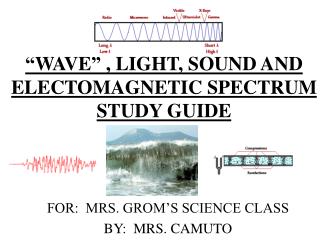
Visible light is a form of electromagnetic (EM) radiation, as are radio waves, infrared radiation, ultraviolet radiation, X-rays and microwaves. Generally, visible light is defined as the wavelengths that are visible to most human eyes.
Infrared waves, or infrared light, are part of the electromagnetic spectrum. People encounter Infrared waves every day; the human eye cannot see it, but humans can detect it as heat. A remote control uses light waves just beyond the visible spectrum of light—infrared light waves—to change channels on your TV. This region of the spectrum is divided into near-, mid-, and far-infrared. The region from 8 to 15 microns (µm) is referred to by Earth scientists as thermal infrared since these wavelengths are best for studying the longwave thermal energy radiating from our planet.
Electromagnetic waves are a method of energy transfer. They are formed by a varying magnetic field that induces a varying electric field. Electromagnetic waves consist of these induced oscillating electric and magnetic fields, which are perpendicular to each other.
Gamma rays are the most energetic form of light, highly penetrating electromagnetic energy emitted by the nucleus of some radionuclides following radioactive decay.The discovery of gamma rays is attributed to a French physicist Henri Becquerel in 1896.
Radar (originally acronym for radio detection and ranging)[1][2] is a detection system that uses radio waves to determine the distance (ranging), angle, and radial velocity of objects relative to the site. It can be used to detect aircraft, ships, spacecraft, guided missiles, motor vehicles, weather formations, and terrain. A radar system consists of a transmitter producing electromagnetic waves in the radio or microwaves domain, a transmitting antenna, a receiving antenna (often the same antenna is used for transmitting and receiving) and a receiver and processor to determine properties of the objects.
Microwaves are a portion or "band" found at the higher frequency end of the radio spectrum, but they are commonly distinguished from radio waves because of the technologies used to access them. Different wavelengths of microwaves (grouped into "sub-bands") provide different information to scientists. Medium-length (C-band) microwaves penetrate through clouds, dust, smoke, snow, and rain to reveal the Earth's surface. L-band microwaves, like those used by a Global Positioning System (GPS) receiver in your car, can also penetrate the canopy cover of forests to measure the soi moisture of rain forests.