Biological Classification
class 11 notes<br>


Biological Classification
E N D
Presentation Transcript
Biological Classification Monera – Protista – Fungi – Plantae - Animalia
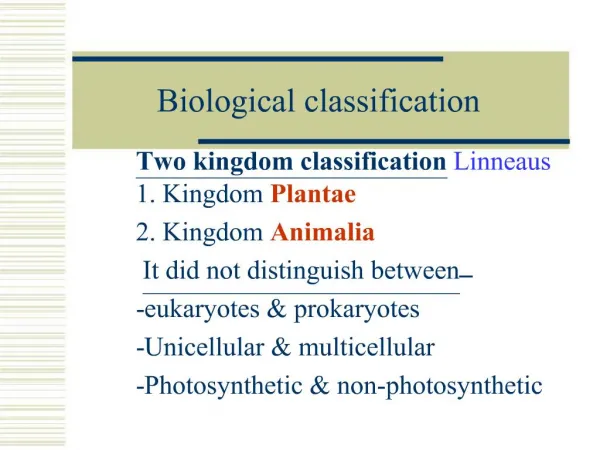
Earliest Classification: food – clothes - shelter • Aristotle : • Plants – • 1.HERBS • 2.SHRUBS • 3.TREES • Carolus Linnaeus : • 2 Kingdom Classification On the basis of : • A. Presence of cell wall • B. Absence of cell wall • 1.ANIMALIA 2.PLANTAE
WITH CELL WALL : WITHOUT CELL WALL : Algae , Bryophytes, Animalia , Protista , Pteridophytes, Reptiles . Gymnosperms, Angiosperms, Bacteria , Fungi . DRAWBACKS : Kept autotrophic with heterotrophic . Kept unicellular organisms with multicellular organisms . Kept prokaryotes with eukaryotes .
EarnstHackel-(3 kingdom ) Plantae Animalia Protista [cell wall +ent] [-ent] Copeland-(4 kingdom ) 1.Plantae [FUNGI] 2.Animalia 3.Protista 4.Monera
~R.H.Whittaker [1969] --- 5 kingdom classification -Plantae -Animalia -Protista -Monera -Fungi He classified it on the basis of : • Cell wall • cell type / organisation • mode of nutrition • mode of reproduction • phylogenetics
Kingdom – [MONERA] • • Bacteria are divides in two parts: • (i) Archaebacteria • (ii) Eubacteria• Halophiles (salt-loving)• Thermoacidophiles (in hot springs)• Methanogens (in marsh and in gut of ruminant animals. Produce methane gas.)• Photosynthetic autotrophs like Cyanobacteria (Blue-green algae-BGA). Some like Anabaena and Nostoc have specialized cells called heterocysts for nitrogen fixation.• Algae bloom is rich growth of blue green algae over the surface of polluted water bodies.• Algae bloom releases neurotoxins, deplete oxygen and water unfit for use.• Chemosynthetic autotrophs : Oxidise various inorganic substances like nitrates/nitrites, ammonia and use released energy for their ATP production. They helps in nutrients recycling of N, P, Fe and S.• Heterotophic bacteria: Decomposers, help in making curd, production of antibiotic, N2 fixation, cause diseases like cholera, typhoid, tetanus and citrus canker.• Mycoplasmas: Completely lack cell wall. Smallest living cells. Can survive without oxygen. Pathogenic in animals and plants.
Kingdom - [PROTISTA] • Chrysophytes: Golden algae and diatoms found in marine and freshwater habitats. • Dinoflagellates: Photosynthetic and marine organisms. • Euglenoids: Mostly found in freshwater habitats. • Slime Moulds: Saprophytic organisms. • Protozoans: Heterotrophs that survive as parasites or predators
(i) Chrysophytes (Has diatoms and golden algae/desmids)→ Fresh water/marine, photosynthetic, microscopic plankton.→ Cell walls have silica which makes it indestructible and cell walls overlap to fit together like a soap box.→ Their accumulation forms 'Diagomaceous Earth' (gritty soil)→ Used in polishing, filtration of oils and syrups • (ii) Dinoflagellates→ Marine, photosynthetic cell wall has stiff cellulose plates.→Two flagella, one longitudinal and other trnasverse in a furrow between wall plates.→ Example : Gonyaulax multiples rapdily, make sea appear red (red tides) and produce toxins to kill marine animals
(iii) Euglenoids→ Found in stagnant fresh water.→ Have protein rich layer ëpellicleí which makes body flexible.→ Photosynthetic in presence of sunlight but become heterotrophs if they do not get sunlight. (Mixotrophic nutrition)→ Example : Euglena • (iv) Slime Moulds• Saprophytic protists• Under suitable conditions form an aggregates called plasmodium, grows on decaying twigs and leaves.• During unfavourable conditions, plasmodium differentiates and forms fruiting bodies bearing spores at their tips.
(v) Protozoans: Are heterotrops and live as predators or parasites. Have four major groups.• Amoeboid: Catch prey using pseudopodia. Example: Amoeba. Entamoeba are parasite.• Flagellated : Have one or more flagella. Cause disease like Sleeping• Sickness e.g., trypanosoma.• Ciliated : Have clilia to move food into gullet and help in locomotion. e.g., Paramoecium.• Sporozoans : Have infective spore like stage in life cycle, e.g., Plasmodium which causes malaria
Kingdom – [FUNGI] Heterotrophic organisms• Non chlorpohyllous hyphae • Network of hyphae called mycelium• Hyphae which have multinucleate cytoplasm are called coenocytic hyphae• Cell wall of chitin and polysaccharides• Cosmopolitan. Grow in warm and humid places.• Saprophytic, parasitic, symbiotic (Lichen and Mycorrhiza) e.g., Puccinia, (wheat rust disesae), Penicillium, Yeast is a unicellular fungus.• Reprouction can take place by vegetative means fragmentation, fission and budding. Asexual reproduction by spores-conidia, sporangiospores or zoospores. Sexual reproduction by Oospores, ascospores and basidiospores produced in fruiting bodies.
Sexual cycle involves 3 steps:(i) Plasmogamy (fusion of Protoplasms.)(ii) Karyogamy (fusion of two nuclei.)(iii) Meiosis in zygote resulting in haploid spores.• Dikaryophase is a condition of having dikaryon in an intervening dikaryotic stage (n + n i.e., two nuclei per cell) between plasmogamy and karyogamy in fungi like ascomycetes and basidiomycetes