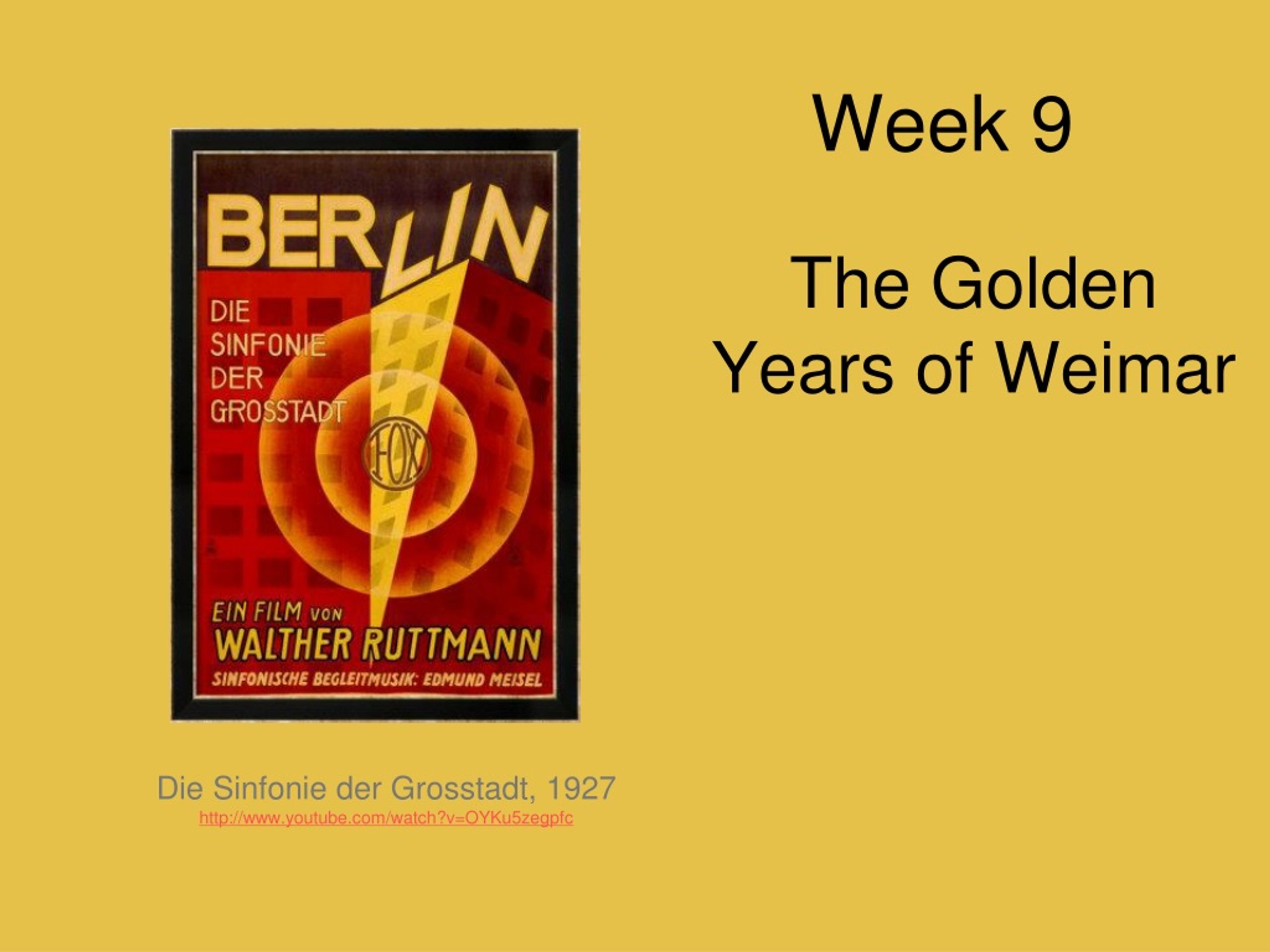
Week 9 The Golden Years of Weimar Die Sinfonie der Grosstadt, 1927 http://www.youtube.com/watch?v=OYKu5zegpfc
Weimar Culture • High vs. Low Culture • Mass culture and the Avant-Garde • Clash of values and new expectations • The Individual vs. the Collective • Social tensions and class stability • Mass Consumption & Modernisation • Technology and its repercussions
Avant-Garde Movements Bruno Taut’s Glass Pavilion
The First International Dada Fair, Berlin, 1920
Dadaism
Expressionist Architecture The Chilehaus in Hamburg (1922-24), designed by Fritz Höger The Einstein Tower in Potsdam (1919-20), designed by Erich Mendelsohn
Expressionist Film Nosferatu (1922), directed by F. W. Murnau Scenes from Das Cabinet des Dr Caligari (1920) The ‘Tower of Babel’ from Fritz Lang’s Metropolis (1927)
Expressionist Theatre • Ernst Toller, Die Wandlung (Transformation, 1919). • George Kaiser, Die Koralle (1917), Gas (1918) & Gas II (1920). The director and impressario Max Reinhardt (1873-1943) did much to popularize an Expressionist aesthetic in the theatre of the Weimar Republic
Union of Art and Technology
Bauhaus, 1919-1933
Bauhaus, Dessau
Social Critique in the Arts
Neue Sachlichkeit / New Objectivity Otto Dix Skat Players 1920
Life in the Big City Großstadt (Metropolis) Triptych (1927-28) by Otto Dix
The Pillars of the Establishment (1926) by George Grosz Three Whores (1926) by Otto Dix
Satires of Middle Class Life Industriebauen (1920) by Georg Scholz and Deutsche Familie (1932) by Adolf Uzarski
Mass Culture and Entertainment
Der Blaue Engel / The Blue Angel, 1930 • Directed by Joseph von Sternberg • Starred Emil Jannings & Marlene Dietrich • The sexually liberated woman!
Metropolis, 1927 • Directed by Fritz Lang • Heady embrace of technology and the machine world alongside its threat to humanity • The logical conclusion: harmonization of labor and capital
Revue Nègre
Josephine Baker
Tiller Girls
Charlie Chaplin’s Modern Times, 1936
Book Review Due: Monday in Lecture, Week 1, Term 2 • You may choose any book that is at least 200 pages and has been published since the year 2000. • The purpose of a book review is to provide a summary of the work, evaluate its strengths and weaknesses, and, most importantly, present your overall assessment of the work. • Towards this assessment, you should discuss one or more of the following: the book’s audience, its usefulness (for scholars, students, the general public), and its contribution to the field.
Sample Book Review Available on Jstor: Hannah Schissler, “Review: Rebuilding West German Society: A Gendered View”, Reviewed work: Protecting Motherhood: Women and the Family in the Politics of Postwar West Germanyby Robert G. Moeller Central European History, Vol. 26, No. 3 (1993), pp. 326-334 http://www.jstor.org/stable/4546350 Linda Gordon, “Review: Nazi Feminists?”, Reviewed work: Mothers in the Fatherland: Women, the Family and Nazi Politics by Claudia Koonz Feminist Review, No. 27 (Autumn, 1987), pp. 97-105 http://www.jstor.org/stable/1394813?&Search=yes&term=feminists&term=gordon&term=linda&term=nazi&list=hide&searchUri=%2Faction%2FdoAdvancedSearch%3Fq0%3Dlinda%2Bgordon%2Bnazi%2Bfeminists%26f0%3Dall%26c1%3DAND%26q1%3D%26f1%3Dall%26acc%3Don%26wc%3Don%26Search%3DSearch%26sd%3D%26ed%3D%26la%3D%26jo%3D&item=2&ttl=321&returnArticleService=showFullText Robert Gellately, “Review: [untitled]”, Reviewed work: Hitler's Willing Executioners: Ordinary Germans and the Holocaust by Daniel Jonah Goldhagen The Journal of Modern History, Vol. 69, No. 1 (Mar., 1997), pp. 187-191 http://www.jstor.org/stable/2953473?&Search=yes&term=gellately&term=hitler%27s&term=executioners&term=willing&term=robert&list=hide&searchUri=%2Faction%2FdoAdvancedSearch%3Fq0%3Drobert%2Bgellately%2Bhitler%2527s%2Bwilling%2Bexecutioners%26f0%3Dall%26c1%3DAND%26q1%3D%26f1%3Dall%26acc%3Don%26wc%3Don%26Search%3DSearch%26sd%3D%26ed%3D%26la%3D%26jo%3D&item=1&ttl=28&returnArticleService=showFullText