Introduction to DBMS
Modern software applications heavily rely on data, making databases indispensable for storing and managing information.

Introduction to DBMS
E N D
Presentation Transcript
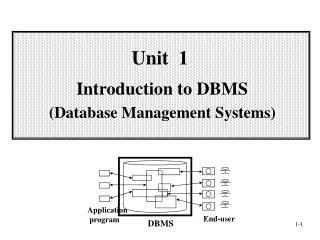
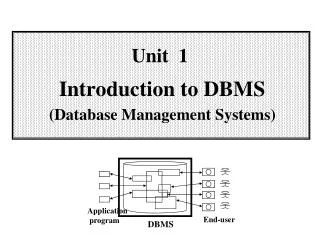
Introduction to DBMS (Database Management System) Modern software applications heavily rely on data, making databases indispensable for storing and managing information. The rise of web and cloud technologies has spurred the evolution of databases from traditional relational ones to advanced types like NoSQL, columnar, key-value, hierarchical, and distributed databases. These variations adeptly handle structured, semi- structured, and unstructured data. Furthermore, databases now handle crucial and sensitive information, often spread across distributed environments, and must comply with stringent regulations. Managing databases in such intricate scenarios has become highly complex. Organizations
necessitate robust, secure, and user-friendly tools to navigate this complexity effectively. This is where database management systems step in, providing a comprehensive platform for managing databases in diverse and demanding contexts. What is DBMS? A Database Management System (DBMS) is specialized software crafted to systematically manage and structure data. It empowers users to create, edit, and retrieve information within a database, while also overseeing security measures and access controls for the stored data. Characteristics of DBMS 1. contains automatic backup and recovery procedures. 2. It can reduce the complex relationship between data. 3. It is used to provide security of data. 4. It uses a digital repository established on a server to store and manage the information.
Examples of DBMS 1. Oracle: Oracle Database stands as a premium commercial relational database management system, leveraging enterprise- grade technology equipped with a comprehensive set of features from the get-go. It offers the flexibility of deployment, allowing storage either in the cloud or on-premises environments. 2. MySQL: MySQL is a widely utilized relational database management system, often paired with open-source content management systems and prominent platforms such as Facebook, Twitter, and YouTube. 3. SQL Server: Created by Microsoft, SQL Server is a relational database management system that operates on the foundation of structured query language (SQL), a standardized programming language enabling database administrators to efficiently manage databases and retrieve data. Conclusion In large organizations, databases house crucial records intertwined with numerous other datasets, their complexity increasing with user numbers. Consequently, organizations must vigilantly monitor, fine- tune, and enhance their databases to maintain high performance levels. Several pivotal factors affect database performance, such as system resources, workload, throughput, contention, and optimization. Without a dedicated database monitoring tool, accurately gauging the impact of these factors on database
performance becomes challenging. This understanding is vital, as it directly influences both application and business performance in the long run. About Ciente ? With Ciente, business leaders stay abreast of tech news and market insights that help them level up now, Technology spending is increasing, but so is buyer’s remorse. We are here to change that. Founded on truth, accuracy, and tech prowess, Ciente is your go-to periodical for effective decision-making. Our comprehensive editorial coverage, market analysis, and tech insights empower you to make smarter decisions to fuel growth and innovation across your enterprise. Let us help you navigate the rapidly evolving world of technology and turn it to your advantage. Explore More for more such blog posts. Follow us for the latest content updates.