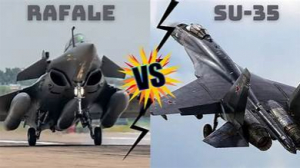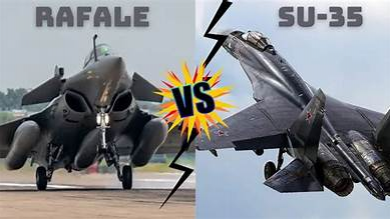
As global air forces continue to modernize, the debate surrounding Su-35 vs Rafale remains highly relevant. Both aircraft represent advanced fourth-and-a-half-generation fighters, yet they are shaped by very different visions of future air combat. At Crew Daily, we examine which jet is better prepared for the battles ahead.
Stealth and Survivability
Neither the Su-35 nor the Rafale is a true stealth fighter like fifth-generation aircraft, but both incorporate features designed to improve survivability. Rafale uses radar-reducing design elements and advanced electronic warfare systems to lower its detection profile during combat missions.
The Su-35, by contrast, relies more on speed, altitude, and extreme maneuverability to avoid threats. Its philosophy favors outmaneuvering enemy aircraft rather than hiding from radar, an approach that remains effective in close-range engagements.
Network-Centric Warfare
Modern air combat is increasingly driven by data sharing and connectivity. Rafale is designed for network-centric operations, allowing it to exchange real-time information with other aircraft, drones, and ground-based systems.
The Su-35 features data-link capabilities, but it is less integrated into large-scale network warfare environments. Crew Daily notes that future conflicts are expected to reward fighters capable of operating as part of a connected combat ecosystem.
Electronic Warfare Capabilities
Rafale’s SPECTRA electronic warfare system is one of its most significant strengths. It provides radar detection, jamming, and threat avoidance, giving pilots a high level of situational awareness and survivability in contested airspace.
While the Su-35 includes powerful countermeasure systems, its electronic warfare approach is more traditional when compared to Rafale’s fully integrated digital suite.
Export Success and Global Operations
Rafale has achieved strong success on the international market, operating with several allied air forces around the world. Its adaptability across air superiority, ground attack, and naval missions makes it attractive to a wide range of operators.
The Su-35 has fewer international users, partly due to political limitations and logistical challenges. However, it remains a formidable platform within the air forces that operate it.
Pilot Training and Adaptability
Rafale is designed to reduce pilot workload through automation and sensor fusion. This allows pilots to focus more on decision, making rather than system management, improving performance in complex combat scenarios.
The Su-35 places greater emphasis on pilot skill and manual control authority. While this rewards experienced pilots, it often requires longer training cycles to master the aircraft’s full capabilities.
Final Thoughts
In the Su-35 vs Rafale comparison, there is no universal winner. The Su-35 excels in raw performance and close-range combat, while Rafale stands out in electronic warfare, connectivity, and adaptability to future battlefields.
At Crew Daily, we view this matchup as a clear reflection of how air combat is evolving, from physical dominance to information-driven superiority.