
SIEM_Explained_By Cybersilo.Tech
"CyberSilo is a professional cybersecurity company that provides advanced digital protection for businesses. nThey offer solutions like 24/7 monitoring, threat detection, incident response, and compliance support to keep nyour systems, networks, and data fully secure. Their goal is to help organizations stay safe from modern ncyber threats with reliable, real-time security services.

SIEM_Explained_By Cybersilo.Tech
E N D
Presentation Transcript
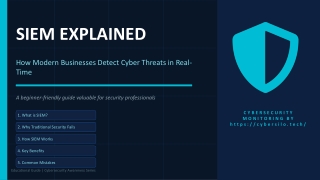
SIEM EXPLAINED How Modern Businesses Detect Cyber Threats in Real-Time A beginner-friendly guide valuable for security professionals CYBERSECURITY MONITORING BY https://cybersilo.tech/ 1. What is SIEM? 2. Why Traditional Security Fails 3. How SIEM Works 4. Key Benefits 5. Common Mistakes Educational Guide | Cybersecurity Awareness Series
01 | WHAT IS SIEM? S I E M Security Information & Event Management 💡 In simple terms: SIEM is like a 24/7 security control room for your digital business — it collects, analyzes, and alerts on suspicious activity across all your systems, in one place. Collect Analyze Alert Gathers log data from servers, firewalls, apps, endpoints, cloud services — everywhere. Uses rules and AI to identify patterns that indicate a potential threat or attack. Sends real-time alerts to security teams so they can respond before damage is done. 2
02 | WHY TRADITIONAL SECURITY FAILS ❌ THE OLD APPROACH ✅ WITH SIEM • Siloed tools — antivirus, firewall, IDS work separately and don't share data • Reactive, not proactive — alerts come after damage is done • Too many alerts with no context — security teams experience 'alert fatigue' • No centralized visibility — impossible to see the full picture • Manual log review — slow, error-prone, and can't scale • Can't detect slow-moving or sophisticated attacks (APTs) • Unified visibility — all logs, events, and alerts in one dashboard • Real-time detection — threats identified as they happen • Context-aware alerts — reduces noise and focuses on genuine risks • Correlation engine — connects dots across hundreds of events • Automated response — workflows trigger instantly on detection • Compliance-ready — built-in reporting for GDPR, HIPAA, PCI-DSS → SIEM Solves This 3
03 | HOW SIEM WORKS: STEP-BY-STEP 1 2 3 4 5 Data Collection Normalization Correlation & Analysis Alert Generation Automated Response › › › › SIEM agents and connectors gather log data from every source — firewalls, servers, cloud apps, endpoints, databases, and network devices. Raw logs come in different formats. SIEM normalizes them into a standard structure so they can be compared and analyzed consistently. The engine applies rules and machine learning to find patterns. Example: 5 failed logins + VPN access from a new country = suspicious. When a threat pattern is detected, SIEM generates a prioritized alert — ranked by severity — and notifies the security team immediately. Modern SIEM platforms can automatically block IPs, disable accounts, or isolate devices — all within seconds of detection. 4
04 | KEY BENEFITS FOR BUSINESSES Real-Time 60–80% Unified Threat Visibility Faster Detection Compliance Reporting See every event across your entire environment simultaneously. Nothing slips through unnoticed. SIEM dramatically cuts the time between a breach occurring and your team knowing about it. Auto-generate audit logs and reports for GDPR, HIPAA, SOC 2, PCI-DSS and other regulations. Smarter Lower Scalable Incident Response Breach Cost Risk For Any Size Business Threat context means analysts spend time on real issues, not chasing false positives. IBM reports breaches with SIEM cost significantly less due to faster containment. From SMEs to enterprises, SIEM solutions like CyberSilo scale to protect businesses of all sizes. 5
05 | REAL-WORLD CASE STUDY 📋 CASE STUDY: Mid-Sized Financial Services Firm (250 employees) BEFORE SIEM AFTER SIEM (6 months) • Average threat detection time: 72 hours • Security team manually reviewed 3 separate tools daily • Two major incidents in 12 months went undetected for days • Compliance reporting took 40+ hours per quarter • No visibility into cloud-based application activity • Security team burned out from manual monitoring tasks • Threat detection time reduced to under 29 hours — a 60% improvement • All security data unified into one dashboard view • Automated alerts caught a credential-stuffing attack within 4 minutes • Compliance reports generated automatically in under 2 hours • Full visibility across on-prem and cloud environments • Security team reallocated 15 hours/week from monitoring to strategy 60% Faster 6
06 | COMMON MISTAKES COMPANIES MAKE WITH SIEM 01 Treating SIEM as a 'Set and Forget' Tool 02 Collecting Too Much (or Too Little) Data 03 Not Training the Security Team SIEM requires ongoing tuning. Threat landscapes change, so rules and correlation logic must be regularly updated to remain effective. Ingesting every log creates noise and cost. Ignoring key sources creates blind spots. Balance is everything. SIEM is a powerful tool, but only as good as the people using it. Undertrained staff miss alerts or generate false escalations. ✅ Fix: Schedule monthly rule reviews and tune alert thresholds based on your environment. ✅ Fix: Start with your highest-risk data sources. Expand systematically based on risk assessments. ✅ Fix: Invest in regular SIEM training, tabletop exercises, and threat-hunting practice. 04 Ignoring Compliance Use Cases 05 No Incident Response Playbooks 06 Underestimating Integration Complexity Many companies implement SIEM purely for threat detection and miss out on automated compliance reporting capabilities. SIEM alerts mean nothing without a clear plan for what happens next. Teams waste critical minutes figuring out what to do. Getting SIEM to talk to all your tools — CRM, HR systems, cloud platforms — takes time and expertise. Rushing creates gaps. ✅ Fix: Map your regulatory requirements to SIEM reports from day one of deployment. ✅ Fix: Build documented response playbooks for your top 10 alert types before going live. ✅ Fix: Plan a phased integration roadmap. Cover critical sources first, expand over 6–12 months. 7
SIEM unifies all your security data into a single, intelligent monitoring platform. Traditional siloed tools leave dangerous gaps that attackers actively exploit. The 5-step SIEM process — Collect, Normalize, Correlate, Alert, Respond — works continuously. KEY TAKEAWAYS A mid-sized firm cut threat detection time by 60% within 6 months of SIEM deployment. SIEM Explained Avoid the 6 common mistakes: tune regularly, train your team, and build response playbooks. SIEM isn't just for large enterprises — scalable solutions make it accessible to businesses of all sizes. SIEM Explained: How Modern Businesses Detect Cyber Threats in Real-Time | Educational Cybersecurity Series 8