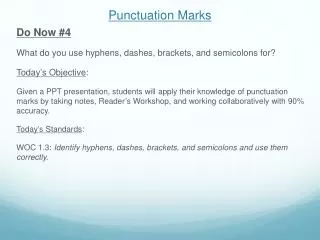
punctuation Marks.
E N D
Presentation Transcript
Satyam College of education Moga Punctuation
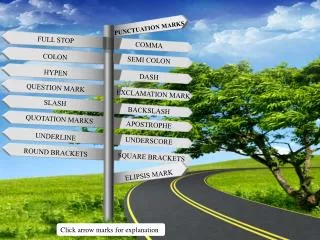
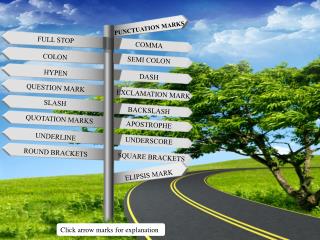
Punctuation Marks • Punctuation is the tool that allows us to organize our thoughts and make it easier to review and share our ideas. The standard English punctuation is as follows: period, comma, apostrophe, quotation, question, exclamation, brackets, braces, parenthesis, dash, hyphen, ellipsis, colon, semicolon.
Question Mark • A question mark (?) is placed at the end of a sentence which is a direct question. Here are some examples: What is the capital of Wales? Does anyone have a pen I can borrow?
Fullstop . • A full stop, also known as a period, is chiefly used to end a sentence. It is mostly used at the end of declarative sentences and imperative sentences. A full stop marks a longer pause than a comma and a semicolon. Furthermore, it marks the end of a thought and the beginning of another.
Semi colon • The semicolon or semi-colon; is a symbol commonly used as orthographic punctuation. In the English language, a semicolon is most commonly used to link two independent clauses that are closely related in thought. When a semicolon joins two or more ideas in one sentence, those ideas are then given equal rank.
Dash • What is a Dash? A dash is an adaptable punctuation mark that can be used to indicate parenthesis within a sentence and can be used instead of a bracket or a colon. The main use of a dash in English is to separate or connect two independent clauses.
Comma • The comma, is a punctuation mark that appears in several variants in different languages. It has the same shape as an apostrophe or single closing quotation mark in many typefaces, but it differs from them in being placed on the baseline of the text.
Square bracket • Definition of ‘square bracket’ Brackets (also called parentheses) are used to enclose a word or words which can be left out and still leave a meaningful sentence