How Do Platinum Mesh Electrodes Perform Under Continuous Testing?
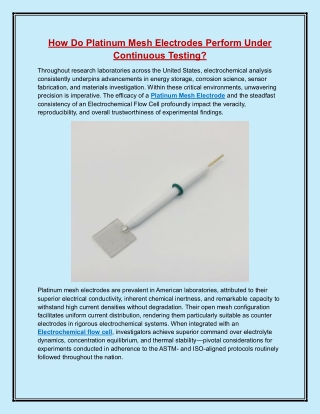
Throughout research laboratories across the United States, electrochemical analysis consistently underpins advancements in energy storage, corrosion science, sensor fabrication, and materials investigation. Within these critical environments, unwavering precision is imperative. The efficacy of a Platinum Mesh Electrode and the steadfast consistency of an Electrochemical Flow Cell profoundly impact the veracity, reproducibility, and overall trustworthiness of experimental findings.

How Do Platinum Mesh Electrodes Perform Under Continuous Testing?
E N D
Presentation Transcript
How Do Platinum Mesh Electrodes Perform Under Continuous Testing? Throughout research laboratories across the United States, electrochemical analysis consistently underpins advancements in energy storage, corrosion science, sensor fabrication, and materials investigation. Within these critical environments, unwavering precision is imperative. The efficacy of a Platinum Mesh Electrode and the steadfast consistency of an Electrochemical Flow Cell profoundly impact the veracity, reproducibility, and overall trustworthiness of experimental findings. Platinum mesh electrodes are prevalent in American laboratories, attributed to their superior electrical conductivity, inherent chemical inertness, and remarkable capacity to withstand high current densities without degradation. Their open mesh configuration facilitates uniform current distribution, rendering them particularly suitable as counter electrodes in rigorous electrochemical systems. When integrated with an Electrochemical flow cell, investigators achieve superior command over electrolyte dynamics, concentration equilibrium, and thermal stability—pivotal considerations for experiments conducted in adherence to the ASTM- and ISO-aligned protocols routinely followed throughout the nation.
Within the context of sophisticated testing configurations, the specialized L-Shaped Glassy Carbon Electrode, featuring a PEEK rod and PTFE isolation ring (φ4mm), emerges as an indispensable working electrode component. Engineered for compatibility with all leading potentiostats brands, this bespoke electrode provides outstanding chemical resilience and a broad electrochemical window. Its distinctive L- shaped geometry enables the active surface to align precisely parallel with the counter electrode, while its compatibility with a curved Luggin capillary effectively mitigates solution resistance (i.e., the 'R drop'). Encased in PEEK and safeguarded by a PTFE isolation ring, the electrode confers robust structural integrity, superior electrical insulation, and an extended operational lifespan—attributes consistently emphasized in scholarly electrochemistry publications. For investigators throughout the United States endeavoring to optimize accuracy, adherence to standards, and operational efficacy, the judicious selection of the appropriate electrode and flow cell configuration is paramount to realizing substantive experimental outcomes. To facilitate these rigorous requirements, Dek Research furnishes premium-grade electrochemical components specifically tailored for professional scientific laboratories. With an unwavering commitment to optimal functionality, consistent dependability, and scientific superiority, Dek Research assists American investigators in constructing truly dependable experimental setups.