
Malmö history
History about The Swedish town Malmu00f6. Text English.
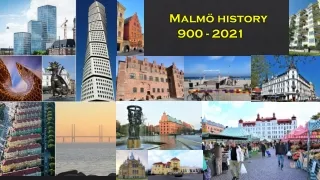

Malmö history
E N D
Presentation Transcript
Malmö (Sweden) is the largest city in the Swedish county (län) of Scania (Skåne). It is the third-largest city in Sweden, after Stockholm and Gothenburg, and the sixth-largest city in the Nordic region, with a population of 316,588 (municipal total 350,647 in 2021). The Malmö Metropolitan Region is home to over 700,000 people, and the Greater Copenhagen region, which includes Malmö as well as Copenhagen, is home to 4 million people. The earliest written mention of Malmö as a city dates from 1275. It is thought to have been founded shortly before that date, as a fortified quay or ferry berth of the Archbishop of Lund, some 20 kilometres (12 miles) to the north-east. Malmö was for centuries Denmark's second-biggest city.
Malmö history 1400 - 1500 Malmöhus Castle Tunneln 6
Erik av Pommern
Malmöhus or Malmöhus Castle is a castle with medieval origins located on Slottsholmen in Malmö. It was built between 1526 and 1539 and is thus the Nordic region's oldest preserved Renaissance castle. The castle's predecessor began to be built in 1434 by King Erik of Pomerania. The king ordered a powerful expansion of Malmö's defense against the sea.
Malmö Castle
In the 15th century, Malmö became one of Denmark's largest and most visited cities, reaching a population of approximately 5,000 inhabitants. It became the most important city around the Øresund, with the German Hanseatic League frequenting it as a marketplace, and was notable for its flourishing herring fishery. In 1437, King Eric of Pomerania (King of Denmark from 1396 to 1439) granted the city's arms: argent with a griffin gules, based on Eric's arms from Pomerania. The griffin's heIn 1434, a new citadel was constructed at the beach south of the town. This fortress, known today as Malmöhus, did not take its current form until the mid-16th century. Several other fortifications were constructed, making Malmö Sweden's most fortified city, but only Malmöhus remains.ad as a symbol of Malmö extended to the entire province of Skåne from 1660.
King Kristoffer of Bayern
King Kristian i Of Denmark 1426 - 1481
Malmö name From before Elbogen
House of Niels Kuntze
A memory in southernmost Sweden (then Denmark) after Erik's reign is Malmö's city coat of arms and later also Skåne's landscape coat of arms, the crowned grip head, which was originally the family coat of arms of the Pomeranian princes. The coat of arms is therefore consistently found in the city coat of arms of the Polish West Pomeranian coastal city of Szczecin. In Stockholm, the royal kitchen garden laid out by Erik in 1430 with cabbage plants - today's Kungsträdgården - is reminiscent of his reign in Sweden. Erik of Pomerania received a memorial stone in 2013 on Landskrona's Walk of Fame, which was then inaugurated by Sweden's King Carl XVI Gustaf.
Lutheran teachings spread during the 16th century Protestant Reformation, and Malmö became one of the first cities in Scandinavia to fully convert (1527– 1529) to this Protestant denomination. In the 17th century, Malmö and the Skåneland region came under control of Sweden following the Treaty of Roskilde with Denmark, signed in 1658. Fighting continued, however; in June 1677, 14,000 Danish troops laid siege to Malmö for a month, but were unable to defeat the Swedish troops holding it. By the dawn of the 18th century, Malmö had about 2,300 inhabitants. However, owing to the wars of Charles XII of Sweden (reigned 1697–1718) and to bubonic plague epidemics, the population dropped to 1,500 by 1727. The population did not grow much until the modern harbour was constructed in 1775. The city started to expand and the population in 1800 was 4,000. 15 years later, it had increased to 6,000.
The Count's Feud (Danish: Grevens fejde) is the largest civil war in Denmark's history. The war broke out in 1534 when the trading city of Lübeck after the death of Fredrik I tried to increase its power in the Nordic countries by trying to reinstate Christian II on the country's throne. This led to several peasant and bourgeois uprisings, as Christian II had great support among the common people in Denmark, where among others Copenhagen and Malmö supported the former king. The feud was named after Count Kristofer of Oldenburg, who led Lübeck's forces. On the other side of the conflict stood the Danish nobility and the higher clergy. They did not want to see Christian II again on the country's throne, and therefore they instead supported Fredrik I's son, Duke Christian (III). The Civil War took place in 1534–1536 and led to a victory for Christian III, the introduction of Protestantism and the consolidation of the aristocracy in the country.
1534 The Danish civil war, Grevefejden, breaks out. Jörgen Kock went with the burghers to Malmöhus, which was taken. He made connections with the mayor of Copenhagen, Ambrosius Bogbinder, and Wullenwever in Lübeck. By trying to restore Christian II to the throne, they tried to prevent the dead king's son Christian III from coming to power. At the same time, they wanted Copenhagen and Malmö elevated to free cities and inmates in the Hanseatic League. Count Kristofer of Oldenburg was won for the plan. It was probably i.a. the affection for Christian II and the fear of the reintroduction of Catholicism for the aristocracy that persuaded the bourgeoisie to follow its mayor in the uprising. But the plan failed. Soon, Copenhagen and Malmö stood alone against the newly elected Christian III.
1534-1536 During the so-called The Count's Feud 1534-1536 (the Danish Civil War) Malmö played a decisive role in the attempts to reinstate the abducted King Christian II. Malmö lost the battle. The new king Christian III had a moat dug around Malmöhus Castle and also threw up the castle's ramparts and built four powerful cannon towers for the castle's protection. A strong garrison was established here. Malmöhusgardet is today a military historical association that in a timeless and unique way tries to illustrate the castle's soldier life in the 16th century.
Jörgen Kock Jörgen Kock, born in 1487 in Westphalia, died in 1556, was a successful mayor and coinmaker in Malmö. Under Cook's leadership, Malmö came to experience a heyday. Jörgen probably came from Westfahlen in Germany because contemporary chroniclers call him "vestphalus". The first time he is mentioned in Denmark is in Malmö in 1517. The following year he became King Kristian II's coin master at Malmöhus when he succeeded the former coin master Dines Blicher. He was married to Citze Kortsdatter, who was previously married to the rich merchant Walter Kniphof in Copenhagen. He thereby became the stepfather of Claus Kniphof.
In 1840, Frans Henrik Kockum founded the workshop from which the Kockums shipyard eventually developed as one of the largest shipyards in the world. The Southern Main Line was built between 1856 and 1864 and this enabled Malmö to become a centre of manufacture, with major textile and mechanical industries. In 1870, Malmö overtook Norrköping to become Sweden's third-most populous city, and by 1900 Malmö had strengthened this position with 60,000 inhabitants. Malmö continued to grow through the first half of the 20th century. The population had swiftly increased to 100,000 by 1915 and to 200,000 by 1952.In 1914 (15 May to 4 October) Malmö hosted the Baltic Exhibition. The large park Pildammsparken was arranged and planted for this large event. The Russian part of the exhibition was never taken down, owing to the outbreak of World War I.
1536 On April 6, 1536, Malmö's bourgeoisie (in Jörgen Kock's absence) entered into a settlement with Kristian III in Elsinore. The condition was that the bourgeoisie was allowed to keep Protestantism and continue to be able to choose their own priests, as well as to avoid coming under the influence of the nobility.
Jörgen Kock became coin master of the Danish King Kristian II Kristian II (Danish: Christian 2.), in Sweden also known as Kristian Tyrann, born 1 July 1481 at Nyborg Castle, Denmark, died 25 January 1559 at Kalundborg Castle, Denmark, was king of Denmark and Norway 1513-1523 and king of Sweden 1520– 1521. He was the son of King Hans, and grandson of Kristian I. Kristian married August 12, 1515, to Elizabeth of Austria. They had six children, but none of them succeeded him as king. Kristian was deposed as a Danish king in 1523 and in 1546 renounced all claims to the throne.
How much coins were delivered Preserved accounts show that during the period Easter 1518 to April 1523 Jörgen delivered minted coins worth over half a million marks. In June 1520, Jörgen was personally at the palace occupied by Kristian II Tre Kronor in Stockholm and received a considerable amount of silver recovered. The last coinage in 1523 of close to 42,000 marks went to the king who brought these on his country flight to buy a lego army that would help him return to Denmark. In the same year he also became mayor of Malmö and promised to keep the city on behalf of the king.
Guess who built the Kockska house In 1522, Jörgen Kock acquired a large property adjacent to the important Adelgatan in close proximity to the port. Here, until 1524, he erected one of the more expensive bourgeoisie houses in the Nordic countries. Jörgen Kock's house is still preserved in Malmö, albeit internally heavily rebuilt. The site occupied a larger part of the block and here he also moved the coin workshop.
On 18 and 19 December 1914, the Three Kings Meeting was held in Malmö. After a somewhat disturbed period (1905–1914), which included the dissolution of the Swedish-Norwegian Union, King Oscar II was replaced with King Håkon VII in Norway, who was the younger brother of the Danish King Christian X. As Oscar died in 1907, and his son Gustav V became the new King of Sweden, the tensions within Scandinavia were still unresolved, but during this historical meeting, the Scandinavian Kings found internal understanding, as well as a common line about remaining neutral in the ongoing war. By 1971, Malmö reached 265,000 inhabitants, but this was the peak which would stand for more than 30 years. By the mid-1970s Sweden experienced a recession that hit the industrial sector especially hard; shipyards and manufacturing industries suffered, which led to high unemployment in many cities of Skåne. Kockums shipyard had become a symbol of Malmö as its largest employer and, when shipbuilding ceased in 1986, confidence in the future of Malmö plummeted among politicians and the public.
Gustav Vasa visited Jörgen kocks house 1524 30
https://sv.wikipedia.org/wiki/J%C3%B6rgen_Kocks_hus#/medi a/Fil:Kockska_huset_1,_Malm%C3%B6.jpg https://sv.wikipedia.org/wiki/J%C3%B6rgen_Kocks_hus#/media/Fil:J%C3%B6rgen_Kocks_hus7.jpg
Built like a Townhouse The length along Västergatan was originally constructed as a townhouse on two floors, a rental hose with three dwellings. The eastern apartment next to the corner house was part of Jörgen's private residence. All buildings have cross-arched basements. The corner building boasts a lot of decoration details, most of them today copies. The original is preserved at the Malmö Museum. In the corner you see the Virgin Mary standing on the moonlight, carrying the Jesus child. The pedestal is dated 1525. The same year is found over one of the wind gaps. Jörgens and Cisse's coat of arms can be seen over another gap.
Siege of Malmö The king's enemies under the leadership of his uncle Fredrik I besieged Malmö for a long time and finally, in the beginning of 1524, Jörgen was allowed to capitulate. He had to retain his mayor's title and also the mint business. The new king himself had to borrow 1,500 marks from Jörgen, which of course was a good deal for the mayor. In August Gustav Vasa came to Malmö to negotiate peace with Danes and Germans for a week. The king then lived at Jörgen's home. He appreciated his host so much that Jörgen, when Gustav Vasa's first-born son Erik was baptized, was one of the sponsors. On August 15, 1526, Jörgen Kock was honored by the Danish king.
Great times in Malmö Malmö came under the auspicious leadership of Malmö to experience a truly great time. Chef allowed Lutheran ministers to preach in Malmö and during the late 1520s the city became one of the important places for the Lutheran Reformation movement in Denmark. He agreed in wide-ranging plans to assert bourgeois interests in connection with Lübeck and get Malmö and Copenhagen elevated to a kind of free national cities
In 1533, the Danish king Fredrik I. died In 1533, the Danish king Fredrik I. died. Protestants in the country feared that Catholicism would be reintroduced and Copenhagen and Malmö therefore initiated a collaboration. They also made contact with Libyan mayor Jürgen Wullenwever and this became the prelude to a three-year civil war in Denmark, the Grevefjden. At first it looked promising, but in January 1535, luck turned. When Kock, at the head of the bourgeoisie from Malmö and Landskrona, drew against the united troops of the nobility and Swedes at Helsingborg, he suffered a devastating defeat and escaped himself with little need. In the spring, Malmö was besieged, and Kock was forced before Malmö surrendered to surrender to Copenhagen. Finally, Copenhagen also capitulated. In order not to be executed, Jörgen was forced to kneel on the road outside the city in front of the new king Kristian III.
He donated a fortune Jörgen Kock quickly won the king's favor but was deposed as mayor. Already in 1537 he succeeded in regaining his large confiscated fortune when, by giving the king 12,000 marks for the fortification of Malmöhus, he won his trust. In 1540 he was re-elected as mayor and held this office until his death. Before his death, Jörgen Kock and his wife Citze donated a huge amount of money to Malmö's poor. He and his wife were given their burial place in the aisle of St. Petri Church, in front of the pulpit.
The economy of Malmö was traditionally based on shipbuilding (Kockums) and construction-related industries, such as concrete factories. The region's leading university, along with its associated hi-tech and pharmaceutical industries, is located in Lund about 16 kilometres (10 miles) to the north-east. In 1944, Malmö Stadsteater (Malmö Municipal Theatre) was established with a repertoire comprising stage theatre, opera, musical, ballet, musical recitals and experimental theatre. In 1993 it was split into three units, Dramatiska Teater (Dramatical Theatre), Malmö Musikteater (Music Theatre) and Skånes Dansteater (Skåne Dance Theatre) and the name was abandoned. The ownership of the last two were transferred to Region Skåne in 2006 Dramatiska Teatern regained its old name. In the 1950s Ingmar Bergman was the Director and Chief Stage Director of Malmö Stadsteater and many of his actors, like Max von Sydow and Ingrid Thulin became known through his films.
Drottningtorget Malmö Name Name After After Queen Queen Fredrika Fredrika
Steamship Lund line Malmö – Gopenhagen aprox 1880 - 1905 Year 1908
Malmö Sweden 1860-1960 Photo/Foto Malmö Museum
1880 Stortorget
1890-1895 Östergatan
1890 Stortorget
Kronprinsens husarregemente, Malmö detachementet 1890
Malmö's oldest building is St. Peter's Church. It was built in the early 14th century in Baltic Brick Gothic probably after St Mary's Church in Lübeck. The church is built with a nave, two aisles, a transept and a tower. Its exterior is characterized above all by the flying buttresses spanning its airy arches over the aisles and ambulatory. The tower, which fell down twice during the 15th century, got its current look in 1890. Another major church of significance is the Church of Our Saviour, Malmö, which was founded in 1870. Another old building is Tunneln, 300 metres (1,000 ft) to the west of Sankt Petri Church, which also dates back to around 1300.The oldest parts of Malmö were built between 1300 and 1600 during its first major period of expansion. The central city's layout, as well as some of its oldest buildings, are from this time. Many of the smaller buildings from this time are typical Scanian: two- story urban houses that show a strong Danish influence.