Hardware Security Modules Market Size, Share, Report Analysis by 2034
0 likes | 1 Vues
According to Fortune Business Insights, the Hardware Security Modules (HSM) Market was valued at USD 1.63 billion in 2025 and is projected to grow to USD 4.55 billion by 2034, exhibiting a compound annual growth rate (CAGR) of 12.10 % over the forecast period from 2026 to 2034. The global Hardware Security Modules (HSM) Market is gaining significant momentum as organizations increasingly prioritize robust cybersecurity infrastructure to protect sensitive data and critical digital transactions. This growth reflects rising cyber threats, stricter regulatory mandates, and the expanding adoption o


Hardware Security Modules Market Size, Share, Report Analysis by 2034
E N D
Presentation Transcript
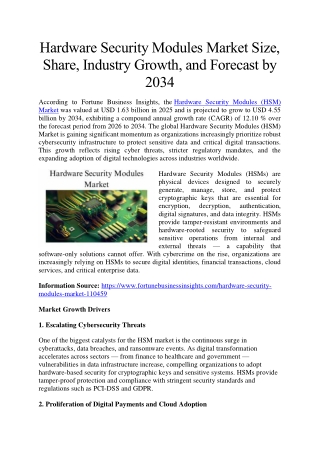
Hardware Security Modules Market Size, Share, Industry Growth, and Forecast by 2034 According to Fortune Business Insights, the Hardware Security Modules (HSM) Market was valued at USD 1.63 billion in 2025 and is projected to grow to USD 4.55 billion by 2034, exhibiting a compound annual growth rate (CAGR) of 12.10 % over the forecast period from 2026 to 2034. The global Hardware Security Modules (HSM) Market is gaining significant momentum as organizations increasingly prioritize robust cybersecurity infrastructure to protect sensitive data and critical digital transactions. This growth reflects rising cyber threats, stricter regulatory mandates, and the expanding adoption of digital technologies across industries worldwide. Hardware Security Modules (HSMs) are physical devices designed to securely generate, manage, store, and protect cryptographic keys that are essential for encryption, decryption, digital signatures, and data integrity. HSMs provide tamper-resistant environments and hardware-rooted security to safeguard sensitive operations from internal and external threats — a capability that authentication, software-only solutions cannot offer. With cybercrime on the rise, organizations are increasingly relying on HSMs to secure digital identities, financial transactions, cloud services, and critical enterprise data. Information Source: https://www.fortunebusinessinsights.com/hardware-security- modules-market-110459 Market Growth Drivers 1. Escalating Cybersecurity Threats One of the biggest catalysts for the HSM market is the continuous surge in cyberattacks, data breaches, and ransomware events. As digital transformation accelerates across sectors — from finance to healthcare and government — vulnerabilities in data infrastructure increase, compelling organizations to adopt hardware-based security for cryptographic keys and sensitive systems. HSMs provide tamper-proof protection and compliance with stringent security standards and regulations such as PCI-DSS and GDPR. 2. Proliferation of Digital Payments and Cloud Adoption
The explosive growth of digital payments, e-commerce, and cloud services has heightened the need for secure cryptographic operations. HSMs play a vital role in securing payment processing systems, digital wallets, banking APIs, and cloud-based applications. With enterprises shifting from on-premise to hybrid and cloud environments, HSM adoption is steadily increasing to ensure seamless key management and robust encryption across distributed systems. 3. Compliance and Regulatory Pressure Regulatory mandates across regions require stringent data protection measures, especially in highly regulated sectors like banking, insurance, and healthcare. HSMs help organizations comply with global data privacy regulations by ensuring that encryption keys are stored and processed securely in tamper-resistant hardware, reducing the risk of data breaches and non-compliance penalties. 4. Integration with Advanced Technologies Emerging technologies such as generative AI, quantum computing, and DevOps are reshaping cybersecurity demand. HSM vendors are innovating to integrate AI-driven analytics and quantum-resistant cryptography into their products, enabling secure key management even in future-proof environments. This trend is expected to further stimulate HSM adoption, particularly in high-performance computing and cloud- native workloads. Market Segmentation Insights Fortune Business Insights segments the HSM market across applications, types, deployment models, and end-user industries: Application Landscape HSMs are used in: Payment Processing – leading the market due to the critical need for secure transaction encryption. Database Encryption – protecting sensitive enterprise data. Authentication & Public Key Infrastructure (PKI) – enhancing secure access and digital identity management. Payment processing is expected to capture nearly 30 % of the market share in 2026, reflecting its importance in financial systems worldwide. By Type The market includes:
USB-based/Portable HSMs – dominant due to ease of deployment and robust security. LAN/Network-attached HSMs PCIe-based Embedded HSMs USB-based modules are preferred for flexibility, while embedded and network- attached HSMs are gaining impetus in enterprise environments. Deployment Model On-Premise Deployment – currently holds the highest share due to the need for strict control of cryptographic keys. Cloud-based HSM Solutions – registering the fastest growth as organizations migrate workloads to the cloud. End-User Vertical The BFSI (Banking, Financial Services, and Insurance) sector leads owing to intense security and compliance requirements. Other growing end users include technology & communications, retail, healthcare, and industrial sectors. Regional Market Dynamics Regionally, North America dominated the market in 2025, owing to strong cybersecurity infrastructure investment and awareness. The U.S., in particular, plays a central role as both public and private sectors increase encryption and key management deployments. Asia Pacific is poised for rapid growth due to digitalization in China, India, and Japan. Europe is also forecasted to register healthy growth supported by stringent data privacy frameworks. Key Players in the Hardware Security Modules Market The global HSM market is competitive and fragmented, with several leading players offering advanced security solutions. Major companies profiled in the Fortune Business Insights report include: Entrust Corporation (U.S.) Thales (France) Utimaco (Germany) IBM Corporation (U.S.) Infineon Technologies (Germany) Securosys (Switzerland) Futurex (Malaysia) Swift (Belgium) Yubico (U.S.) Fortanix (India)
These players are actively investing in R&D, partnerships, and product innovations to expand their footprint, address evolving threats, and deliver scalable security solutions across industries. Conclusion The Hardware Security Modules market is set for robust growth through 2034, driven by escalating cybersecurity threats, rapid digital transformation, regulatory demands, and advanced cryptographic requirements. As enterprises continue to prioritize secure key management and tamper-resistant systems, HSMs will remain an indispensable component of modern information security strategies worldwide.