Persuasieve Communicatie
80 likes | 81 Vues
Persuasieve Communicatie Keuzevak Bedrijfscommunicatie in de praktijk - door Smits Tim


Persuasieve Communicatie
E N D
Presentation Transcript
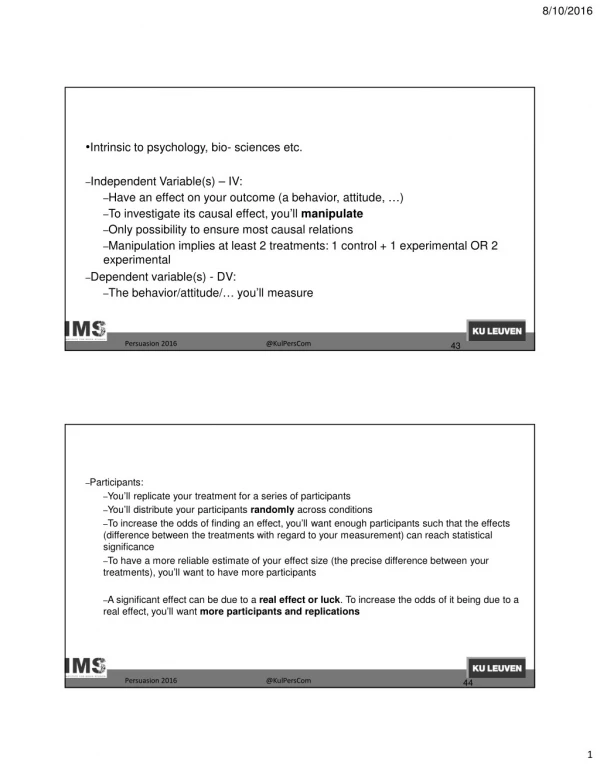
8/10/2016 •Intrinsic to psychology, bio- sciences etc. –Independent Variable(s) – IV: –Have an effect on your outcome (a behavior, attitude, …) –To investigate its causal effect, you’ll manipulate –Only possibility to ensure most causal relations –Manipulation implies at least 2 treatments: 1 control + 1 experimental OR 2 experimental –Dependent variable(s) - DV: –The behavior/attitude/… you’ll measure Persuasion 2016 @KulPersCom 43 –Participants: –You’ll replicate your treatment for a series of participants –You’ll distribute your participants randomly across conditions –To increase the odds of finding an effect, you’ll want enough participants such that the effects (difference between the treatments with regard to your measurement) can reach statistical significance –To have a more reliable estimate of your effect size (the precise difference between your treatments), you’ll want to have more participants –A significant effect can be due to a real effect or luck. To increase the odds of it being due to a real effect, you’ll want more participants and replications Persuasion 2016 @KulPersCom 44 1
8/10/2016 Two methods for manipulation –Between-subjects (between-participants) –One group vs. the other group –Advantage: participants do not know what you manipulate –Disadvantage: You’ll need more participants, certainly when adding treatments or dependent variables –Within subjects (within-participants) –Participants exposed to different treatments –Advantage: stronger effects, so less participants needed –Disadvantage: Easier for participants to understand the hypothesis; analyses a bit more difficult • When combining dependent variables, we look for interactions! Persuasion 2016 @KulPersCom 45 •Double-blind research: •Both participant AND researcher are blind to the hypothesis •Participants do not know such that they cannot deliberately follow (or oppose) the expectations •Researchers do not know such that they can not subtly (and even unknowingly) influence participants Persuasion 2016 @KulPersCom 46 2
8/10/2016 The goal of participant sampling for experiments = causality ≠ representativity • Experiments in the realm of persuasion Often disguised as a questionnaire Manipulate elements of a message or its circumstance and measure the effect on attitudes Persuasion 2016 @KulPersCom 47 Chapter 2 Attitudes 48 3
8/10/2016 Attitudes Structure Arguments: Central route Arguments: Peripheral route Persuasive message Narrative persuasion Behavior Persuasion 2016 @KulPersCom 49 Overview •Introduction •Direct attitude measures •(Semi-direct attitude measures) •Indirect attitude measures 50 4
8/10/2016 Definition • Attitude = a general evaluation of an attitude object •Evaluation = a value on a negative-to-positive continuum (or a double continuum: negative-to-neutral AND neutral-to-positive) •Attitude object = every social stimulus to which you can ascribe such an evaluation examples: yourself, somebody else, a group, a thing, a brand, an idea, a political viewpoint, a behavior, a concept, … Persuasion 2016 @KulPersCom 51 Object X Negative Positive Persuasion 2016 @KulPersCom 5
8/10/2016 Attitude measures Persuasion deals with the effect of messages. To systematically study such effects, we need to measure the dependent variables. Most times, attitudes will be our dependent variable o Change in behavior is difficult to observe/measure systematically o Assumption that we often change behavior via an attitudinal change, so we first need to know whether the attitde change is real Persuasive message Behavior Attitudes o Chapter 3 will study the attitude-behavior link o For such type of studies, attitudes will be the independent variable Persuasion 2016 @KulPersCom 53 •Sources for attitude measures 1.What people tell about their attitudes 2.Observation of one’s reaction towards the attitude object 3.Observation of one’s interaction with the attitude object QUANTIFICATION? 4.Information through others (friends, relatives, …) 5.Judgments about the attitude object measure adapted to audience? 6.Fysiological reactions towards the attitude object Complex and multi-faceted ?Evaluative tendency (positive/negative) ?Attitude strength ; Attitude ambivalence ?Basis: cognitive versus affective ?Function: utilitarian – value expressive – social – ... Persuasion 2016 @KulPersCom 54 6
8/10/2016 Object X Negative Positive Deliberate Direct Unstructured: Interview Structured One-item measure Multi-item measure Semantic differential Likert Scale Semi-Direct Likert Scale Equal Appearing Interval Equal Appearing Interval Relative measures Ranking Lost Letter Choice Error Evaluative Priming IAT … Automatic Indirect Persuasion 2016 @KulPersCom 1-item measure •Easiest to construct and to use: •Extreme evaluative statement + question to what extent you agree (cf. Likert) •Direct question: how much do you like X + response scale •Perfect for certain situations: long questionnaires, target groups such as young children •Best solution if your concept can be measured in a straightforward way: double concrete measures (Bergkvist & Rossiter, 2009) •But issues if your measure is biased! measure Persuasion 2016 @KulPersCom 56 7
8/10/2016 Single item biases •Acquiescence •Persuasive question wording •Double questions •Missing scale points •Missing information These are also problems in multi-item measures, but such biases can get corrected there because you’ll look at the total joint information of all items, ignoring the noise in each measure See book for further advice on randomizing question order (primacy, recency); whether or not to include a “don’t know” option; suggestion to also look for attitude strength rather than merely attitude extremity Persuasion 2016 @KulPersCom 57 8