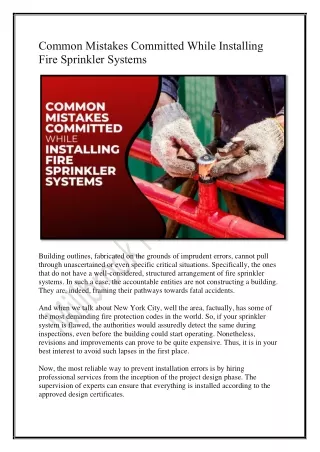
Understanding Fire Sprinkler Systems: A Comprehensive Safety Solution
Reliability is everything. Automatic fire sprinklers systems immediately suppress the fire without human intervention. Unlike portable fire extinguishers and alarm systems, which only alert the presence of fire, sprinklers action without human intervention. Each head functions autonomously, activated only by the heat of the fire. Most of the time, only the closest sprinklers to the fire source will release water, thereby reducing water damage while enabling the control the fire.


Understanding Fire Sprinkler Systems: A Comprehensive Safety Solution
E N D
Presentation Transcript
Understanding Fire Sprinkler Systems: A Comprehensive Safety Solution It is important for every building owner, property manager, and facility operator, to factor in fire protection for their facilities. Along with several methods of fire suppression, more people rely on automatic sprinkler systems to safeguard lives and property. Over the past century, these sophisticated water-based suppression systems have undergone rapid technological advancements and incredible engineering designs to provide the best possible fire control and extinguishment capabilities. The Evolution and Importance of Automatic Sprinkler Technology
Over the decades, the fire protection systems we have today is the result of years of research, innovation, and real applications in the systems for fire protection. The innovation is in the design of these water distribution networks. The design features detecting the heat of a developing fire and automatically discharging water, controlling or extinguishing flames that would otherwise spread throughout a structure. This automated response is critical in eliminating the dangerous delays associated with waiting on the fire to be extinguished by hand or waiting for people to intervene. Across different occupancy kinds in North America, the life-saving systems have increasingly been installed due to the building code and fire safety regulations. All protective systems cover residential, commercial, industrial, and institutional structures. The effectiveness of these systems installed and kept in good condition is evidenced in the statistics. Unprotected structures suffer more fire fatalities and property damages than those with protected building systems. Reliability is everything. Automatic fire sprinklers systems immediately suppress the fire without human intervention. Unlike portable fire extinguishers and alarm systems, which only alert the presence of fire, sprinklers action without human intervention. Each head functions autonomously, activated only by the heat of the fire. Most of the time, only the closest sprinklers to the fire source will release water, thereby reducing water damage while enabling the control the fire. Components and Infrastructure of Water-Based Fire Protection. Numerous components make up a complete sprinkler system. They form seamless interconnection to deliver water at the precise time and place needed. Understanding the systems helps in appreciating the sophisticated engineering embedded in the ostensibly simple devices mounted on the building ceilings. Every effective system is built on the foundation of a water supply. This supply may connect to municipal water mains, private water sources, or even fire pumps with dedicated storage tanks. For the system to function, sufficient pressure and volume of water needs to be provided. The system has to provide the ability to consistently supply a minimum flow of water to all the sprinkler heads which may be activated in a fire scenario. Adequate hydraulic calculations carried by qualified designers to set the water supply assures the demand requirements for a specific hazard classification and building configuration are fully met. Networks of piping are used to distribute water to all the protected areas. These pipes are usually made of either steel, copper or approved plastic materials and are configured in grid arrangements across the ceiling tiles. The network of pipes is designed in a specific manner where the larger mains supply pipes are interconnected to smaller diameter pipes. This design helps to maintain a proportional flow and pressure which is required downstream and assists the system in meeting its design objectives. Control valves allow for system testing and maintenance while regulating water flow. The main control valve, typically in a supervised position, can completely isolate the
system when needed. Extra sectional valves allow for more flexibility by letting some system parts fall out of service for repairs or changes while still providing protection in other system parts. Certified Fire Sprinkler installation in Toronto projects often use sophisticated valve assemblies with system monitoring features. These monitor valve status and inform building personnel when a valve is closed, stopping a potential hazard of the system being inoperative and uncontrolled for extended periods. Water flow alarm systems actively inform system users and emergency responders. Flow switches, pressure switches, and Vane water flow detectors trigger local bells, horns, or strobes and send fire alarm control panels and monitoring stations a simultaneous alarm. This fast notification system significantly cuts emergency response time and building evacuation. Different Applications Require Different Systems Fire protection engineering has different system configurations to resolve unique challenges of varied buildings and their conditions. Correct system type selection comes after a careful study of the ambient temperature, type of occupancy, water supply, and specific fire hazard present. The most widely used and most basic system is the wet pipe system, where the system is piping is filled with pressurized water. When a fire sprinkler head is activated, the pressurized water is immediately discharged. The construction and installation process simplicity of these systems translates to low prices, low maintenance, and high dependability. They work best for areas where the climate is controlled and there is no risk of low temperatures. Dry pipe systems work best for places where there is a risk of freezing. The systems do not have water, but compressed air or nitrogen is used and the piping is placed above a dry pipe valve. Triggering the sprinkler head releases air pressure, which allows the dry pipe valve to open and water is able to flow into the piping and out of the activated sprinkler heads. Although dry pipe systems do add a small delay to the release of water, they do stop the risk of freezing in unheated warehouses, parking garages, loading docks, and outdoor canopies. Preaction systems add another control layer by requiring the activation of the detection system and the operation of sprinkler heads before the system releases water. Such systems are used in environments where accidental water discharge could damage sensitive materials or valuables, such as data centers, museums, and libraries and archives. The detection system, which could consist of smoke, heat, or flame detectors, must first activate the preaction valve. Then, if the fire continues to develop and a sprinkler head is activated, water will flow through that head. Deluge systems are much less restricted, as they feature open sprinkler heads that are not heat-sensitive. A detection system controls a deluge valve that, when activated, releases water to completely saturate the area all at once. These extreme hazard systems are used in places where rapid fire spread is likely to occur, like
aircraft hangars, chemical storage, and areas with flammable liquids. These systems need to expose the area to large amounts of water to aggressive suppress the fire as it develops. The Vital Function of Sprinkler Heads in Fire Suppression Sprinkler heads, which can be referred to as sprinklers or nozzles, are the last components of the entire system. They can be referred to as the last components of the entire system. These devices are built to detect heat and to release and distribute water in a pattern specifically designed to control a fire. The various designs and styles of sprinkler heads available in the market portray the diverse modern requirements which need to be applied in fire protection. Temperature ratings is one of the important specifications of a sprinkler head. In every head, there is a heat responsive element and every one of them is set to perform at a specific preset degree of temp. Temperature ratings are common at 135 degrees F and at 57 degrees Celsius which is for ordinary domestic purposes and at 286 degrees F and 141 degrees C for higher ambient temperature areas. Temperature ratings are determined by colored coded components, which are also designed to help the installer choose the heads appropriate to the expected ambient temperature conditions for each location. The response characteristics define the speed at which a sprinkler head can activate. The standard response head has been the most popular choice for decades as it has large thermal elements that are slower to reach operating temperature. Quick response and fast response heads contain smaller, essentially more sensitive elements that trigger much quicker, offering earlier suppression for residential occupancies as well as areas where rapid fire control is paramount for life safety. Water distribution characteristics are influenced by different spray patterns. Pendent spray heads are positioned below the pipe and have downward deflectors, creating a hemispherical spray pattern appropriate for most uses. Mounted above the pipe, upright heads spray water upward and deflect it downward to form a similar pattern. Sidewall heads are mounted to walls and generate uneven patterns that extend outwards, enabling coverage of rooms from the edge. These heads are intended primarily for perimeter mounting. Concealed and recessed heads are designed to look hidden but have the full functionality of non-recessed heads. Design Considerations and Hydraulic Engineering A complete set of building codes, engineering principles of fire protection, and hydraulic calculations applied to the system is indicative of system design that enhances the overall performance. Such fire protection system designs are the work of professionals and must balance a multifactorial approach; this is the only way to comply with all standards governing systems that protect life and property.
How a hazard is classified is extremely influential to the design criteria. In the case of light hazard occupancies which include offices and schools, the required water density is far less than that of ordinary hazard designs for warehouses and manufacturing facilities. Extra hazard designs require the highest applied water rates especially for flammable liquids stored in a concentration of large volumes and processing chemicals in a manufacturing facility. Spacing requirements determine the maximum distance allowed between sprinkler heads and depend on the hazard classification and the sprinkler head coverage capabilities. For instance, standard coverage sprinkler heads protect up to 130 square feet during light hazard applications, and for higher hazard classification, coverage areas have to be reduced. Advanced coverage heads have specialized deflectors and, under certain conditions, can protect 400 square feet which helps reduce the number of heads and may decrease the cost of installation. Pipe sizing and water supply requirements are defined by hydraulic calculations. The current sprinkler system designers are using sophisticated hydraulic modeling software to design water flow within the pipes using the various water supply system components while considering friction loss, elevation, and other components to devise systems that are flexible and have multiple sprinkler heads. The calculations focus on the extreme areas of the system that are usually the most challenging to supply, and thus determine the required pressure and flow for other system components. Installation Standards and Professional Implementation Reliability and performance of the system depend on the quality of installation. This is achieved by skilled contractors because various interrelated activities or system components need to be coordinated. Cordinated activities and other components to be installed rely on the adherence of the contractors to various standards and best practices. Installation involves the interaction of multiple trades and the coordinated activities rely on adherence to certain manufacturer specifications and code requirements. Hire Fire Sprinkler installation in Hamilton and across Ontario observes the NFPA standards NFPA 13, NFPA 13R, and NFPA 13D for standard, residential, and one/two family dwelling installations, respectively, along with other NFPA guideline standards. These extensive standards provide the guidelines on the selection of components required in sprinkler system design, pipe size, the calculation of head spacing, the design and spacing of hangers and supports, valve arrangement, and system acceptance testing. The design and construction of system piping involves the selection of appropriate joining and soldering techniques according to the type of pipe. For instance, threaded and welded joints in steel piping require engineering consideration for sealing and strength to eliminate joining technique induced leaks. Grooved pipe couplers, which are more common now, are easier to install and provide tight seals. For CPVC and other plastic piping, the spacing of supports, impact resistance, and the application of solvent cement are critical in design.
Sprinkler heads require specific positional installation to achieve the design coverage area and to avoid any potential obstruction of water distribution pattern. There are design codes which state sprinkler head required clearances to walls, ceilings, and other structural components. Seismic bracing and hangers for pipes require the same design consideration to support the pipes especially in earthquake prone areas or where braced systems are to remain operational after quakes. Testing and commissioning ascertains that systems have been properly installed and functional. Contractors conduct hydrostatic pressure tests to check the integrity of the piping, perform flow tests to ascertain the adequacy of the water supply, and engage in operational tests to confirm the proper functioning of all alarm systems. As-built drawings, test reports, and other documentation specified provide owners with necessary records that are essential for maintenance and future modifications of the building. Maintenance Requirements and Ongoing Performance Systems, no matter how well designed and installed, need regular maintenance to ensure that their reliability is consistent. Comprehensive maintenance programs provide for the required routine inspections and the scheduled testing outlined in NFPA 25, the standard for inspection, testing, and maintenance of water-based fire protection systems. Weekly and monthly inspections cover the visual control of the valves to ensure that they are in the open position, the gauges for pressure are read, and the alarm devices are checked for damage. These inspections, which are simple in nature, help to ensure that apparent problems do not emerge to compromise the system readiness. Quarterly inspections include testing of alarm devices, examination of hydraulic nameplates and signs, and inspection of gauges for proper operation. Inspectors verify that valve supervisory switches and tamper devices function properly, ensuring that any unauthorized valve closure will trigger appropriate alarms. Annual assessments necessitate thorough reviews of every element of the systems. This involves internal examinations of the check valves in alarms, dry valves, and preaction valves, assessing the flow of the main drain, and complete functional assessments of each detection and alarm system. For sprinkler heads, thorough inspections for any signs of potential activation impairments or water distribution obstructions, such as for corrosions and damages, paints, or any undue loadings, must be conducted. In the case of five years and older, the testing includes internal visual inspections of the pipes, forward flow assessments of the backflow preventers, and testing or replacing sprinkler heads. Pipes may need to be flushed to remove build-up of sediments or to scale. Sprinkler heads pre-dating 1920 or those which are corroded need to be replaced in accordance with the prescribed timelines.
Due to the potential consequence of poor water quality, water quality is especially important. Corroded pipes with internal pinhole leaks and failing systems result from unchecked poor water quality. Microbiologically influenced corrosion (MIC) is a growing challenge, especially in stagnant water systems. These systems must undergo frequent water quality tests and, if necessary, treatments to prevent loss of water, and structural systems from failing. Integration with Comprehensive Building Fire Safety Although automatic sprinkler systems offer remarkable fire protection, they do so most efficiently when incorporated into an overall integrated building fire safety plan. Using fire protection systems in conjunction with one another achieves a layered, defense-in-depth, multifaceted approach to fire prevention, early detection, suppression, and safe egress. Advance warning of potential fire emergencies is the primary function of fire detection and alarm systems, and they initiate emergency response action. Smoke and heat detectors, as well as manual pull stations, interface with fire alarm control panels to activate notification appliances and send alerts to monitoring stations. The integration of detection systems with preaction sprinkler systems provides building managers and emergency responders with enhanced situational awareness and advanced control of fire protection systems. Active suppression systems and passive protection features such as fire rated walls, floors, doors, and penetration firestops work in concert. Fire suppression systems activate to control a fire while permitted passive protection elements temporality contain the fire and smoke providing the system time to activate, allowing occupants to evacuate safely. Well maintained fire doors and automatic dampers close and prevent smoke and fire passage through openings in fire-resistance rated assemblies. Controlled emergency egress systems enable building evacuation through exit signs, emergency lighting and well marked escape routes. Sprinkler systems controlling the growth of a fire enable occupants to escape and allow fire personnel to conduct search and rescue operations more safely.Smoke control systems are designed to extract smoke and heat from evacuation routes and pre-identified refuge areas. These systems operate in conjunction with sprinklers, whether through natural ventilation and mechanical exhaust and sophisticated pressurization, to remain within tenable limits throughout the evacuation and firefighting activities The Industry is Largely Safe and New Innovations Are Improving it The introduction of other New and innovative technologies to improve the efficiency and operational potential of systems in the fire protection industry is accompanied by decreased installation costs and increased versatility within numerous industries. Improvements in systems intelligent, material, and designing methodologies and the overall systems has also been impressive.
Fire sprinklers in homes have become mainstream owing to the changed building codes and favorable life safety data. Specialized residential sprinkler heads have also been made to reduce costs in installation, aesthetic control, and fire control. Fast response sprinklers control fire at opened areas of the modern home which are furnished with fast combustibles and enable the fire to develop quickly. The use of alternative piping materials has also opened new designs and lower installation costs with the incorporation of various plastic systems. CPVC, PEX and other approved residential materials and their ease of installation and corrosion resistance are of great benefit in residential setting. Limitations and proper installation should still be the core of focus. Corrosion-resistant piping systems handle the ongoing issue of corrosion within pipes. For systems designed at preventing premature failures, coated steel pipes, stainless steel systems, and nitrogen inerting programs are useful. These systems are of great use in aggressive water quality situations where the reliability of the system is critical. Smart monitoring systems incorporate the Internet of Things (IoT) to monitor systems in real time and provide the status of the entire system. Advanced sensors that log and track water pressure, valve positioning, and other variable environmental factors send information to cloud systems and are accessed from anywhere. Predictive analytics are useful to address the problems that develop in systems before failures to increase system reliability. Alternate suppression technologies using less water than traditional systems are water mist systems. They use finer water droplets which cool and remove oxygen from the fire quicker than of conventional methods. While not appropriate for all situations, water mist systems are advantageous in situations where weight is a factor, in environments where water is sensitive, and in marine environments. Life Safety and Economic Benefits The life safety valve of automatic sprinkler systems is only a fraction of the economic value these systems provide. These systems and their installation provide a great deal of value to property owners in multiple ways. Over time, the cost of installing automatic sprinklers can be offset by reductions in insurance premiums. Since automatic sprinklers significantly reduce the impact of fire damages, insurance providers tend to give substantial premium discounts to property owners with fire protection systems in place. This premium discount savings also provide returns on investments year after year. The extent of fire damages on a property also determines the extent of financial losses to be compensated. According to the National Fire Protection Association, sprinklered buildings suffer fire losses that are on average significantly less than unprotected buildings. This is true even when the sprinkler system is active and discharging water, as the amount of water released by a sprinkler is much less than what the fire department would use to combat the fire and any structural damages
caused by the fire would be contained. The amount of fire damage and the resulting business interruptions are direct losses that can be compensated.



![[PDF] Free Download Wild Fire By Ann Cleeves](https://cdn4.slideserve.com/7999330/slide1-dt.jpg)
![[PDF] Free Download Line of Fire By Andy McNab](https://cdn4.slideserve.com/8071665/slide1-dt.jpg)
![[PDF] Free Download Fire and Blood By George R.R. Martin & Doug Wheatley](https://cdn4.slideserve.com/8085030/slide1-dt.jpg)
![[PDF] Free Download Fire and Blood By George R.R. Martin & Doug Wheatley](https://cdn4.slideserve.com/8124975/slide1-dt.jpg)
![[PDF] Free Download The Night Fire By Michael Connelly](https://cdn4.slideserve.com/8493885/slide1-dt.jpg)