
RELATIONAL INTELLIGENCE
Webinar presentation by Lorna Karumba and Francis Mwaura

RELATIONAL INTELLIGENCE
E N D
Presentation Transcript
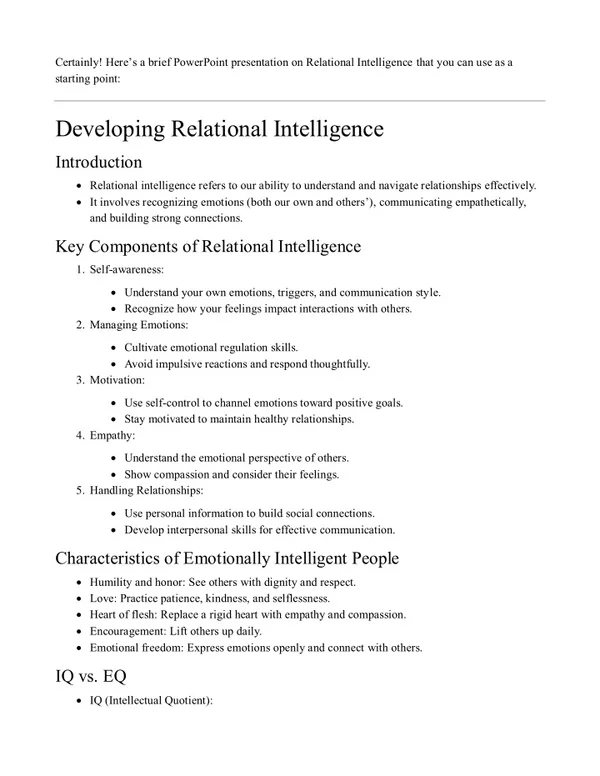
Certainly! Here’s abrief PowerPoint presentation on Relational Intelligencethat you can use as a starting point: Developing Relational Intelligence Introduction Relational intelligencerefers to our ability to understand and navigate relationships effectively. It involves recognizing emotions (both our own and others’), communicating empathetically, and building strong connections. Key Components of Relational Intelligence 1.Self-awareness: Understand your own emotions, triggers, and communication style. Recognize how your feelings impact interactions with others. 2.Managing Emotions: Cultivate emotional regulation skills. Avoid impulsive reactions and respond thoughtfully. 3.Motivation: Use self-control to channel emotions toward positive goals. Stay motivated to maintain healthy relationships. 4.Empathy: Understand the emotional perspective of others. Show compassion and consider their feelings. 5.Handling Relationships: Use personal information to build social connections. Develop interpersonal skills for effective communication. Characteristics of Emotionally Intelligent People Humility and honor: See others with dignity and respect. Love: Practice patience, kindness, and selflessness. Heart of flesh: Replace a rigid heart with empathy and compassion. Encouragement: Lift others up daily. Emotional freedom: Express emotions openly and connect with others. IQ vs. EQ IQ (Intellectual Quotient):
Fixed and peaks around age 17. Measures memory, vocabulary, and visual motor skills. Remains constant through adulthood. EQ (Emotional Quotient): Not fixed; can be improved throughout life. Predicts 90% of success for outstanding leaders. Focuses on emotional awareness, empathy, and relationship skills. Importance of Relational Intelligence EQis twice as important asIQfor success. Cultivating relational intelligence leads to better interactions, teamwork, and overall well-being. Implementation Become emotionally literate: Label your feelings and distinguish them from thoughts. Take responsibility for your emotions. Use emotions to make decisions and set goals. Practice empathy and compassion: Validate others’ feelings. Show respect and avoid invalidating behaviors. Stay emotionally energized: Connect through meaningful touches and emotional expression. Feel free to customize this presentation further to suit your specific needs. Good luck with your talk on relational intelligence! ? References: 1.Developing Relational Intelligence1 2.Emotional Intelligence2 1:Developing Relational Intelligence2:Emotional Intelligence Relational Intelligence (RQ)is a fascinating concept that delves into our ability to connect with others and establish trust. It goes beyond emotional intelligence (EQ) by focusing on how well we choose and maintain relationships in our lives. Let’s explore what it means and how you can enhance your own RQ. 1.What Is Relational Intelligence?
Relational Intelligence is our capacity to connect with others and build trust. It’s about understanding the purpose different relationships serve in our lives. While EQ helps us recognize and respond to emotional cues, RQ involves determining who should be in our lives, their roles, and how to manage those relationships1. 2.Why Is Relational Intelligence Important? In today’s rapidly evolving workplace, behavioral skills take precedence over technical skills. Relational Intelligence is a top competitive advantage for business success. As we become more connected digitally, finding genuine connections in the real world remains a challenge.RQ helps bridge that gap1. 3.How Can You Build Relational Intelligence? Start with genuine curiosity and deep listening. These are foundational to RQ. Consider the purpose of each relationship in your life. Reflect on whether someone should be part of it and what role they should occupy. Make non-judgmental observations about patterns and behaviors in your relationships. Divide your friendships into levels (e.g., close friends, acquaintances) to invest time and effort appropriately1. 4.Key Skills for Relational Intelligence: Making a Good First Impression: Understand how your initial interactions impact relationships. Drawing Others into the Conversation: Engage people and create connections. Finding Common Ground: Identify shared interests and build rapport. Utilizing Nonverbal Behaviors: Eye contact and body language play a crucial role. Being Curious and Deep Listening: These foster understanding and trust2. 5.Assessing Your Relational Intelligence: Evaluate the purpose and impact of each relationship. Determine if you’re investing time and effort wisely. Avoid relational wishy-washiness by being intentional about who you keep in your life3. Remember, strong RQ enhances your ability to connect, influence, and thrive in both personal and professional spheres.So, let curiosity guide you as you navigate the intricate web of human connections! ?13