AI Solution Design That Turns Data Into Action
AI Solution Design helps businesses turn ideas into intelligent systems through strategic planning, human-centric design, automation, and data-driven intelligence built for real-world impact.

AI Solution Design That Turns Data Into Action
E N D
Presentation Transcript
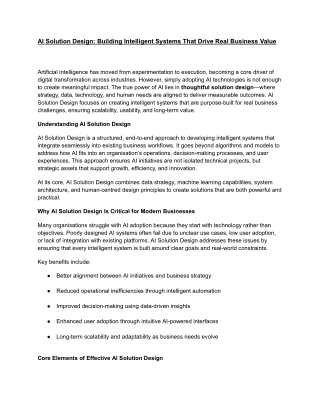
AI Solution Design: Building Intelligent Systems That Drive Real Business Value Artificial intelligence has moved from experimentation to execution, becoming a core driver of digital transformation across industries. However, simply adopting AI technologies is not enough to create meaningful impact. The true power of AI lies in thoughtful solution design—where strategy, data, technology, and human needs are aligned to deliver measurable outcomes. AI Solution Design focuses on creating intelligent systems that are purpose-built for real business challenges, ensuring scalability, usability, and long-term value. Understanding AI Solution Design AI Solution Design is a structured, end-to-end approach to developing intelligent systems that integrate seamlessly into existing business workflows. It goes beyond algorithms and models to address how AI fits into an organisation’s operations, decision-making processes, and user experiences. This approach ensures AI initiatives are not isolated technical projects, but strategic assets that support growth, efficiency, and innovation. At its core, AI Solution Design combines data strategy, machine learning capabilities, system architecture, and human-centred design principles to create solutions that are both powerful and practical. Why AI Solution Design Is Critical for Modern Businesses Many organisations struggle with AI adoption because they start with technology rather than objectives. Poorly designed AI systems often fail due to unclear use cases, low user adoption, or lack of integration with existing platforms. AI Solution Design addresses these issues by ensuring that every intelligent system is built around clear goals and real-world constraints. Key benefits include: ● Better alignment between AI initiatives and business strategy ● Reduced operational inefficiencies through intelligent automation ● Improved decision-making using data-driven insights ● Enhanced user adoption through intuitive AI-powered interfaces ● Long-term scalability and adaptability as business needs evolve Core Elements of Effective AI Solution Design
1. Strategic AI Planning Successful AI solutions begin with a deep understanding of business objectives. This stage involves identifying high-impact use cases, defining success metrics, and ensuring AI initiatives support broader organisational goals. Strategic planning prevents wasted investment and ensures AI delivers tangible value. 2. Data-First Architecture Data is the foundation of any AI system. AI Solution Design focuses on assessing data quality, availability, and governance while creating architectures that allow secure, scalable, and efficient data processing. Well-designed data pipelines enable AI models to learn continuously and deliver accurate insights. 3. Intelligent Automation Design AI-driven automation helps organisations eliminate repetitive manual tasks and optimise complex workflows. By embedding intelligence into processes such as document handling, forecasting, customer support, and operations, businesses can improve productivity while reducing errors and costs. 4. Human-Centric AI Experience AI systems must be understandable and accessible to users. Human-centric design ensures that AI tools enhance human capabilities rather than complicate workflows. Clear interfaces, transparent outputs, and explainable AI models help users trust and adopt intelligent systems with confidence. 5. Generative AI Capabilities Generative AI introduces new possibilities for content creation, ideation, analysis, and interaction. Thoughtfully designed generative AI solutions can support knowledge workers, streamline creative processes, and unlock new forms of innovation when aligned with business objectives. 6. AI-Driven Insights and Intelligence One of AI’s greatest strengths is its ability to transform large volumes of data into actionable insights. AI Solution Design enables predictive analytics, pattern recognition, and intelligent reporting that help organisations anticipate trends, manage risk, and make informed decisions faster. A Structured Approach to AI Solution Design Discover and Define
This phase focuses on understanding organisational challenges, stakeholder needs, and operational constraints. Clear problem definition ensures AI solutions are purpose-driven rather than experimental. Design and Prototype Wireframes, workflows, and AI models are designed with usability and performance in mind. Early prototyping allows teams to test assumptions and refine ideas before full-scale development. Build and Validate AI systems are developed, trained, and tested using real-world data. Validation ensures accuracy, reliability, fairness, and compliance with ethical standards. Deploy and Scale Once proven, AI solutions are deployed across the organisation with the infrastructure required for performance and scalability. Training and documentation support adoption across teams. Monitor and Evolve AI is not static. Continuous monitoring, optimisation, and retraining ensure systems remain effective as data, users, and business conditions change. Responsible and Ethical AI Design AI Solution Design also prioritises responsible AI practices. This includes data privacy, transparency, bias mitigation, and regulatory compliance. Ethical AI builds trust among users, customers, and stakeholders while reducing long-term risk. The Business Impact of Well-Designed AI Solutions When executed effectively, AI Solution Design delivers measurable outcomes such as: ● Faster decision-making and improved forecasting ● Lower operational costs through automation ● More personalised customer experiences ● Increased productivity across teams ● Greater agility in responding to market changes
Rather than replacing human expertise, well-designed AI systems amplify it—allowing organisations to focus on strategic, creative, and high-value activities. Conclusion AI Solution Design is the bridge between technological potential and real-world business impact. By combining strategic thinking, intelligent automation, data-driven insights, and human-centred design, organisations can unlock the full value of artificial intelligence. A carefully designed AI solution is not just a tool—it is a long-term capability that evolves alongside the business, driving sustainable innovation and competitive advantage. For more information visit: https://imobisoft.co.uk/services/ai-solution-design/