Download
1 / 5
0 likes | 1 Vues
Discover how cloud migration services help businesses enhance scalability, strengthen security, and improve operational efficiency. Learn how transitioning to the cloud builds a future-ready digital foundation that supports innovation, flexibility, and sustainable long-term business growth in an evolving digital environment.

E N D
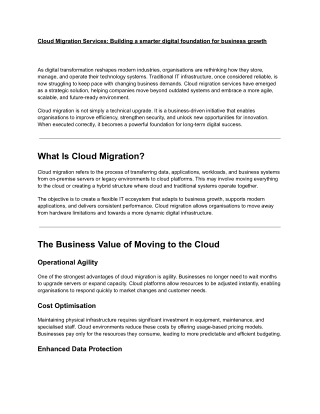
Cloud Migration Services: Building a smarter digital foundation for business growth As digital transformation reshapes modern industries, organisations are rethinking how they store, manage, and operate their technology systems. Traditional IT infrastructure, once considered reliable, is now struggling to keep pace with changing business demands. Cloud migration services have emerged as a strategic solution, helping companies move beyond outdated systems and embrace a more agile, scalable, and future-ready environment. Cloud migration is not simply a technical upgrade. It is a business-driven initiative that enables organisations to improve efficiency, strengthen security, and unlock new opportunities for innovation. When executed correctly, it becomes a powerful foundation for long-term digital success. What Is Cloud Migration? Cloud migration refers to the process of transferring data, applications, workloads, and business systems from on-premise servers or legacy environments to cloud platforms. This may involve moving everything to the cloud or creating a hybrid structure where cloud and traditional systems operate together. The objective is to create a flexible IT ecosystem that adapts to business growth, supports modern applications, and delivers consistent performance. Cloud migration allows organisations to move away from hardware limitations and towards a more dynamic digital infrastructure. The Business Value of Moving to the Cloud Operational Agility One of the strongest advantages of cloud migration is agility. Businesses no longer need to wait months to upgrade servers or expand capacity. Cloud platforms allow resources to be adjusted instantly, enabling organisations to respond quickly to market changes and customer needs. Cost Optimisation Maintaining physical infrastructure requires significant investment in equipment, maintenance, and specialised staff. Cloud environments reduce these costs by offering usage-based pricing models. Businesses pay only for the resources they consume, leading to more predictable and efficient budgeting. Enhanced Data Protection
Modern cloud platforms are built with advanced security frameworks, including encryption, access management, and continuous monitoring. These measures help protect sensitive business data from cyber threats, accidental loss, and system failures. Remote Accessibility With cloud systems, employees can securely access business tools and data from any location. This supports remote work, global collaboration, and flexible operating models, which are now essential in modern business environments. Support for Innovation Cloud infrastructure enables access to advanced digital tools such as artificial intelligence, analytics platforms, and automation systems. These technologies empower businesses to experiment, innovate, and develop smarter digital products and services. Types of Cloud Migration Approaches Every organisation has unique requirements, and cloud migration strategies are designed accordingly. Common approaches include: Rehosting (Lift and Shift) This involves moving applications and data to the cloud without major changes. It is often chosen for speed and simplicity. Refactoring Applications are redesigned to take full advantage of cloud capabilities. This approach offers long-term performance benefits but requires more planning. Replatforming Minor modifications are made to applications before migration to improve compatibility and efficiency. Hybrid Migration Some systems remain on-premise while others move to the cloud. This is useful for organisations with regulatory or operational constraints. Selecting the right approach depends on business goals, technical readiness, and long-term strategy.
A Structured Cloud Migration Process Successful cloud migration relies on a well-defined methodology that reduces risks and ensures continuity. 1. Discovery and Evaluation The first step is analysing existing infrastructure, applications, and data flows. This helps identify dependencies, risks, and opportunities for optimisation. 2. Strategic Planning A detailed migration roadmap is created, outlining timelines, priorities, and performance targets. Security, compliance, and scalability requirements are addressed at this stage. 3. Environment Preparation Cloud environments are configured to match business needs. This includes setting up networks, access controls, backup systems, and monitoring tools. 4. Data and Application Transfer Data and systems are transferred in stages to minimise disruption. Testing ensures that performance and functionality remain consistent. 5. Validation and Testing After migration, systems are rigorously tested for security, reliability, and usability. Any issues are resolved before full deployment. 6. Ongoing Optimisation Post-migration support focuses on improving efficiency, managing costs, and implementing advanced cloud features for continued growth. Common Challenges in Cloud Migration Although cloud migration offers many benefits, it also presents challenges that require careful management. Data Complexity
Large volumes of data and interconnected systems can make migration technically demanding. Proper planning is essential to avoid data loss or corruption. Legacy System Compatibility Older applications may not integrate easily with modern cloud platforms. Some may require redevelopment or replacement. Cost Management Without proper monitoring, cloud usage costs can increase unexpectedly. Transparent governance and optimisation tools help control spending. Security Configuration While cloud platforms are secure, misconfigured settings can expose vulnerabilities. Security must be built into every stage of migration. Change Management Employees need training and support to adapt to new systems. Successful migration includes preparing teams for digital transformation. Why Professional Cloud Migration Services Matter Cloud migration is a complex initiative that combines technical expertise, business strategy, and risk management. Professional cloud migration services provide: ● Expert assessment of existing systems Customised migration strategies Secure data handling practices Minimal operational disruption Ongoing technical support Performance optimisation ● ● ● ● ● With experienced specialists guiding the process, businesses can avoid costly mistakes and maximise return on investment.
The Role of Cloud in Future-Ready Organisations Cloud technology continues to evolve, becoming the backbone of digital enterprises. Businesses that migrate successfully position themselves to adopt emerging technologies, improve customer experiences, and remain competitive in fast-changing markets. Cloud environments support scalable digital platforms, intelligent automation, and data-driven decision-making. They enable organisations to move from reactive operations to proactive innovation. Conclusion Cloud migration services provide far more than infrastructure upgrades. They enable businesses to modernise operations, enhance security, reduce costs, and accelerate innovation. By moving to the cloud, organisations gain the flexibility and resilience required to thrive in today’s digital economy. A structured, well-planned migration strategy—supported by professional expertise—ensures that businesses can transition smoothly and confidently. As technology continues to advance, cloud migration remains a critical step in building a sustainable, future-focused digital foundation. FOR MORE INFORMATION VISIT: https://imobisoft.co.uk/services/cloud-migration-services/