From data to decisions: Advanced LLM and generative AI development
0 likes | 1 Vues
LLM and Generative AI development enables businesses to build intelligent systems that understand context, generate insights, and evolve with data. Discover how custom AI models drive smarter automation, decision-making, and innovation.


From data to decisions: Advanced LLM and generative AI development
E N D
Presentation Transcript
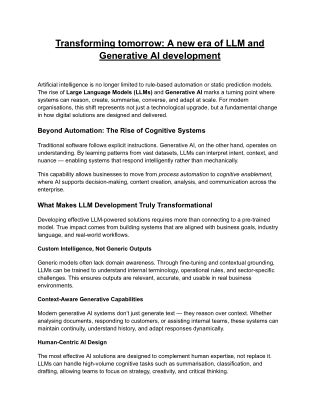
Transforming tomorrow: A new era of LLM and Generative AI development Artificial intelligence is no longer limited to rule-based automation or static prediction models. The rise of Large Language Models (LLMs) and Generative AI marks a turning point where systems can reason, create, summarise, converse, and adapt at scale. For modern organisations, this shift represents not just a technological upgrade, but a fundamental change in how digital solutions are designed and delivered. Beyond Automation: The Rise of Cognitive Systems Traditional software follows explicit instructions. Generative AI, on the other hand, operates on understanding. By learning patterns from vast datasets, LLMs can interpret intent, context, and nuance — enabling systems that respond intelligently rather than mechanically. This capability allows businesses to move from process automation to cognitive enablement, where AI supports decision-making, content creation, analysis, and communication across the enterprise. What Makes LLM Development Truly Transformational Developing effective LLM-powered solutions requires more than connecting to a pre-trained model. True impact comes from building systems that are aligned with business goals, industry language, and real-world workflows. Custom Intelligence, Not Generic Outputs Generic models often lack domain awareness. Through fine-tuning and contextual grounding, LLMs can be trained to understand internal terminology, operational rules, and sector-specific challenges. This ensures outputs are relevant, accurate, and usable in real business environments. Context-Aware Generative Capabilities Modern generative AI systems don’t just generate text — they reason over context. Whether analysing documents, responding to customers, or assisting internal teams, these systems can maintain continuity, understand history, and adapt responses dynamically. Human-Centric AI Design The most effective AI solutions are designed to complement human expertise, not replace it. LLMs can handle high-volume cognitive tasks such as summarisation, classification, and drafting, allowing teams to focus on strategy, creativity, and critical thinking.
Embedding Generative AI into Business Operations Successful LLM implementation focuses on seamless integration. Rather than operating as standalone tools, AI models are embedded directly into business systems such as internal platforms, operational dashboards, and communication channels. This approach ensures: ● Faster access to insights ● Reduced friction in daily workflows ● Consistent and scalable decision support When AI becomes part of the workflow, its value compounds across teams and departments. Responsible, Secure, and Scalable AI Systems As generative AI takes on a greater role in business processes, responsibility becomes critical. Enterprise-grade LLM development prioritises: ● Data privacy and security to protect sensitive information ● Bias detection and mitigation to ensure fair outputs ● Explainability and transparency for informed decision-making ● Model governance to maintain control as systems evolve Responsible AI isn’t an afterthought — it’s a foundation for long-term success. From Concept to Continuous Evolution LLM and generative AI development is not a one-time deployment. It follows an iterative lifecycle: 1. Exploration and strategy definition to identify high-impact use cases 2. Solution design aligned with technical feasibility and business value 3. Model development and validation in real-world scenarios
4. Deployment and adoption with user enablement 5. Ongoing optimisation through monitoring, feedback, and retraining This continuous evolution ensures AI systems remain accurate, relevant, and aligned with changing business needs. The Future of Generative AI in Enterprise Solutions The next generation of LLM-driven systems will be more collaborative, multi-modal, and autonomous. These systems will synthesise text, data, and reasoning to support complex tasks such as strategic planning, knowledge discovery, and intelligent automation across entire organisations. Businesses that invest today in tailored, responsible generative AI development are not just adopting a new technology — they are building the foundation for smarter, faster, and more adaptive digital operations. Conclusion LLM and generative AI development represents a shift from software that executes instructions to systems that understand intent and generate value. When designed with purpose, security, and scalability in mind, these intelligent solutions become powerful enablers of innovation, efficiency, and growth — shaping the future of how organisations think, work, and compete. For more information visit: https://imobisoft.co.uk/services/llm-generative-ai-development/