

Order a Coffee C1
E N D
Presentation Transcript
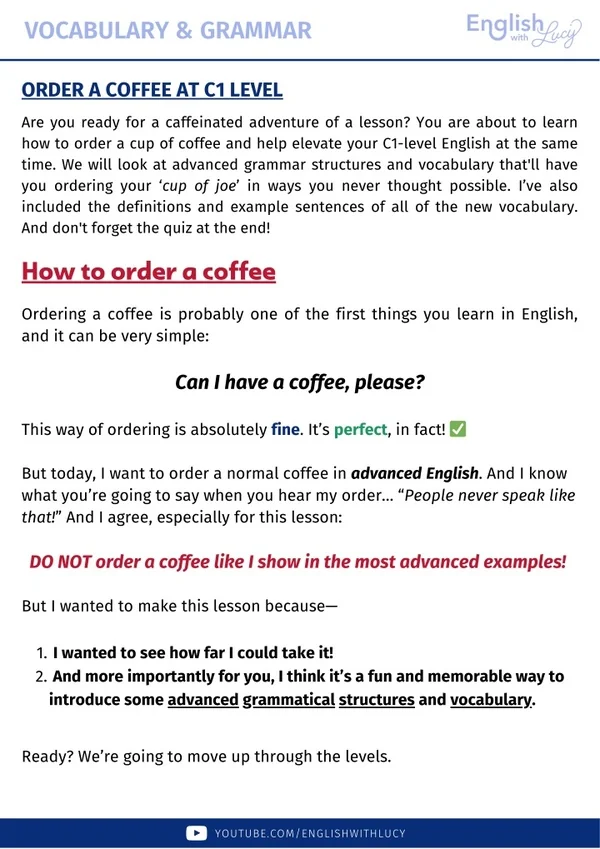
VOCABULARY & GRAMMAR © ORDER A COFFEE AT C1 LEVEL Are you ready for a caffeinated adventure of a lesson? You are about to learn how to order a cup of coffee and help elevate your C1-level English at the same time. We will look at advanced grammar structures and vocabulary that'll have you ordering your ‘cup of joe’ in ways you never thought possible. I’ve also included the definitions and example sentences of all of the new vocabulary. And don't forget the quiz at the end! How to order a coffee Ordering a coffee is probably one of the first things you learn in English, and it can be very simple: Can I have a coffee, please? This way of ordering is absolutely fine. It’s perfect, in fact! ✅ But today, I want to order a normal coffee in advancedEnglish. And I know what you’re going to say when you hear my order… “People never speak like that!” And I agree, especially for this lesson: DO NOT order a coffee like I show in the most advanced examples! But I wanted to make this lesson because— 1. 2. I wanted to see how far I could take it! And more importantly for you, I think it’s a fun and memorable way to introduce some advanced grammatical structures and vocabulary. Ready? We’re going to move up through the levels. YOUTUBE.COM/ENGLISHWITHLUCY
VOCABULARY & GRAMMAR © LEVEL 1 Black coffee, please. This is the simplest way to order a coffee. It’s perhaps not the most polite way to order in a coffee shop, but if you’re ordering as part of a group, after dinner, for example, I think it’s fine. The addition of ‘please’ at the end is important. LEVEL 2 Can I have a black coffee, please? Here, the request is formulated as a question using the modal verb ‘can’, which makes it more polite than the first one. You will often hear this said as— Can I get a black coffee, please? This is more common in American English, but it’s making its way into British English. Some people don’t like the use of ‘get’ here, but a lot of native speakers use it. LEVEL 3 May I please have a black coffee with a splash of milk? We’re getting a little more complex now. This is a very polite way to order a coffee using the modal verb ‘May’. You can also replace ‘may’ with the modal verb ‘could’, which is a more polite way to make requests than ‘can’. YOUTUBE.COM/ENGLISHWITHLUCY
VOCABULARY & GRAMMAR © You can also see that the word ‘please’ has moved from the end to directly after ‘May I’. This front-loading of ‘please’ emphasises the politeness of the request and sets a formal tone from the outset. We are also now asking for ‘a splash of milk’ — splashn/splæʃ/ - a small amount Rather than drowning the salad in dressing, Geraldine opted for a modest splash of balsamic vinegar. LEVEL 4 Could you kindly prepare a black coffee with a splash of milk and two sugars? OK, we’re getting closer to an advanced level (and further from reality) now. We have the modal verb ‘Could’, which I talked about in the third example. And instead of ‘please’, we can see the adverb ‘kindly’. This is another way to soften a request and make it more polite. LEVEL 5 Would it be possible for you to brew a medium-sized black coffee with a splash of milk, two sugars and a sprinkling of cinnamon on top? Alright, this one is even more polite and a bit poetic as well. ‘Would it be possible...’ is a very polite way to form a question. We also have some more advanced vocabulary, including— YOUTUBE.COM/ENGLISHWITHLUCY
VOCABULARY & GRAMMAR © to brew v/bruː/ - to make a hot drink like coffee or tea Emily took great care brewing her pot of exotic oolong tea. sprinkling /ˈsprɪŋklɪŋ/ - a small amount of liquid or powder that is dropped onto a surface The recipe called for a sprinkling of cocoa powder atop the cappuccino foam. LEVEL 6 If it's not too much trouble, could you please craft a medium-sized black coffee, enriched with a splash of organic milk and precisely two cubes of raw sugar, while ensuring it's brewed to the optimum temperature, and then garnish it with a delicate sprinkling of cinnamon on top? We’re moving into nightmarecustomer territory now. ‘If it’s not too much trouble...’ is a very polite way of asking someone to do something; we often add it to the beginning of a request. Now we’re asking for the barista ‘to craft’ the coffee - to craft v/krɑːft/ - to make objects in a skilled way, especially with your hands Drawing from ancient techniques, the master glassblower crafted a series of delicate ornaments that shimmered in the sunlight. And the coffee is to be ‘enriched’ with a splash of milk— YOUTUBE.COM/ENGLISHWITHLUCY
VOCABULARY & GRAMMAR © to enrichv /ɪnˈrɪtʃ/ - means to make the quality of something better by adding something else To enrich the soil and promote healthy plant growth, the gardener incorporated well-rotted compost into the flower beds. Then, it is to be brewed to the optimum temperature - optimum adj /ˈɒptɪməm/ - the best possible In wine-making, choosing the optimum moment to harvest the grapes is crucial for capturing the desired flavour profile. You might hear the synonym ‘optimal’ /ˈɒptɪməl/ used in American English. LEVEL 7 Would you be so kind as to commence the artisanal preparation of a medium-sized black coffee, sourced, if possible, from single-origin beans and brewed at precisely 89 degrees Celsius? It should be complemented with a splash of organic, locally sourced milk, sweetened to a modest degree with exactly two cubes of raw sugar and adorned with a subtle yet discernible sprinkling of hand-ground cinnamon. Finally, I request that it be presented in a ceramic mug featuring a handle ergonomically designed for a right- handed individual. Someone is definitely going to spit in this customer’s coffee. Let’s look at the grammar: ‘Would you be so kind as to...’ is a very, very polite and formal way to make a request. And in the final sentence, you saw YOUTUBE.COM/ENGLISHWITHLUCY
VOCABULARY & GRAMMAR © the structure ‘I request that it be presented’. This sentence uses the subjunctivemood, which is a formal structure in English and appears after certain verbs, like ‘request’. And the vocabulary: tocommence v /kəˈmens/ - to begin The university's academic year will commence with an orientation week designed to familiarise new students with campus life. artisanal adj /ɑːˈtɪzənl/ - prepared in a traditional way The resurgence of artisanal crafts is perceived as a response to the overabundance of mass-produced items. to complement v /ˈkɒmplɪment/ - to go well with another thing and make it better Our interior designer chose muted earth tones to complement the natural light pouring in through the large windows. to adorn v /əˈdɔːn/ - to add something decorative to a person or thing to make it more attractive To mark the festive season, the town square was adorned with strings of fairy lights and elaborate wreaths. subtleadj /ˈsʌtl/ - not obvious or noticeable The aroma of the dish was subtle, featuring delicate notes of saffron and thyme that enhanced the dish without overwhelming it. discernibleadj /dɪˈsɜːnəblable/ - to be recognised Though the renovations were minor, they had a discernible impact on the overall aesthetic of the room. YOUTUBE.COM/ENGLISHWITHLUCY
VOCABULARY & GRAMMAR © And finally, perhaps the most egregious request: an ergonomically designed handle— Lucy’s Note egregious = extremely bad in a noticeable way ergonomically adj /ˌɜːɡəˈnɒmɪkli/ - in a way that makes something, often equipment or furniture, comfortable and effective for people who use it The new gym equipment is ergonomically superior and allows users to maximise their output. YOUTUBE.COM/ENGLISHWITHLUCY
VOCABULARY & GRAMMAR © QUIZ! Choose the correct answer for each question. 1) Excuse me, __________ you be so kind as to pass the salt? 6) Which of the following is a very polite way to make a request? a. do b. would c. may a. Get me a serviette. b. Would you be so kind as to get me serviette? c. Can you get me a serviette? 2) What is an 'optimum' temperature? 7) Which of these is a subtle sound? a. the lowest possible b. the best possible c. the highest possible a. a siren blaring b. a cat purring c. a baby crying 3) “I request that it be presented..." is an example of which grammatical mood? 8) What might you adorn a Christmas tree with? a. indicative b. imperative c. subjunctive a. ornaments and lights b. fruits and vegetables c. cleaning supplies 4) The wine we have chosen __________ the meal perfectly. 9) The ceremony will __________ at noon. a. complements b. supplements c. discerns a. comments b. commence c. complements 5) __________ I have another cup of tea, please? 10) My life has been greatly ________ by my friendship with Sarah. a. Shall b. Must c. May a. enriched b. garnished c. adorned The End! 1) b 2) b 3) c 4) a 5) b 6) b 7) b 8) a 9) b 10) a YOUTUBE.COM/ENGLISHWITHLUCY