Building Earthquake-Resistant Structures Guide - Top 5 Methods
The study of structural and earthquake engineering uses advanced engineering and management technologies to improve the seismic flexibility of civil structures and vital infrastructure. While natural forces are highly beneficial to humans, natural disasters such as hurricanes, earthquakes, and tsunamis can cause devastation, putting lives and infrastructure worth billions of dollars at risk. Civil Engineering Companies in Pakistan use some prevention methods to avoid all types of circumstances to save people.<br>

Building Earthquake-Resistant Structures Guide - Top 5 Methods
E N D
Presentation Transcript
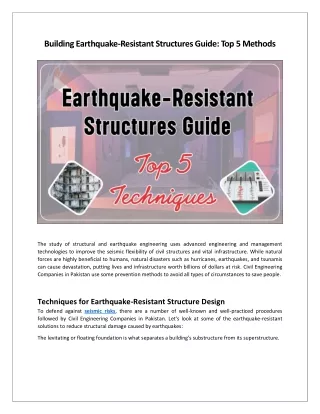
Building Earthquake-Resistant Structures Guide: Top 5 Methods The study of structural and earthquake engineering uses advanced engineering and management technologies to improve the seismic flexibility of civil structures and vital infrastructure. While natural forces are highly beneficial to humans, natural disasters such as hurricanes, earthquakes, and tsunamis can cause devastation, putting lives and infrastructure worth billions of dollars at risk. Civil Engineering Companies in Pakistan use some prevention methods to avoid all types of circumstances to save people. Techniques for Earthquake-Resistant Structure Design To defend against seismic risks, there are a number of well-known and well-practiced procedures followed by Civil Engineering Companies in Pakistan. Let's look at some of the earthquake-resistant solutions to reduce structural damage caused by earthquakes: The levitating or floating foundation is what separates a building's substructure from its superstructure.
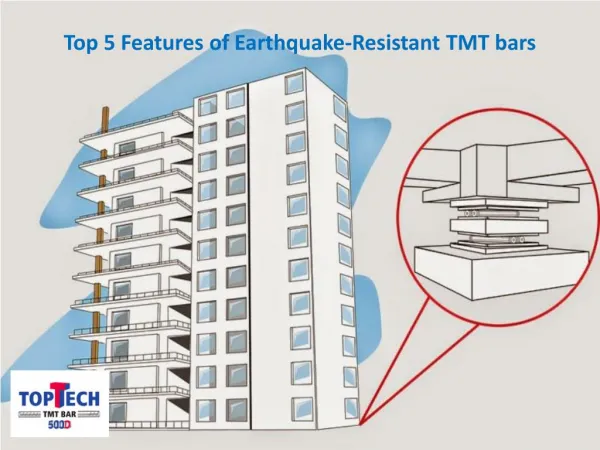
Floating Foundation: One method is to float a structure above its foundation on lead-rubber bearings, which are made up of a solid lead core with alternating layers of rubber and steel. Steel plates are used to join the bearings to the building and its foundation. As a result, if there is an earthquake, the floating foundation can shift without causing damage to the structure above it. Civil Engineering Companies in Pakistanuse this method in office, hospital and high building to prevent structural damage and save lives. This base separation concept is taken to a whole new level in Japan. Buildings can float in mid-air thanks to their design. The system levitates the structure, keeping it on an air cushion. Sensors installed into the system detect seismic activity and communicate with the air compressor that forms the air layer between the building and its foundation. Shock Absorption: Similar to the shock absorbers found in automobiles, structures employ this technology. This earthquake- resistant technology aids in the slowing down and reduction of the magnitude of vibratory vibrations in buildings. Shock absorbers should ideally be installed at each level of the structure, with one end attached to the beam and the other to the column. Each consists of a piston head that operates inside a silicone oil-filled cylinder. The horizontal motion of the building during an earthquake causes the piston to push against the oil, converting mechanical energy from the quake to heat. Rocking Core-Wall: Civil Engineering Companies in Pakistan in modern high-rise buildings use the rocking core-wall technology to improve seismic protection at a reasonable cost. A reinforced concrete core is established through the heart of the structure, encircled by elevator banks, to make this work. This approach is used in many modern high-rise structures to boost seismic resilience in a cost-effective manner. When used in conjunction with base isolation, it is most successful. Elastomeric bearings use alternating layers of steel and natural rubber/neoprene for base isolation. The resulting bearing has a low horizontal stiffness and a high vertical rigidity. The combination is highly effective, cost-efficient, and easy to use. Pendulum Power: This approach works by suspending a massive mass near the structure's top. Steel cables support the mass, and viscous fluid dampers are installed between the mass and the structure it protects. In the event of seismic activity, the pendulum swings in the opposite direction to restore equilibrium. These systems are known as tuned mas dampers because each of the pendulums is tuned to match the structure's inherent frequency. Their purpose is to diminish the dynamic response of the structure by counteracting resonance.
Symmetry, Diaphragms, and Cross-Bracing: Symmetry is a typical criterion used in seismic design. Asymmetrical designs have a higher seismic risk. Although L-shaped, T-shaped, and split-level constructions are more visually pleasing, they are also more susceptible to torsion. As a result, engineers create symmetrical buildings to ensure that forces are distributed evenly throughout the structure and to keep aesthetic aspects such as cornices and cantilever projections to a minimum. A considerable lateral force is produced by an earthquake. In both horizontal and vertical structural systems, seismic design counteracts these stresses. Diaphragms are essential components of horizontal constructions such as building floors and roofs. Civil Engineering Companies in Pakistan create each diaphragm on its own deck and reinforce it horizontally to transfer sideways forces with vertical construction sections. Engineers have various options when it comes to vertical constructions. Braced frames are frequently utilized in the construction of walls. Trusses are used to prevent sideways movement in braced frames. Cross-bracing is a popular technique for building earthquake-resistant structures that uses two diagonal elements in an X-shape to form wall trusses. Finally Seismic engineering is a difficult and ever-changing field. Seismic structural evaluation is a powerful method in Earthquake Engineering that combines thorough modelling of the structure with structural analysis to determine the building's resistance to earthquakes. It's just as necessary to upgrade older structures with better designs or materials as it is to build new structures from the ground up. Civil Engineering Companies in Pakistan purpose is to preserve lives by preventing buildings from collapsing and allowing residents to flee in a timely way. More Articles