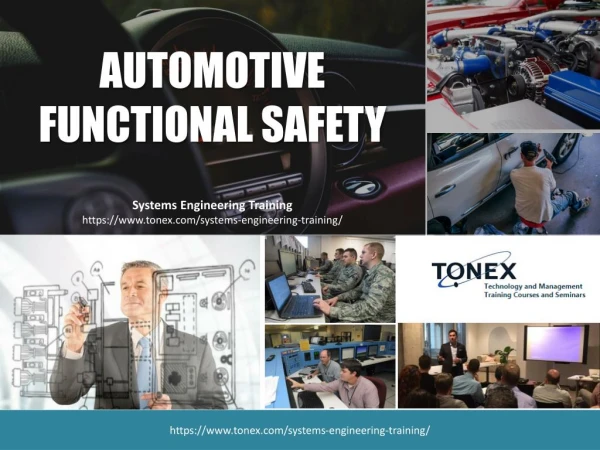
functional safety management system
The Ensuring vehicle safety and compliance has never been more critical. Omnex Systemu2019s Functional Safety Management System (FSMS) provides automotive manufacturers and suppliers with a comprehensive, integrated platform to manage functional safety across the entire product lifecycle. From hazard analysis and risk assessment to ASIL assignments, safety goals, and verification activities, the system ensures full traceability and regulatory compliance with ISO 26262 and related standards.<br>For more info visit us https://www.omnexsystems.com/products/functional-safety-software


functional safety management system
E N D
Presentation Transcript
How Omnex System’s Functional Safety Management System Ensures Compliance and Reliability in Automotive Development The evolving automotive industry, especially with the rise of electric vehicles (EVs) and autonomous vehicles (AVs), ensuring functional safety is no longer optional—it is mission- critical. Vehicle safety, reliability, and compliance are paramount not only for meeting regulatory standards but also for maintaining brand trust and consumer confidence. Omnex System’s Functional Safety Management System (FSMS) offers a comprehensive, integrated approach to manage functional safety throughout the product development lifecycle, enabling organizations to meet ISO 26262 requirements efficiently while accelerating time-to- market. Understanding Functional Safety in Automotive Functional safety refers to the absence of unreasonable risk caused by malfunctioning electrical, electronic, or software systems in vehicles. Standards like ISO 26262 define the framework for achieving functional safety in automotive development. Compliance involves several stages including hazard analysis, risk assessment, safety goal definition, functional and technical safety concepts, and verification and validation of all safety requirements. Managing functional safety manually or across disconnected tools is error-prone and time- consuming. This is where Omnex System’s FSMS steps in, providing a centralized, automated, and traceable platform that connects safety activities to the broader product development process.
Key Challenges in Automotive Functional Safety Automotive manufacturers face several challenges in functional safety implementation: 1.Complexity of Modern Vehicle Systems– Modern vehicles integrate advanced driver assistance systems (ADAS), autonomous navigation, EV powertrains, and connected technologies, creating complex dependencies between hardware and software. 2.Compliance with Global Standards– ISO 26262, Automotive SPICE, and other regional or industry-specific standards must be adhered to for both regulatory and contractual reasons. 3.Traceability Across Development Phases– Linking hazards, safety goals, functional and technical safety requirements, and verification activities is essential but difficult with siloed tools. 4.Efficient Risk Management– Identifying and mitigating risks early in design reduces costly late-stage redesigns and improves product reliability. Omnex System’s FSMS addresses all these challenges through a single, integrated software platform that ensures compliance, traceability, and operational efficiency. Features of Omnex System’s Functional Safety Management System 1. Integrated Safety Workflow Management Omnex System FSMS connects Item Definitions, Hazard Analysis and Risk Assessment (HARA), Safety Goals, Technical Safety Concepts, and Hardware-Software Interfaces in a unified platform. This allows safety engineers to monitor the entire functional safety lifecycle without switching between multiple tools or manual spreadsheets. 2. Automated Traceability and Version Control
The software maintains forward and backward traceability of all safety artifacts. Changes in hazard analysis automatically propagate to safety goals and functional safety requirements, ensuring no critical safety aspect is overlooked. Version control provides a clear history of modifications, supporting audits and regulatory compliance. 3. Support for ISO 26262 and Other Standards Omnex System FSMS is aligned with ISO 26262 and supports integration with other frameworks such as Automotive SPICE, SOTIF (Safety of the Intended Functionality), and cybersecurity standards. This allows organizations to meet industry regulations and customer requirements efficiently. 4. Risk Analysis and ASIL Management Automotive Safety Integrity Levels (ASILs) are critical in classifying risks. Omnex FSMS allows engineers to assign ASIL ratings, track them across the lifecycle, and link them to verification tests. Failure Modes, Effects, and Diagnostic Analysis (FMEDA) and Fault Tree Analysis (FTA) are integrated, helping teams identify and mitigate high-risk components early. 5. Real-Time Dashboards and Analytics The platform provides visual dashboards for monitoring safety activities, testing status, and compliance metrics. Decision-makers can quickly identify bottlenecks, track progress, and ensure safety requirements are implemented accurately. 6. Collaboration and Reusability Omnex FSMS enables cross-functional collaboration between design, software, hardware, and safety teams. Components, hazards, and safety requirements can be reused across similar vehicle projects, reducing duplication and accelerating development timelines. Implementation of Functional Safety Management with Omnex System Implementing functional safety in automotive development requires a Functional Safety Management System. Omnex System FSMS supports organizations at every stage: Step 1: Defining the Item and Scope The first step is to define the vehicle system, software modules, or hardware components under consideration. Omnex FSMS allows teams to capture Item Definitions that include boundaries, operational context, and system interfaces. Step 2: Hazard Analysis and Risk Assessment (HARA) Using Omnex FSMS, engineers perform hazard identification and risk assessment efficiently. Hazards are evaluated based on severity, exposure, and controllability, leading to a formal risk classification. The system links hazards directly to Safety Goals for clear accountability.
Step 3: Functional and Technical Safety Concepts Once safety goals are defined, Omnex FSMS supports creation of Functional Safety Concepts (FSC) and Technical Safety Concepts (TSC). Functional requirements are linked to system architecture, while technical requirements specify the necessary design and control measures. Step 4: ASIL Assignment and Risk Mitigation Omnex FSMS provides tools for assigning Automotive Safety Integrity Levels (ASILs) to hazards and requirements. Engineers can simulate failure scenarios, perform FMEDA and FTA, and implement mitigation strategies. The software automatically updates all linked documents, maintaining consistency. Step 5: Verification and Validation Verification and validation activities are critical for functional safety. Omnex FSMS tracks test plans, verification results, and compliance with ASIL requirements. Dashboards display real-time status, ensuring that safety requirements are fully tested before release. Step 6: Documentation and Audit Readiness Every action, change, and decision is version-controlled and traceable within Omnex FSMS. Documentation for audits, ISO 26262 certification, or customer reviews can be generated automatically, significantly reducing administrative overhead. Benefits of Using Omnex System FSMS 1.Regulatory Compliance– Full alignment with ISO 26262 and related standards ensures that vehicles meet legal and contractual requirements. 2.Reduced Development Time– Reusable safety artifacts and integrated workflows accelerate product development. 3.Improved Safety and Reliability– Early identification of hazards and consistent risk management enhance vehicle safety. 4.Enhanced Collaboration– Cross-functional teams can work seamlessly, reducing errors and miscommunication. 5.Audit-Ready Documentation– Every safety artifact is traceable, versioned, and ready for certification audits. 6.Cost Savings– By preventing late-stage rework and reducing compliance errors, organizations save significant time and resources.
Real-World Applications Omnex System FSMS has been deployed by automotive OEMs and Tier-1 suppliers to manage functional safety in: Electric Vehicle Platforms– Ensuring battery management systems, power electronics, and charging modules meet functional safety standards. Autonomous Driving Systems– Managing sensor fusion, braking, steering, and ADAS components with traceable hazard mitigation. Connected Vehicles– Integrating cybersecurity considerations alongside functional safety requirements. Medical-Grade Automotive Systems– Supporting ISO 13485 compliance in safety- critical automotive devices. Why Choose Omnex System FSMS Unlike traditional tools or spreadsheets, Omnex System FSMS offers a centralized, intelligent, and standards-compliant solution for functional safety management. It reduces human error, ensures real-time traceability, and enables faster decision-making. The software’s integration with APQP, PPAP, and FMEA further strengthens its capability to link functional safety to overall product quality, making it a complete solution for modern automotive development. Conclusion In the current automotive landscape, functional safety is essential for compliance, reliability, and customer trust. Omnex System’s Functional Safety Management System offers a comprehensive solution to manage hazards, safety goals, ASILs, and verification activities throughout the product lifecycle. Its integrated workflows, automated traceability, dashboards, and reusable components empower organizations to achieve regulatory compliance, reduce development time, improve safety, and streamline audits. For more info Contact Us : (734) 761-4940 or send mail : info@omnexsystems.com to get a quote