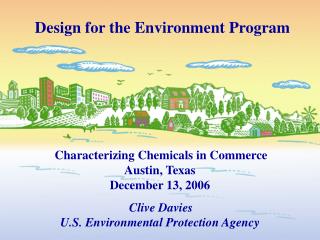
Design for the Environment Program
Design for the Environment Program. Characterizing Chemicals in Commerce Austin, Texas December 13, 2006 Clive Davies U.S. Environmental Protection Agency. Design for the Environment Program (EPA/OPPT). Focus Industry sectors using chemicals of concern Informed Substitution Methods

Design for the Environment Program
E N D
Presentation Transcript
Design for the Environment Program Characterizing Chemicals in CommerceAustin, TexasDecember 13, 2006 Clive DaviesU.S. Environmental Protection Agency
Design for the Environment Program (EPA/OPPT) • Focus • Industry sectors using chemicals of concern • Informed Substitution • Methods • OPPT technical tools and expertise are unique • Business “client” is often a driver • Multi-stakeholder participation is critical • Considerations • Business realities factor in • Potential benefits for industry and the environment
DfE Alternatives Assessments – Chemical Focus Furniture Flame Retardancy Partnership Electronics Partnerships Printed Circuit Boards Computer Monitors Lead-Free Solder Wire & Cable DfE Formulator Program – Product Focus Recognizing Safer Formulations Safer Detergents Stewardship Initiative DfE Best Practices Auto Refinishing DfE Partnerships
Informed Substitution • Considered transition from a chemical of particular concern to safer chemicals or non-chemical alternatives • May result in… • Cleaner production • Development or use of non-chemical technologies
Goals of Informed Substitution • Minimize the likelihood of unintended consequences • DfE Furniture Flame Retardancy Partnership • Choose a course of action based on the best information available or modeled
Alternatives Identified Through Informed Substitution • Considered transition • Must be technologically feasible • Deliver similar or better value in cost and performance • Provide an improved profile for health and environmental issues • Have potential to result in lasting change • Public data sources provide valuable information on alternatives • HPV data • Data submitted under the Inventory Update Rule (IUR) • EPA estimation models (Sustainable Futures)
DfE Alternatives AssessmentFurniture Flame Retardancy Partnership (Completed) • Predominant flame retardant (pentaBDE) was being found increasingly in human tissue, breast milk and the environment. • This flame retardant was phased-out at the end of 2004. • Need for fire safety will likely increase based on planned national standards. • Report provides data to inform industry. • Decision-making for alternatives to this 19 million pound per year chemical. • The Report • Summary assessments of chemicals in flame retardant formulations. • Tables summarizing EPA assessment for environmental and human health endpoints. • Detailed hazard reviews.
DfE Alternatives AssessmentFlame Retardants Partnership Report Ecotoxicity Hazard Concern Environmental Hazard Concern Human Health Hazard Concern Potential Exposure • Chart is valued by industry as a decision-making tool
DfE Alternatives Assessment Flame Retardants in Printed Circuit Boards • Goal: To identify and characterize commercially available flame retardants and their environmental, health, safety and environmental fate aspects in FR-4 printed circuit boards. • Apply life-cycle thinking to consider hazards and exposures. • Evaluate hazard and environmental fate concerns through: • EPA New Chemicals Program and/or • Globally Harmonized System Classification criteria
DfE Alternatives Assessment Flame Retardants in Printed Circuit Boards • Tetrabromobisphenol A (TBBPA) • Highest volume brominated flame retardant (~ 330 million pounds/year ) • Primary FR in printed circuit boards • Industry need for information on flame retardants • Concern by some stakeholders over environmental impacts and combustion by-products
Continuum of Improvement Formula Ingredient by Use Class Sustainable Improved Of Concern Characteristics of Sustainable Ingredient Characteristics of Improved Ingredient Characteristics of Ingredient of Concern DfE Formulator Program • Recognizes chemical formulations that are safer than other products in their class • Floor and carpet care products • Laundry detergents • Holding tank treatments • Surface finishes • Conversion Coatings • Program Focus • First-time innovations • Market leaders • Making Formulator information more broadly available • CleanGredients • SDSI
CleanGredientsSupporting Informed Substitution for Cleaning Products • Multi–stakeholder coalition, with over 500 participants • Identify key characteristics of detergent ingredients – for each functional class • Product formulator could choose “recognition worthy” ingredients • Used HPV data to add to the number of listed surfactants Need new screenshot
DfE Formulator ProgramThe Safer Detergents Stewardship Initiative - SDSI • Recognition for companies that lead change • Encourages environmental stewardship programs • Drives the use of safer surfactants • Why safer surfactants? • Surfactants are used widely in detergents • One class of surfactants – NPEs – degrades to more toxic compounds • Safer, cost-effective alternatives are available • SDSI complements the ambient water quality criteria (AWQC) for NP and harmonizes with international environmental protection efforts
Contact Information Clive Davies Davies.Clive@epa.gov 202-564-3821 http://www.epa.gov/dfe