Evaluating Limits Analytically: Properties and Strategies
This guide covers the properties of limits in calculus, emphasizing the importance of direct substitution for continuous functions. It identifies which functions—like lines, polynomials, and constant functions—allow for direct substitution, and suggests checking rational or radical functions for continuity. The guide outlines a general strategy for evaluating limits, including when to factor, rationalize, or simplify an expression. Additionally, it provides examples and discusses the use of graphs or tables to find limits, along with practical exercises.

Evaluating Limits Analytically: Properties and Strategies
E N D
Presentation Transcript
Properties of Limits • If f(x) is continuous then direct substitution will find limits • Continuous? • Lines, polynomials, absolute value → yes • Rational, Radical,… → better check • Direct substitution also works for trig functions
Constant function like y = 3 All are continuous so these are just direct substitution Try Example 1
Other properties: most are obvious… Example 2
General Strategy • Recognize if direct substitution will find the limit at c • If not, try to find an equivalent function where direct substitution will work: • Factor, rationalize, simplify • Use a graph/table to check Problem Set 1.3.1
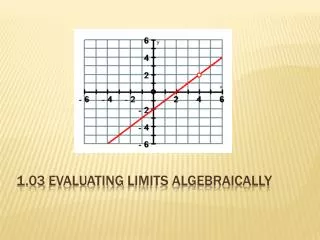
Is there a difference between the graphs of the following functions?
Finding Limits: Rationalizing • Factor or eliminate radicals to make an equivalent function • Evaluate this equivalent function for the limit at the undefined value Example Find the limit:
2 Useful Trig Limits Example Find the limit: