Pentose Phosphate Pathway
Pentose Phosphate Pathway. Generation of NADPH and Pentoses. Overview. Function NADPH production Reducing power carrier Synthetic pathways Role as cellular antioxidants Ribose synthesis Nucleic acids and nucleotides. Characteristics: Tissue Distribution. Demand for NADPH

Pentose Phosphate Pathway
E N D
Presentation Transcript
Pentose Phosphate Pathway Generation of NADPH and Pentoses
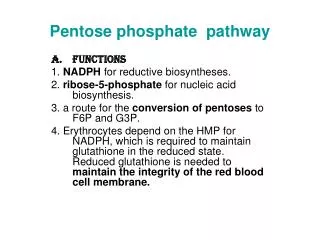
Overview • Function • NADPH production • Reducing power carrier • Synthetic pathways • Role as cellular antioxidants • Ribose synthesis • Nucleic acids and nucleotides
Characteristics:Tissue Distribution • Demand for NADPH • Biosynthetic pathways • FA synthesis (liver, adipose, mammary) • Cholesterol synthesis (liver) • Steroid hormone synthesis (adrenal, ovaries, testes) • Detoxification (Cytochrome P-450 System) – liver • Reduced glutathione as an antioxidant (RBC) • Generation of superoxide (neutrophils)
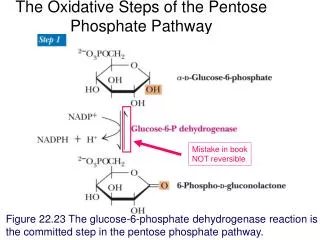
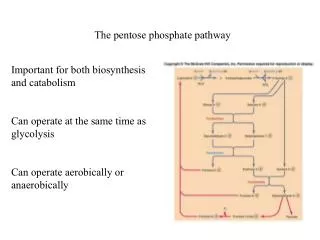
Characteristics:Oxidative and Non-oxidative Phases • Oxidative phases • Reactions producing NADPH • Irreversible • Non-oxidative phases • Produces ribose-5-P • Reversible reactions feed to glycolysis
NADPH producing reactions • Glucose-6-P dehydrogenase • 6-P-gluconate dehydrogenase
Regulation • Glucose-6-P dehydrogenase • First step • Rate limiting • Allosteric Regulation • Feedback inhibited by NADPH • Inducible enzyme • Induced by insulin
Role of NADPH in the RBC • Production of superoxide • Hb-Fe2+-O2 -> Hb-Fe3+ + O2-. • Spontaneous rxn, 1% per hour • O2-. + 2H2O -> 2H2O2 • Both O2-. & H2O2 can produce reactive free radical species, damage cell membranes, and cause hemolysis
Detoxification of Superoxide Anion and Hydrogen Peroxide • Antioxidant enzymes • Superoxide dismutase • Glutathione peroxidase • Glutathione reductase
Case Study • 21 yo male medical student with malaria • Treated with primaquine • Four days later: • Black colored urine • Low RBC count • Elevated reticulocyte count • RBC with Heinz bodies • Low hemoglobin • Elevated serum bilirubin • Pt recovered in a few days
G6PDH Deficiency and Hemolytic Anemia • Most common genetic enzymopathy • 400 hundred variants of G6PDH deficiency • Mediterranean, Asian, African descent • 400 million people affected worldwide • 50% of Kurdish men • 10-14% of African-American men with G6PD deficiency
G6PD Deficiency • Distribution of G6PD deficiency coincides prevalence of malaria • G6PD deficiency may impart some degree of malaria resistance • Also sickle cell anemia
Genetics • Recessive sex-linked mutation • X-chromosome • Rare in females (two X-chromosomes) • Homozygous mutation: • high hemolysis and anemia • Heterozygous mutation: • Normally asymptomatic • unless exposed to drugs (primaquine, anti-malarial drug) or compounds (fava bean) that produce superoxide or hydrogen peroxide
G6PD Deficiency • Exposure to anti-malarial drugs (Primaquine) results in increased cellular production of superoxide and hydrogen peroxide (Primaquine sensitivity) • Other chemicals known to increase oxidant stress • Sulfonamides (antibiotic) • Asprin and NSAIDs • Quinadine and quinine • Napthlane (mothballs) • Fava beans (vicine & isouramil)
Fava Beans • Grown worldwide • Important in Middle East • High in protein • Frost resistant perennial • Genetically modified fava bean being developed • Low in vicine and isouramil • Favism
Case Study • 21 yo male medical student with malaria • Treated with primaquine • Four days later: • Black colored urine • Low RBC count • Elevated reticulocyte count • RBC with Heinz bodies • Low hemoglobin • Elevated serum bilirubin • Pt recovered in a few days
Symptoms • Black colored urine • Hemolysis may result in urinary excretion of hemoglobin • Low RBC count & low hemoglobin • Result of high rate of hemolysis • Elevated bilirubin • Catabolism of heme
RBCs with Heinz Bodies • Precipitation of hemoglobin due to disulfide bond formation between Hb molecues • Upper photo shows distorted RBCs with large Heinz bodies • Bottom photo shows RBC stained with methylene blue
Elevated Reticulocytes • A RBC containing granules or filaments representing an immature stage in cell development • Normally constitutes 1% of circulating RBCs • Reticulocytosis • Elevation of reticulocytes • Indicative of active erthropoiesis in red bone marrow
Defective G6PDH • Results in enzyme with unstable structure • Patient with 10% of normal activity • Enough to generate NADPH under normal condition • Newly made RBCs have normal 6PDH activity • Patients recover quickly (8 days)