
How Does A Door Access Control System Work?
You can forget the need for keys altogether, and with in-depth reporting and metrics, you will know exactly who unlocked a door, and when. It is possible to customize the system according to your unique requirements, and you can easily grant or revoke permissions whenever you want.

How Does A Door Access Control System Work?
E N D
Presentation Transcript
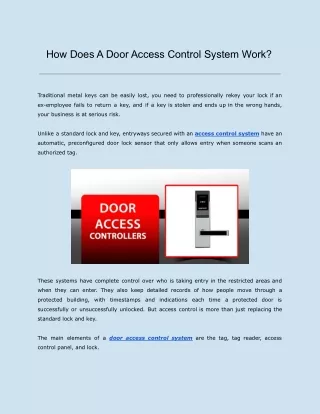
How Does A Door Access Control System Work? Traditional metal keys can be easily lost, you need to professionally rekey your lock if an ex-employee fails to return a key, and if a key is stolen and ends up in the wrong hands, your business is at serious risk. Unlike a standard lock and key, entryways secured with an access control system have an automatic, preconfigured door lock sensor that only allows entry when someone scans an authorized tag. These systems have complete control over who is taking entry in the restricted areas and when they can enter. They also keep detailed records of how people move through a protected building, with timestamps and indications each time a protected door is successfully or unsuccessfully unlocked. But access control is more than just replacing the standard lock and key. The main elements of a door access control system are the tag, tag reader, access control panel, and lock.
A tag is made based on a wireless technology known as radio frequency identification (RFID) to send signals to the access control panel.When an individual shows their tag to the reader, the reader’s antenna gets its encrypted ID number. The tag reader sends the ID number to the access control panel. The control panel receives the encrypted tag number from the reader,and then after decoding the number compares the ID number to ID numbers already loaded onto the system. The access control panel operates the electrical door lock—if a user is allowed to take entry the door will automatically unlock and can be opened.
