
3-ACP_Module3
E N D
Presentation Transcript
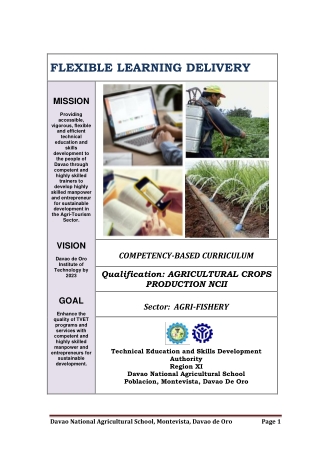
FLEXIBLE LEARNING DELIVERY MISSION Providing accessible, vigorous, flexible and efficient technical education and skills development to the people of Davao through competent and highly skilled trainers to develop highly skilled manpower and entrepreneur for sustainable development in the Agri-Tourism Sector. VISION Davao de Oro Institute of Technology by 2023 GOAL Enhance the quality of TVET programs and services with competent and highly skilled manpower and entrepreneurs for sustainable development. COMPETENCY-BASED CURRICULUM Qualification: AGRICULTURAL CROPS PRODUCTION NCII Sector: AGRI-FISHERY Technical Education and Skills Development Authority Region XI Davao National Agricultural School Poblacion, Montevista, Davao De Oro Davao National Agricultural School, Montevista, Davao de Oro Page 1
MODULE 3 Caring and MaintainingCrops UNIT OF COMPETENCY: Care and Maintain Crops MODULE DESCRIPTOR: This unit covers the knowledge, skills and attitudes required to provide maintenance activities in the production of different agricultural crops. LEARNING OUTCOMES: At the end of this module, you must be able to: 1. Apply pest control measure 2. Apply fertilizer 3. Water crops 4. Perform pruning 5. Perform physical growth-enhancing practices Davao National Agricultural School, Montevista, Davao de Oro Page 2
LEARNING OUTCOME 1: APPLY PEST CONTROL MEASURE INFORMATION SHEET 3.1-1 Pests and Diseases Pests and diseases are one of the major constraints to increase production in agricultural crops. Though most of them can be treated but a late detection could lead to the plant’s death. At the very first signs of any pest attack, adopt timely measures to save your plant. What is a pest? o Any organisms that hinder agricultural crop production processes. o Includes insects, weeds, pathogens, rodents and other vertebrate pests. o It is one of the major constraints to increase production in agricultural crops. o Some examples of insect pests are aphids, cucumber beetle, cutworm, flea beetle, squash bug, slug, snail and others (Details on separate sheet). What is plant disease? ▪ The abnormal growth and development of a plant. ▪ A condition and disorder in plants that result in pathological signs and symptoms. ▪ Wet weather, inadequate air flow and poor drainage often encourage plant disease. Diseases manifest themselves through wilting, blotches, scabs, rot, rusts and moldy coatings. o Some examples of plant diseases are anthracnose, bacterial leaf spot, club root, common rust, late blight, mosaic virus, powdery mildew and wilts (Details on separate sheet). What is a weed? ▪ A plant growing where it is not wanted. ▪ It grows in a wide range of environmental conditions which affect the activities and welfare of man especially in crop production. ▪ It competes with cultivated crops causing losses in harvest or yield. ▪ Some examples of weeds are jungle rice, knot grass, para grass, nut grass, spiny amaranth, morning glory, hagonoy grass, and others (Details on separate sheet). Classification of weeds based on morphology: 1. Grasses - weeds under family Poaceae with long narrow leaves and parallel veins, has solid nodes and hallow internodes. 2. Sedges - weeds belong to family Cyperaceae having modified triangular stem, leaf blades have parallel veins but n o nodes and internodes. 3. Broad leaves - weeds with fully expanded broad leaves and various shape and arrangements of veins. Davao National Agricultural School, Montevista, Davao de Oro Page 3
INFORMATION SHEET 3.1-2 Prevention and Control Measures of Pests and Diseases Methods to prevent and control pests and diseases: ▪ Natural or physical control ▪ Biological control ▪ Cultural control ▪ Mechanical control ▪ Chemical control (bio-pesticide and synthetic) ▪ Integrated pest management (IPM) What is natural control? ▪ It is the natural way to control pest which include maintaining a healthy soil and healthy crop, using resistant varieties, crop rotation, sanitization, correct soil pH, timely sowing, companion planting, using plants to attract predators/parasites and hand picking. ▪Using resistant varieties - acts as insurance against crop failure. ▪Sanitization – clearing and disposal of plant remains by composting the debris. ▪Companion planting - growing certain/other plants to protect the main crops from pests. ▪Planting plants to attract predators and parasites - planting plants that deter pests from the main crop and attractant plants that attract predatory insects. ▪Hand picking and squashing - Done especially with caterpillars and other large insects in small plots of land. What is biological control? ▪ The use of one organism to control pest. ▪ It involves introducing natural enemies or beneficial insects to the area such as predators, parasites or pathogens and adds beneficial organisms to the soil or plant environment. ▪Predators/predatory insects –insects thatconsume and destroy several hosts during their development. Examples are ground beetles, ladybirds, assassin bugs, weevils and others. ▪Insect parasitoids - insects that lay and develop their eggs in on or within a single insect host and finally killing or fatally infecting the host. The larvae eat the host once the eggs hatch. ▪Pathogens -are disease-causing organisms such as bacteria, fungi, viruses and nematodes. They kill or weaken their own host and are relatively specific. The best known example is the bacterium Bacillus thuringiensis. Davao National Agricultural School, Montevista, Davao de Oro Page 4
What is cultural control? ▪ The purposeful manipulation of the garden’s environment such as: the method of growing, planting and cultivation to hinder pests’ breeding, feeding and shelter habits. ▪ Ii includes crop rotation, sanitation, soil sterilization, using resistant varieties and certified plants, and intercropping or companion planting. ▪Crop rotation - rotating the site to a different type of crop or change the type of crops grown in the garden plot. Do not put members of the same plant family in the same location in consecutive seasons. ▪Sanitation - removal of crop residues/weeds/waste materials and disposing it in a compost to prevent pest buildup and eliminate food and shelter for many insects and diseases. It can also be done by pruning, sterilizing tools, washing hands, etc. ▪Intercropping or companion planting - growing certain plants to protect other plants from pests or diseases. One plant acts as a barrier for another. The pest is deterred by the companion plant or because it is attracted to the companion plant rather than the main crop. Examples are planting marigold flowers among vegetables that attract beneficial wasps seeking the flowers’ nectar. ▪Soil Sterilization - killing weed seeds, insects and numerous pathogens by using heat and chemicals. What is mechanical control? ▪ The use of hands-on techniques and simple equipment or devices and natural ingredients that provide a protective barrier between plants and insects. ▪ Includes the use of traps and attractants, barriers (screens covers or net), water pressure sprays, insect vacuums and insecticidal soap. ▪ Mechanical traps and attractants trap insects such as yellow sticky traps, yellow pan traps and light traps. ▪ Water pressure sprays are used to dislodge insects from foliage and plant stems. This should only be used on sturdy plants to avoid plant damage. ▪ Insecticidal soaps are distributed for control of insects and mites. Available under a variety of trade names and their active ingredient is potassium salt of fatty acids. Davao National Agricultural School, Montevista, Davao de Oro Page 5
What is chemical control? ▪ The application of chemicals or pesticides to control pests and diseases such as fungicides, bactericides, nematicides, soil fumigants and others. ▪ In applying pesticides, choose the right chemical, apply the chemical in the right way at the right time and in the right concentration, and read/follow the label/directions carefully. What is integrated pest management (IPM)? ▪ An environmentally sensitive approach to pest management that relies on a combination of common-sense practices. ▪ Uses the combination of strategy to manage pest such as the biological, cultural, mechanical, and the minimal use of pesticides based on regular monitoring of the field to diagnose pest damage. ▪ It considers the population dynamics of pests and their natural enemies and the effects of controls on agro-ecosystems to manage pests more efficiently. Davao National Agricultural School, Montevista, Davao de Oro Page 6
INFORMATION SHEET 3.1-3 Pesticides and their Usage What is a pesticide? ▪ Any substance intended for preventing, destroying or controlling pest causing harm during production, processing, storage, transport or marketing of food, agricultural commodity, wood and wood product or animal feedstuff. ▪ It includes insecticides, fungicides, herbicides, rodenticides, plant growth regulators and others. ▪ Are classified according to the (1) pest they control, (2) their chemical structure, (3) how/when they work, and (4) their mode of action (site action). Classification of Pesticides According to Types of Pests they Control ▪Bactericide is used to control bacteria. ▪Fungicide is used to kill fungi including blights, mildews, molds and rusts. Herbicide is used to kill weeds and other unwanted plants or slow the growth of some plants. ▪Insecticide is used to control insects and other arthropods. It is classified further into broad spectrum, narrow spectrum, short term, and residual insecticides. ▪Molluscicide is used to kill snails and slugs. Example is bait. ▪Rodenticide is used to control mice, bats and other rodents. Classification of Pesticides by How or When they work ▪Contact pesticides are use to control pest as a result of direct contact. Insects are killed when sprayed directly or when they crawl across surfaces treated with residual contact insecticide. ▪Systemic pesticides are pesticides which absorbed by plants or animals and move to untreated tissues. Systemic insecticides or fungicides move throughout treated plants and kill certain insects or fungi. ▪Fumigants are chemicals that are applied as toxic gas or as a solid or liquid which forms a toxic gas (e.g. formaldehyde, methyl bromide) intended to destroy pests in buildings or soil. ▪Repellents are chemical that repel insect pests and birds. ▪Pre-emergent herbicides are applied to the soil after planting but before emergence of the crop or weed. ▪Post-emergent herbicides– are applied after the crop or weed has emerged; Pre-plant herbicides are applied to the soil before seeding or transplanting. ▪Selective pesticides will only control certain pests. ▪Non-selective pesticides will control a wide range of pests. ▪Residual pesticides do not break down quickly and may control pests for a long time (i.e. several weeks or a year) ▪Non-residual pesticides are quickly made inactive after application and do not affect future crops. ▪Protectant fungicide is used prevent the plant from getting the disease and is applied before the disease gets start ▪Eradicant fungicide is applied when the disease appears. Davao National Agricultural School, Montevista, Davao de Oro Page 7
INFORMATION SHEET 3.1-4 Safety Measures in Handling and Using Pesticides Precautionary measures in handling of pesticide ▪ Read and follow label information and directions. ▪ Wear clean and appropriate personal protective equipment (PPE) during handling and application of pesticides. ▪ Never eat, drink or smoke when handling pesticides. ▪ Do not keep food or smoking products on your body when handling pesticides. ▪ Wash thoroughly with soap and water after using and preparing insecticides. ▪ Wash before eating, drinking, smoking, or using the toilet. ▪ Label insecticide properly and include the skull and crossed bones figures, the notation “poison”. ▪ Keep insecticide away from the reach of children and people who are unaware of their danger. Do not store them with utensils and other items for cooking. ▪Observe manufacturer’s recommendations on dosages and time intervals between last application and harvest. ▪ Avoid applying insecticides near streams and wells especially soil drenches near potable water resources. ▪ Bury empty containers of pesticides. ▪ Do not spray or apply insecticides against the wind. ▪ Avoid skin contact with pesticides. Curative measures when using pesticides: 1. Immediately clean/wipe all spilled pesticides with rags. Do not burn rags. Burning will convert the pesticides into its gaseous state and will pose hazards to other individuals in the vicinity. 2. Wash thoroughly with soap and water the skin which came in contact with insecticides. Contaminated clothing should either be buried or washed thoroughly before it is used again. 3. If a person has swallowed pesticide, induce him to vomit and immediately seek medical attention for him. Storing Pesticides ▪ Store pesticides in their original, labeled container with the label clearly visible. ▪ Store pesticides in tightly sealed containers and check containers periodically for leakage, corrosion breaks, tears, etc. ▪ Store pesticides where they are protected from freezing or excessive heat. ▪ Store pesticide in storage areas, well-ventilated to prevent the accumulation of toxic fumes. ▪ Never store pesticides in old bottles or food containers where they could be mistaken for food or drink for humans or animals. ▪ Never store pesticides near food, feed, or seed. Davao National Agricultural School, Montevista, Davao de Oro Page 8
LEARNING OUTCOME 2: APPLY FERTILIZER INFORMATION SHEET 3.2-1 Fertilizer Application What is fertilizer? ▪ Any substance which is added to the soil to supply those elements required in the nutrition of the plant. It can be classified as organic and inorganic fertilizer. Types of Fertilizer 1. Organic fertilizer 2. Inorganic fertilizer Organic Fertilizer ▪ Any product with basic ingredients are from plant or animal that has been decomposed biologically, chemically or through any process as long as the original materials are no longer recognizable, and are soil like in texture and which can supply nutrients to the plants. ▪ Derived from either plants or animal residues. Potential sources of organic fertilizer: 1. Crop wastes such as decomposed straw husk, leaves, grasses, coconut coir, sawdust, etc; 2. Animal wastes such as manure of cattle, poultry, pigs, goats, chicken, ducks and horses; 3. Vermicomposting of organic materials or waste through the digestion of earthworm. The soil-like excreta of the earthworms known as casts contains high quality top soil which is an excellent fertilizer material; 4. Composting with guano, ash, fish waste, sea weeds, etc; 5. Green manure such as azolla, ipil-ipil and other legumes. Inorganic Fertilizer ▪ Are chemical materials which consist of one or more inorganic compounds (salt, oxides, etc.) that when applied in the soil yield one or more of the essential elements needed for plant nutrition. ▪ The 3 numerals which are marked on the fertilizer bag indicate the grade or analysis of the fertilizer contained in the bag. ▪ Fertilizer Grade or analysis means the percentage of total Nitrogen (N), available Phosphoric acid or phosphate (P2O5) and the water soluble Potash (K2O) contained in the fertilizer material. ▪ The 3 numerals 5-10-15 for example indicate the percentage of N, P and K contained in the bag and these are designated by 3 numerals listed in the same order as N - available P2O5 - water soluble K2O. Davao National Agricultural School, Montevista, Davao de Oro Page 9
Common inorganic fertilizers: 1. Single fertilizer – contains only N, P or K. Examples are Ammonium Sulfate (21-0-0), Urea (46-0-0), Muriate of Potash (0-0-60), Sulfate of potash (0-0- 50), Ordinary Super phosphates(0-20-0, 0-18-0, 0-45-0,) 2. Incomplete fertilizer – contains only two major fertilizer elements. Examples are Ammophos(16-20-0), Mono ammonium super phosphate (16-20-0), Diammonium super phosphate (18-46-0) 3. Complete fertilizer – contains all the three (3) major fertilizer elements (N, P and K). Common examples are 14-14-14 and 12-12-12. Methods of Fertilizer Application 1. Broadcasting - the fertilizer is applied uniformly over the surface of the land or field. This method is usually practiced in rice fields. 2. Side dressing – the fertilizer is placed in or in between the rows of crops like in vegetables, or corn or placing it around the plant or tress like mango, papaya, etc. 3. Band or row or localized placements – the fertilizer is applied in bands to one or both sides of the plant. In the case of orchard trees, coconut, etc, band application can be done by making a small trench with a hole around at some distance at the base putting the fertilizer into it. 4. Foliar or Spray application - involves dissolving the fertilizer material in the water and applying it as spray to the plant. 5. Fertigation/drenching - applying the fertilizer material with irrigation water. Davao National Agricultural School, Montevista, Davao de Oro Page 10
LEARNING OUTCOME 3: WATER CROPS INFORMATION SHEET 3.3-1 Methods of Irrigation What is irrigation? ▪ The artificial application of water to the land or plant. It helps the growing of crops, maintenance of landscapes vegetation of disturbed soils in dry areas and during periods of inadequate rainfall. Methods of Irrigation 1. Surface Irrigation ▪ The application of water by gravity flow to the surface of the field. Water is applied and distributed over the soil surface either in furrows or by flooding, depending upon the crop. 2. Sub-surface Irrigation ▪ Water is applied in the field below the ground surface so that it is supplied directly to the root zone of the plants. ▪ The main advantages of these types of irrigation is reduction of evaporation losses and less hindrance to cultivation works which takes place on the surface. 3. Sprinkler Irrigation ▪ Water is applied in the form of spray or artificial rain. ▪ A pump is needed to provide pressure to force the water through perforated pipes oscillating sprinkles. ▪ Water is distributed through a system of pipes usually pumping. 4. Drip Irrigation ▪ The dripping water into the soil at very low rates (2-20 liters/hour) from a system of small diameter plastic pipes fitted with outlets called emitters or drippers. ▪ Water is applied close to plants so that only part of the soil in which the roots grow is wetted. and re- or by Davao National Agricultural School, Montevista, Davao de Oro Page 11
INFORMATION SHEET 3.3-2 Irrigation Scheduling The critical period to apply water for most crops is during the part of the growing season where pod, fruit, tuber or ear formation and development occurs. The table below shows the critical growth stages of crops in which water must be applied: Critical Stages for Irrigation of Different Crops Name of the Crop Cereals Rice/Paddy Tillering, panicle initiation, heading and flowering Crown root initiation, tillering to booting, flowering and grain development. Sorghum and other millets Early vegetative period, silking and tasseling to dough stage Pulses or Grain Legumes Beans Early vegetative growth, flowering and pod development. Peas Flowering and early pod developmnet Oil Seeds Ground nut Flowering, peg formation and pod development Sesame Blooming to maturity Sunflower Pre-flowering to pos-flowering Soybean Blooming and seed formation Vegetables Asparagus Spear and fern growth Onion Bulb formation and enlargement Eggplant, peppers, tomatoes Chilies Flowering and Fruit Setting Broccoli Flower bud production Cabbage, cauliflower Head development and enlargement Cucumbers, muskmelons, watermelon Flowering, fruit setting and development Lettuce, spinach Throughout growth Potato Tuber development to maturity Carrot, turnip Root enlargement Sweet corn Silking, tasseling and ear development Others Cotton Flowering and boll formation Fruit trees Flowering, fruit setting and enlargement Critical Stages Wheat Booting, blooming and and grain development Maize Flowering, fruit setting and enlargement Davao National Agricultural School, Montevista, Davao de Oro Page 12
LEARNING OUTCOME 4: PERFORM PRUNING INFORMATION SHEET 3.4-1 Pruning What is pruning? ▪ The removal of unnecessary branches or parts to improve growth, appearance and canopy of the plant. The more branches a plant grows the more energy and “food” it must provide to these branches which reduces the size and number of fruits that reach maturity. ▪ Includes removal of diseased plant parts, suckering growth or excess branches to give their best display and prevent them outgrowing their space. Pruning techniques ▪ Cut in a location where growth occurs since cutting a branch beyond where growth occurs will prevent the plant from forming a callus over the cut surface which in turn will invite insects and infection. ▪ Pruning techniques include the following: ▪ Identify and remove problem branches. ▪ When deciding which competing branches to prune, always retain the straight ones. ▪ When pruning large branches, use a pruning saw. Before cutting, make a one-third undercut through the branch before taking it down as this will reduce the weight of the branch for an easier cut. ▪ Always use hand pruners and loppers to ensure proper cuts. ▪ To reduce the chance of spreading diseases, clean equipment in a 10% mixture of bleach to water. ▪ Only remove one-third of the tree branch mass every five years. ▪ Newly planted trees should only be pruned to remove dead and broken branches during the first two years after planting. ▪ Broken branches need to be pruned because they will invite insects into the live wood. ▪ When pruning crossing branches, cut the smaller branch. Reasons for Pruning 1. Maintain plant health ▪ Remove dead, damaged and diseased branches to help prevent insect and decay organisms from entering the tree. ▪ Thin a dense canopy to increase air and sunlight penetration thus, resulting in fewer disease problems. ▪ Remove suckers and water sprouts to eliminate weak wood and provide more food and water for the tree. ▪ Eliminate crossing branches to prevent damage caused by their rubbing against each other. ▪ Remove weak or narrow branches Davao National Agricultural School, Montevista, Davao de Oro Page 13
2. Safety ▪ Create and maintain a strong tree structure, preventing safety hazards such as low growing branches subject to storm damage near a sidewalk or driveway and reducing risk from falling branches. 3. Train the plant ▪ Maintain a desirable shape of a plant by shaping and controlling or directing growth. ▪ Early removal of these vigorous branches maintains a natural tree form. 4. Stimulate or restrict growth ▪ Pruning can stimulate growth in sparse areas of the tree. ▪ It can also restrict growth where too much growth is undesirable. 5. Improve the quality of flowers, fruit, foliage or stem, thus, increasing yield. Tools Used in Pruning ▪ Hand pruner / pruning shear ▪ Lopper ▪ Pruning saw Pruning Techniques in Cacao (In separate sheet) Davao National Agricultural School, Montevista, Davao de Oro Page 14
PERFORM PHYSICAL GROWTH-ENHANCING PRACTICES LEARNING OUTCOME 5: INFORMATION SHEET 3.5-1 Cultivation What is cultivation? ▪ The process of loosening or breaking up the soil between the growing plants in order to maintain a condition favorable for their growth. ▪ The main purpose is to destroy weeds and stimulate growth by letting air into the soil, freeing unavailable plant food, and conserving soil moisture. ▪ It is important to many soils to create temporary macro-pores for water movement, gas exchange, and root growth. When to cultivate? ▪ It should be done when the weeds are small and before they compete seriously with the cultivated crops for moisture, nutrients, light and air. Likewise, it should be done as often as necessary to prevent weeds from injuring the crop. Types of Cultivation Methods 1. Cultural Method - can be done by growing a crop that is capable of suppressing (shading) weeds. The crop that has the ability to suppress weeds includes squash, beans, peas, cucumbers, sweet corn, melons, potatoes and tomatoes. 2. Mechanical Method - is weeding by hand with the aid of hand tools. Weeds can be hand pulled or removed using hand tools such as hand trowels, hand hoe, and hand cultivator. There are also several implements and cultivators that can be used to control weeds. 3. Chemical Method - is done by using herbicides to control weeds. This material is applied or sprayed over the top of the weeds and will kill all them. Hand tools used in cultivation: Hand cultivators Davao National Agricultural School, Montevista, Davao de Oro Page 15
INFORMATION SHEET 3.5-2 Growth Training Techniques Pricking ▪ The time to transfer seedlings to individual containers. It is the first potting or transplanting of young seedling that are grown in seed beds, seedling trays or any container wherein individually planted. ▪ Seedlings need to be pricked out after developing their first set of true leaves because they need space to establish a strong root system. ▪ The main reason for pricking out seedlings is to prevent overcrowding as they grow larger. Overcrowding will cause seedlings to develop into inferior plants. How to prick out seedling? 1. Choose the strongest seedlings. 2. Use a dibber or stick to remove the plant out while retaining the root intact. 3. Transplant your seedling to its new location. 4. When finished pricking out seedlings, water them and place them on a place where they will keep warm and receive adequate sunlight. Hardening ▪ Any treatments that result in firming or hardening the tissues of plants. ▪ It involves setting out the plants on a sunny day and gradually extending the time they are outdoors until they become accustomed to changing conditions. ▪ It enables plants to survive unfavorable environmental conditions such as extreme temperatures, hot drying winds and blown by the wind. ▪ It should be done 7-10 days before transplanting. It is also a continuous process ending when the transplants are set in the field. Methods of Hardening 1. Gradually reduce water. Water lightly at less frequent intervals but do not allow the plants to wilt severely. 2. Expose plants to lower temperature than optimal for their growth. 3. Gradually expose the plants to more sunlight. This results in the development of a thicker cuticle layer thereby reducing water loss. seeds are not Davao National Agricultural School, Montevista, Davao de Oro Page 16
Thinning ▪ The removal of excess plants to make room for growth of the other plant. ▪ It is also the selective removal of flowers, fruits and shoots of the plant to allow adequate space for the remaining organs to grow efficiently. ▪ The main purpose of thinning is to improve quality and size of the plant or plant parts. ▪ Thinning maximizes fruit size, quality and ensures return bloom on the following season. Optimum timing is usually done in the first 2 to 3 weeks after bloom. The advantages of thinning (Price 1989) are the following: ▪ Allows easier access to the crop for better management and inspection. ▪ Promotion of stand hygiene by removing unhealthy or excess plant per hill. ▪ Allows free air circulation. ▪ Promotion of opportunities for natural regeneration. ▪ Improved the size and quality of the crop. The practice of fruit thinning is done for two reasons: (1) to develop adequate size and quality; and (2) to increase the plant's ability to form flower buds for the next year provided the thinning is done early enough. Thinning also reduces the total load on the branches and reduces breakage. Davao National Agricultural School, Montevista, Davao de Oro Page 17
INFORMATION SHEET 3.5-3 Mulching What is mulching? ▪ The process of covering the soil surface around the plants with mulch to create good conditions for the growth of plant. ▪ The major purpose includes moisture conservation, weed control, temperature moderation (protect roots of plant from heat, cold or drought), clean fruit and increase yields. Types of Mulch 1. Organic mulch - includes grass clippings, leaves, shredded wood bark, newspaper, straw, and other products usually derived from plants. This kind of mulch decomposes in the soil hence it improves soil quality and fertility. 2. Inorganic mulch - includes various types of commercial plastic films, rocks, stones and gravel. These mulches do not decompose and do not need to be replenished often. Plastic mulches have been used by commercial growers with black and clear plastics being the most popular. . How to apply mulch? ▪ Lay mulches over the moist soil after removing weeds. ▪ Organic mulches should be at least 5.0 cm and ideally 7.5 cm thick. Benefits of Proper Mulching 1. Helps reduce soil moisture loss through evaporation 2. Helps control weed germination and growth 3. Insulates soil, protecting roots from extreme temperatures 4. Improves soil biology, aeration, structure (aggregation of soil particles) and drainage. 5. Improves soil fertility as certain types of mulch decompose over time. 6. Inhibits certain plant diseases caused by mud splashing on crop surface. 7. Gives plant beds a uniform and well-cared-for look. Different Types of Mulching Materials: Davao National Agricultural School, Montevista, Davao de Oro Page 18