Download
1 / 4
0 likes | 2 Vues
Brownloop empowers private equity firms with AI solutions data analytics and consulting to streamline deal sourcing, optimize portfolios, and drive data-backed growth.<br>

E N D
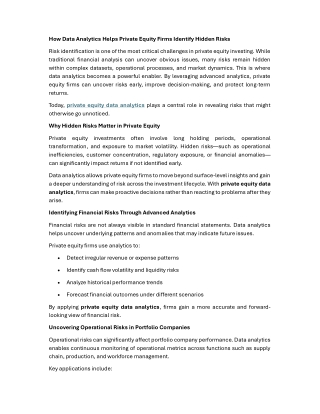
How Data Analytics Helps Private Equity Firms Identify Hidden Risks Risk identification is one of the most critical challenges in private equity investing. While traditional financial analysis can uncover obvious issues, many risks remain hidden within complex datasets, operational processes, and market dynamics. This is where data analytics becomes a powerful enabler. By leveraging advanced analytics, private equity firms can uncover risks early, improve decision-making, and protect long-term returns. Today, private equity data analytics plays a central role in revealing risks that might otherwise go unnoticed. Why Hidden Risks Matter in Private Equity Private equity investments often involve long holding periods, operational transformation, and exposure to market volatility. Hidden risks—such as operational ine?iciencies, customer concentration, regulatory exposure, or financial anomalies— can significantly impact returns if not identified early. Data analytics allows private equity firms to move beyond surface-level insights and gain a deeper understanding of risk across the investment lifecycle. With private equity data analytics, firms can make proactive decisions rather than reacting to problems after they arise. Identifying Financial Risks Through Advanced Analytics Financial risks are not always visible in standard financial statements. Data analytics helps uncover underlying patterns and anomalies that may indicate future issues. Private equity firms use analytics to: Detect irregular revenue or expense patterns Identify cash flow volatility and liquidity risks Analyze historical performance trends Forecast financial outcomes under di?erent scenarios By applying private equity data analytics, firms gain a more accurate and forward- looking view of financial risk. Uncovering Operational Risks in Portfolio Companies Operational risks can significantly a?ect portfolio company performance. Data analytics enables continuous monitoring of operational metrics across functions such as supply chain, production, and workforce management. Key applications include:
Identifying process ine?iciencies Monitoring productivity and cost drivers Detecting early signs of operational disruption Benchmarking performance across portfolio companies Through private equity data analytics, firms can uncover operational weaknesses early and implement corrective actions. Market and Competitive Risk Analysis Market conditions and competitive dynamics can shift rapidly. Data analytics helps private equity firms assess external risks that may impact investment performance. Analytics supports: Market trend analysis Customer demand forecasting Competitive benchmarking Scenario modeling based on economic indicators Using private equity data analytics, firms can anticipate market shifts and adjust strategies accordingly. Regulatory and Compliance Risk Detection Regulatory and compliance risks are increasingly complex, especially for firms operating across multiple regions and industries. Data analytics enables continuous compliance monitoring and early detection of potential issues. Private equity firms use analytics to: Track regulatory changes and exposure Monitor compliance metrics across portfolio companies Identify patterns that indicate potential violations Reduce legal and reputational risk With private equity data analytics, firms gain better visibility into compliance-related risks. Customer and Revenue Concentration Risks
Overdependence on a small number of customers or revenue streams can pose significant risks. Data analytics helps identify concentration risks that may not be obvious at first glance. Analytics-driven insights include: Customer segmentation and dependency analysis Revenue diversification assessment Churn prediction and customer behavior analysis By leveraging private equity data analytics, firms can proactively address concentration risks and strengthen revenue stability. Risk Monitoring Throughout the Investment Lifecycle Risk identification does not end after acquisition. Data analytics enables continuous risk monitoring throughout the holding period. Private equity firms use analytics to: Track real-time performance and risk indicators Identify emerging risks early Support data-driven operational improvements Inform exit timing and strategy This continuous approach makes private equity data analytics an essential tool for long-term risk management. Challenges in Implementing Data Analytics for Risk Detection Despite its benefits, implementing data analytics can be challenging due to data silos, inconsistent data quality, and limited analytical capabilities. Successful adoption requires strong data governance, the right technology, and skilled teams. Firms that address these challenges early are better positioned to maximize the value of analytics. The Future of Risk Management in Private Equity As analytics technologies evolve, private equity firms will increasingly rely on advanced analytics and AI to identify and manage risks. Predictive and real-time analytics will become standard components of investment decision-making. Firms that invest in private equity data analytics today will be better equipped to navigate uncertainty and outperform competitors.
Conclusion Hidden risks can significantly impact private equity returns if left undetected. Data analytics empowers private equity firms to uncover financial, operational, market, and compliance risks early. By adopting private equity data analytics, firms can make more informed decisions, reduce uncertainty, and safeguard long-term investment performance.




![[PDF] Free Download Hidden Bodies By Caroline Kepnes](https://cdn4.slideserve.com/8156699/slide1-dt.jpg)












![[PDF] Download A Most Remarkable Creature: The Hidden Life and Epic Journey of the World’s Smartest Birds of Prey Full](https://cdn5.slideserve.com/11100914/slide1-dt.jpg)