Download
1 / 7
0 likes | 2 Vues
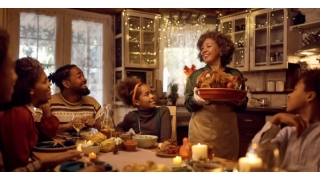
Invisible things we carry to the Thanksgiving table grief, love, memories, and courage that shape every family gathering<br>

E N D
When I think back to the Thanksgivings of my childhood, the memories come in warm, heavy waves. Everything felt prepared long before I ever stepped into the kitchen: mashed potatoes already whipped to a creamy softness, cranberry sauce cooling in its glass dish, casseroles arranged in careful rows that promised comfort long before anyone even sat down. Back then, Thanksgiving didn’t feel like a holiday someone had to work for. It felt like something that simply happened, almost like the table set itself. I wandered, I waited, I ate, without ever realizing how much invisible labor pulsed beneath the surface of all that ease. What I remember most vividly, though, is seeing my mother at the counter one year, slicing something, in my memory it’s red, something bright and bold, and her eyes were watering. As a child, I didn’t think twice about it. I assumed the sting in her eyes came from whatever she was chopping. Maybe onions, maybe peppers, maybe something sharp enough to summon tears without warning. Kids don’t ask why adults cry in kitchens. They don’t imagine there might be layers under a single moment. At that age, I simply watched her wipe her cheek with the back of her wrist and kept moving, believing Thanksgiving was just about food and laughter and the easy kind of love that floats around a dining room.
But now I’m in my early thirties, and it’s my turn to prepare a Thanksgiving dinner that suddenly feels too big and too symbolic for my small kitchen. My mother is in her late fifties now, and although she still helps, the emotional weight of the holiday feels like it has quietly slipped into my hands, the way family responsibilities often do without anyone announcing it. While chopping vegetables this year, my eyes began to sting, and at first, I blamed the onions. But then the memory of my mother’s teary-eyed face returned so strongly it pulled something deep in me loose. I found myself stopping mid-chop, hand hovering over the cutting board, wondering for the first time why she cried that day when I was too young to notice anything past the ingredients. Later that night, after the kitchen had settled into its quiet hum and we both sat with tea warming our palms, I finally asked her. It felt almost intrusive, asking about something that happened decades ago, but the question was already lodged in my throat. I told her what I remembered and asked softly, “Ma, why were you crying that Thanksgiving?”
She didn’t answer right away. Instead, she stared at her tea as if the steam rising from it carried her back to a place she had tucked away for years. When she finally spoke, her voice was steady, but there was a break in it that made me realize she had never said these words out loud. She told me first about her own father, my grandfather, a man who is full of generosity. Every Thanksgiving, after carving the turkey, he would set aside a portion and walk it to neighbors who didn’t have much. He had his warm hands carry a plate across the street because he believed no one deserved to feel forgotten during a holiday that celebrates belonging. “Your grandfather thought a meal could save someone’s spirit for a day,” she said, her eyes softening. “Every time I cooked turkey, I remembered him. That alone could make me cry.” But then she told me the second part, the part that lived in her chest like a bruise she learned to hide. Back when she was studying psychology, she had a close friend who was always around during Thanksgiving prep. Someone who laughed loudly, chopped vegetables with her, and made jokes to fill the room with joy. Someone who looked whole. Someone who seemed fine.
And on one Thanksgiving afternoon, right as she was setting the table and checking on the turkey in the oven, she received a phone call that shattered her understanding of people completely. Her friend had died by suicide. She told me that the grief wasn’t the only thing that broke her; it was the guilt. She was studying human behavior, surrounded by textbooks and theories and lectures about signs and symptoms, yet she still missed the silent suffering of someone right beside her. “I thought I should have seen it,” she said, pressing her hand to her chest like she was holding a memory in place. “He was helping me prepare the meal. Laughing, acting fine, and I couldn’t tell. I’ve carried that guilt every Thanksgiving since. Silently, the way certain memories make you cry without asking permission.” In that moment, I understood something I had never considered, that we never show up to the table empty-handed, even when our hands are free. We bring memories that sting, regrets that linger, grief that softens but never fully leaves. We bring generational stories, old wounds, private fears, and the weight of people we never got the chance to save. We bring kindness passed down from those who taught us how to care, and guilt from moments we wish we could rewrite.
All of it arrives with us, pressed between the dishes and the laughter and the rituals we perform because they anchor us to something familiar. As I prepare for this year’s Thanksgiving, I realize the food matters, of course it does, but it is never the real offering. What fills the room long before the turkey is carved are the invisible things we carry: the tenderness, the grief, the love, the shame, the memories that make us feel both grounded and undone. And maybe showing up imperfectly, with all of that inside us, is its own kind of courage. These are the things we bring to the table.
Thank You For More Info Do Visit www.peonymagazine.com



![[PDF] Free Download Table For Eight By Tricia Stringer](https://cdn4.slideserve.com/8020922/slide1-dt.jpg)




![[Epub] The Scout Mindset: Why Some People See Things Clearly and Others Don't Full](https://cdn5.slideserve.com/11106377/slide1-dt.jpg)