Download
1 / 8
0 likes | 0 Vues
For years, platforms operated with one quiet belief: most images are real. A photo meant a real person, a real moment, a real event. That belief no longer holds.<br><br>AI generated images changed the risk equation. Anyone can create convincing visuals on demand. One prompt can produce thousands of variations. This makes harmful content faster to create, easier to spread, and harder to disprove after it goes live.<br><br>This shift creates new abuse that looks real at first glance.<br><br>Fake scenarios can be made to look like real events.

E N D
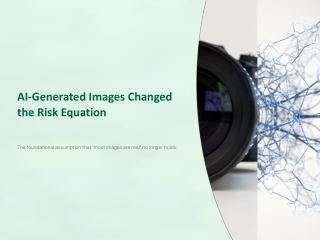
AI-Generated Images Changed the Risk Equation The foundational assumption that "most images are real" no longer holds.
The Broken Assumption Real Moments Traditional content moderation operated on default authenticity. Photos meant real moments, real people, real events. Real Events Real People That foundational layer is gone. Deprecated
Synthetic Media Scales Risk Exponentially Prompt Input Generate Variants ×1000
On-Demand Visuals Enable New Abuse Vectors Fake Scenarios Easier Impersonation Fabricated events that appear photorealistic and credible Synthetic faces and contexts lower barriers to identity fraud Visual Misinformation Manufactured Evidence False narratives gain credibility through convincing imagery Synthetic "proof" undermines truth-verification systems
Classic Authenticity Signals Fail Traditional photo-forensics relied on artifacts that modern AI eliminates: Lighting and Blur Camera Noise Patterns "Looks Real" Heuristic No longer reliable indicators Easily replicated by generators Human perception inadequate
The Operational Gap: Speed vs. Verification Upload Fast initial posting Distribution Very fast, spreading radius Reports Late verification arrives
Trust Requires Infrastructure, Not Hope 01 Detect Likely AI-Generated Images Technical classification before distribution 02 Screen Before Wide Distribution Upload Gate high-risk content at upload Safety Gate 03 Label or Enforce Where Required Feed Context-appropriate interventions 04 Human Review for Sensitive Cases Expert judgment on edge cases
Mediafirewall.ai Protect Trust While Supporting Creativity AI-Generated Image Filter Identify synthetic visuals early — before they scale Flag likely synthetic images early, enabling pre-distribution screening and human review for sensitive cases. Authenticity decisions shouldn't rely solely on user reports. Early Detection Pre-Distribution Screening Expert Review