
COUN520 - Group One- POWERPOINT
Cognitive Behaviour Therapy and Reality Therapy <br>

COUN520 - Group One- POWERPOINT
E N D
Presentation Transcript
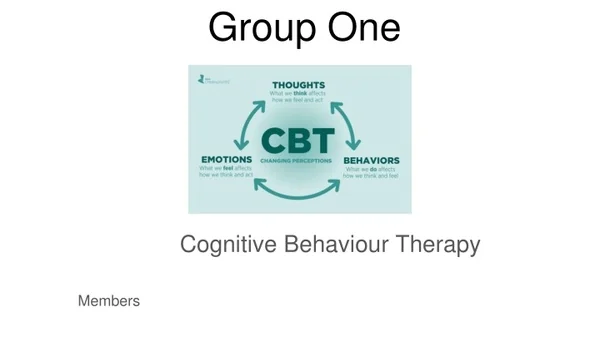
Group One Cognitive Behaviour Therapy Members
Cognitive Behaviour Therapy Explain the Theory Cognitive-behavioral therapy (CBT) is a form of psychological treatment that is based on the underlying assumption that mental disorders and psychological distress are maintained by cognitive factors, that is, that general beliefs about the world, the self, and the future contribute to the maintenance of emotional distress and behavioral problems (Gianluca et al., 2022).
Therapeutic Relationship The therapeutic relationship is what galvanizes techniques and lays a foundation for case conceptualization, modeling behaviors,collaborating with clients, and supporting their Autonomy (Okamoto et al, 2019). Broadly speaking, the therapeutic relationship may be defined as an exchange between Therapist and client with the goal of sharinging intimate thoughts and emotions to facilitate change.This exchange differs from the therapeutic alliance, which implies overt agreement on goals, tasks, and bond (Kazantzis, 2017 as cited in Okamoto et al, 2019 ).
Strengths and Weaknesses of Cognitive Behaviour Therapy ( Merlissa) Cognitive Behaviour Therapy is beneficial for the following reasons. • It is Practical • The skills obtained from Cognitive Behaviour Therapy or CBT is applicable to real-life and has long - term benefits. • It is Time-Efficient • This form of therapy can be completed within a short time • It promotes healthy relationships • CBT supports positive relationships between the therapist and his/ her client .
CBT does not require medication, thus there are no side effects of utilizing this therapy. However, this form of therapy is just as effective as therapies which require medication. • Cognitive Behaviour Therapy supports clients development of positive self esteem. • It helps clients develop coping skills • It is affordable • It is useful for a wide range of maladaptive behaviours such as
Cognitive Behaviour Therapy pose the following challenges; • It may not be effective or appropriate for complex mental health problems or learning disabilities. • It demands that the client be fully dedicated in order for the therapy to be successful. • Religious and Cultural practices and beliefs may be the reasons for cognitive defects. • It is well structured and may not be effective for those who have difficulty with structure and order.
Evaluate the role that some skills play in the field of Counselling ( Merlissa ) Cognitive Restructuring and Reframing are approaches that are used to help clients design or establish a new way of thinking in order think more positively, make better decisions and respond more positively to events that they have little control over. During the therapy, the client is taught how to apply new techniques of thinking and interpreting their life’s situations, events and ideologies.
Reframing allows the client to learn how to be selective in how they think about themselves. Moving from a place of negative self talk to one where the client is able to embrace the fact that they are important and valuable. The client is guided to move from having the mindset of a pessimist to that of an optimist.
Evaluate the Role that some skills play in the field of Counselling
Case Study: Alex’s Journey through Anger & Despair to Hope Alex, a 28-year-old software developer is seeking counseling, for intense anger, frustration, and feelings of isolation over the past year. He says recently, his thoughts have increasingly turned towards suicide as a way to escape these feelings. Alex's anger issues have escalated, affecting relationships with family, friends, and colleagues.
Professional Life Alex often finds himself in heated arguments with colleagues over project directions and deadlines. He perceives feedback on his work as personal attacks, leading to defensive and sometimes aggressive responses. Despite being part of a team, Alex feels isolated, believing that no one at work truly understands or values his contributions. This has led to a decrease in motivation and a sense of alienation from his colleagues. The constant stress and anger have started to affect Alex's performance. He struggles to concentrate, misses deadlines, and his work quality has declined, leading to an ultimatum from his employer to seek help or face termination.
Personal Life Alex says his relationship with family and friends have deteriorated. He finds it hard to engage in conversations without becoming irritable or angry, leading to fewer social interactions and increased loneliness. Activities that once brought him pleasure now feel pointless. He spends most of his free time alone, gaming or browsing the internet, but these activities no longer provide an escape from his feelings of anger and sadness. To compound matter Alex has difficulty falling asleep and awaken frequently at nights. His sleep is often disturbed by ruminations over conflicts at work and his perceived failures in life.
Emotional and Psychological State Alex complains of constantly feeling on edge, with minor irritations quickly escalating into intense anger. He often feels this anger is beyond his control. Stemming from unresolved childhood trauma, there's a pervasive sense of hopelessness about the future. He questions whether his situation can ever improve and doubts his ability to change his circumstances. Initially, thoughts of suicide appeared as fleeting considerations of escape from his pain. Over time, these thoughts have become more frequent and detailed, though Alex has not made any plans or taken any steps towards acting on these thoughts.
Physical Health Alex’s current experiences begins to take a toll on his physical health. Despite poor sleep quality, Alex often feels exhausted, struggling to find the energy for work or even basic daily activities. He reports headaches, muscle tension, especially in the neck and shoulders, and occasional stomach issues, which he attributes to his constant state of stress and agitation.
Follow up Evaluation Alex will be monitored regularly through twice a month sessions to monitor progress, adjust treatment plans as needed, and address any emerging issues. • Adjustments to the treatment plan will be based on Alex's response to interventions, including changing therapeutic techniques or medications.
Treatment • Due to the objectives set Alex will be exposed to ‘Anger Management Training’ to learn and practice strategies for managing anger effectively. • In consultation with a psychiatrist Alex will be placed on anti-anxiety medication, due to the severity of symptoms. • There will also be some lifestyle modifications for Alex: • He will go jogging twice a week (Mondays and Thursdays at 5:30pm) for 30 minutes each day. He will also engage in playing volleyball (a group sport) monthly, on weekends. • adapt healthy eating habits, and get adequate sleep, and engaged in regular meditative practices. • Family and friends will be involved in the treatment process to provide appropriate additional support. • Will develop a safety plan addressing suicidal ideation, including identifying warning signs, coping strategies, and emergency contacts.
Objectives • For Depression: • Alex will identify and challenge negative thought patterns contributing to depression. • Engage in at least two activities weekly that previously brought pleasure. • For Anxiety: • Learn and regularly practice relaxation techniques (e.g., deep breathing, progressive muscle relaxation). • Gradually expose himself to anxiety-provoking situations to build tolerance. • For Anger Management: • Identify triggers and early warning signs of anger. • Implement at least one anger management technique (e.g., time-out, deep breathing) when noticing these signs.
Goals The goals that were set out by Alex under the guidance of the counselor are to: 1. Reduce Symptoms of Depression and Anxiety: Aim to decrease the intensity and frequency of symptoms to improve Alex's overall mood and functioning. 2. Improve Anger Management: Develop strategies to manage anger more effectively, reducing the frequency of outbursts and improving relationships. 3. Enhance Coping Mechanisms: Equip Alex with tools to cope with stressors more healthily, reducing reliance on maladaptive coping strategies. 4. Prevent Suicidal Ideation: Create a safe environment and strategies to manage and eventually eliminate suicidal thoughts.
Diagnosis • Primary Diagnosis: Major Depressive Disorder, given the presence of depressive symptoms such as persistent sadness, loss of interest, fatigue, and suicidal thoughts. • Secondary Diagnoses: Generalized Anxiety Disorder and Anger Management Issues, considering his symptoms of constant worry, muscle tension, and frequent conflicts stemming from anger.
Evaluation Diagnosis based on the detailed complaints and behaviors described by Alex, he may be experiencing a combination of psychological conditions detailed in the Diagnostic and Statistical Manual of Mental Disorders (DSM-5), a comprehensive classification system and diagnostic tool published by the American Psychiatric Association (APA) to aid in the diagnosis and treatment of mental disorders. According to the American Psychiatric Association (2013), Alex exhibits symptoms that may align with:
Evaluation Cont’d Major Depressive Disorder (MDD). His persistent feelings of hopelessness, loss of interest in previously enjoyed activities, sleep disturbances, chronic fatigue, and especially suicidal ideation are indicative of major depression. The severity and duration of these symptoms are key factors in diagnosing MDD. Generalized Anxiety Disorder (GAD). While the primary focus has been on anger and depression, the constant state of stress, muscle tension, headaches, and difficulty concentrating could also suggest underlying generalized anxiety disorder, where excessive worry and physical symptoms prevail.
Evaluation Cont’d Insomnia - Alex's difficulty falling asleep and maintaining sleep, coupled with the impact on his daily functioning, may indicate insomnia. This condition can be both a symptom of other mental health issues, like depression and anxiety, and a standalone disorder that exacerbates these issues, and Possible Complex PTSD (C-PTSD): If Alex's unresolved childhood trauma is significantly impacting his current functioning, and his symptoms include emotional regulation difficulties, feelings of hopelessness, and relationship problems, he might be experiencing Complex PTSD. This condition goes beyond PTSD to include prolonged exposure to traumatic circumstances, often during childhood, such as chronic abuse or neglect.
Assessment The therapist begins by establishing a connection with Alex, creating a safe and non-judgmental space for open communication. He/she will then conduct an in-depth (clinical) interview with Alex to gather information about his symptoms, history of anger, depressive episodes, suicidal ideation, and any substance use. The therapist will then utilize standardized psychological tests to assess depression, anxiety levels, and any personality disorders, such as: Patient Health Questionnaire (PHQ-9), Generalized Anxiety Disorder 7 (GAD-7), Personality Diagnostic Questionnaire-4 (PDQ-4), all self-administered questionnaires used to screen for these disorders. The therapist will also carry out a medical Evaluation to rule out any medical conditions that might be contributing to Alex's psychological symptoms. And finally, conduct a Social and Environmental Assessment to Evaluate Alex's social supports, work environment, and any stressors or triggers in his life.