Basic Principles of Light Polarization Lecture #17
220 likes | 558 Vues
Basic Principles of Light Polarization Lecture #17. Thanks to Yoav Schechner, Nayar, Larry Wolff. Polarization Photography. Reduce Sun Glare Reduce Reflections Darkens Sky Increase Color Saturation Reduce Haze. Polarization Photography. With Polarizer. Without Polarizer.


Basic Principles of Light Polarization Lecture #17
E N D
Presentation Transcript
Basic Principles of Light Polarization Lecture #17 Thanks to Yoav Schechner, Nayar, Larry Wolff
Polarization Photography Reduce Sun Glare Reduce Reflections Darkens Sky Increase Color Saturation Reduce Haze
Polarization Photography With Polarizer Without Polarizer • Provides better Color Saturation • Darkens the sky
Polarization Photography With Polarizer Without Polarizer
Polarization Photography : Scattering Haze De-hazed
Polarization Photography : Wide Angle Lenses Vignetting of the Sky
Polarization Photography : Reflections ReduceReflections
Polarization Photography : Reflections ReduceReflections
Polarization Photography : Reflections Many titled planes
Aqua-polaricam Y. Schechner & N. Karpel, underwater imaging
Polarization Photography : Underwater • Underwater pipelines • and communication • Offshore structures • Offshore drilling rigs • Vessel inspection • Underwater ROV/AOV • Marine biology • Recreational photography • Marine archaeology • Underwater mapping
Birefrengence Interference pattern due to different refractive indices
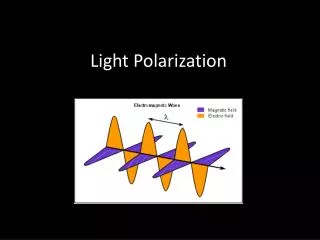
o 180 Light as Plane Waves • Sinusoidal plane waves very • good approximation. • Very useful for characterizing • polarization. • Polarized Wave: Has only one preferred orientation. • Un-polarized Wave: Has no preferred orientation. • or has all orientations. • Partially polarized wave: Has preferred orientation but • has energy in other orientations as well.
Classification of Polarization Linear : Two orthogonal plane waves with same phase but possibly different amplitudes. Circular: Two orthogonal plane waves with 90 deg phase shift but same amplitudes. Elliptical: Possibly any degree phase shift with different amplitudes.
Polarizer Puzzle If crossed polarizers block all light, why does putting a third polarizer at 45° between them result in some transmission of light?
Law of Malus Amplitude: Intensity = Const . (Amplitude)^2
Polarized Sunglasses Reduce glare off the roads while driving
NEXT CLASS Applications of Polarization in Vision Lecture #18 Thanks to Yoav Schechner, Nayar, Larry Wolff