Download
1 / 25
250 likes | 367 Vues
Explore the intricate layers and composition of Earth's atmosphere. Initially formed from volcanic outgassing, the early atmosphere lacked oxygen until plants and algae introduced it. The atmosphere is primarily composed of nitrogen (78%) and oxygen (21%), divided into four main layers: Troposphere, Stratosphere, Mesosphere, and Thermosphere. Each layer has unique features, including weather formation, temperature variation, and the protective ozone layer. Additionally, human activities are impacting the atmosphere, leading to environmental challenges like ozone depletion and global warming.

E N D
A. Early atmosphere • Created from gases released from volcanoes – outgassing. • Mostly water vapor, nitrogen, and carbon dioxide. • Oxygen was not part of atmosphere until a long time later • The presence of newly formed green algae and plants released oxygen into the atmosphere.
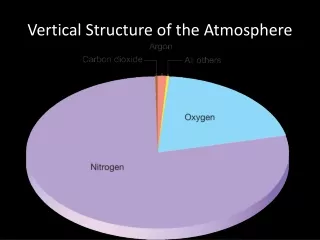
B. Composition of Atmosphere • Mostly made of nitrogen and oxygen • Nitrogen = 78% • Oxygen = 21% • A few other gases are present in small amounts.
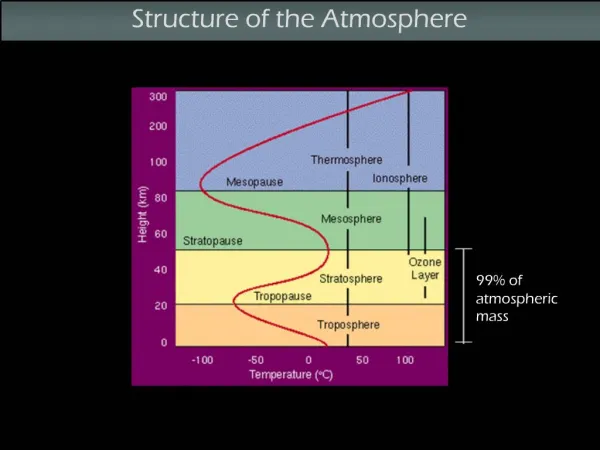
C. 4 Layers • Troposphere • Stratosphere • Mesosphere • Thermosphere
D. Troposphere • Closest layer and the layer we live in! • Clouds, wind, rain, and snow • Densest • Why? • Temperature decreases as altitude increases • Temperature stops decreasing – tropopause*
E. Stratosphere • 2nd layer • Oxygen (O2)-deficient; no H20 vapor • Temperature increases as altitude increases • Why does it get hotter? • ozone layer –upper stratosphere • What does ozone protect us from? • What is molecular formula for ozone? • Temperature stops increasing at - stratopause
F. Mesosphere • 3rd layer • Temperature decreases as altitude increases • No gases that absorb the sun’s radiation. • Coldest layer ~ -80°C*
G. Thermosphere • Temperature increases as altitude increases • Oxygen and nitrogen in this layer absorb sun’s radiation • Hottest layer ~980°C • Convert to Farhenheit • Tf = 32 + 9/5 Tc Tf = 32 + 9/5 (980) Tf = ? 1796° F • Outer portion= exosphere
H. Ionosphere • Electrically charged ions; solar radiation • What is ion? • Positively charged ion? • Upper mesosphere and lower thermosphere • Helpful in radio communication
Air Pressure • Atmospheric pressure – pressure due to weight of atmosphere • Sea level- 14.7 pounds per square inch. 3. The more air above you, the greater the air pressure. a. Higher air pressure in Valley, than in the mountains. • Mercury barometer
III. Human Influence on Atmosphere • Clorofluorocarbons (CFC’s) destroy ozone molecules. • Already a hole in ozone near south pole. • Ozone is getting thinner. • Excess carbon dioxide leads to greenhouse effect • Transportation vehicles responsible for ½ of pollutants in air. • Sun’s radiation trapped – global warming • What effect can global warming have on environment?
Solar radiation • Some radiation is reflected by clouds • Pollution from cars and factories release carbon dioxide. • Heat is released towards atmosphere. Some escapes, some is trapped by greenhouse gases.