
ahmed 2019
jurnal ini berisi informasi tentang tumbuhan khaya (khaya anthotheca)

ahmed 2019
E N D
Presentation Transcript
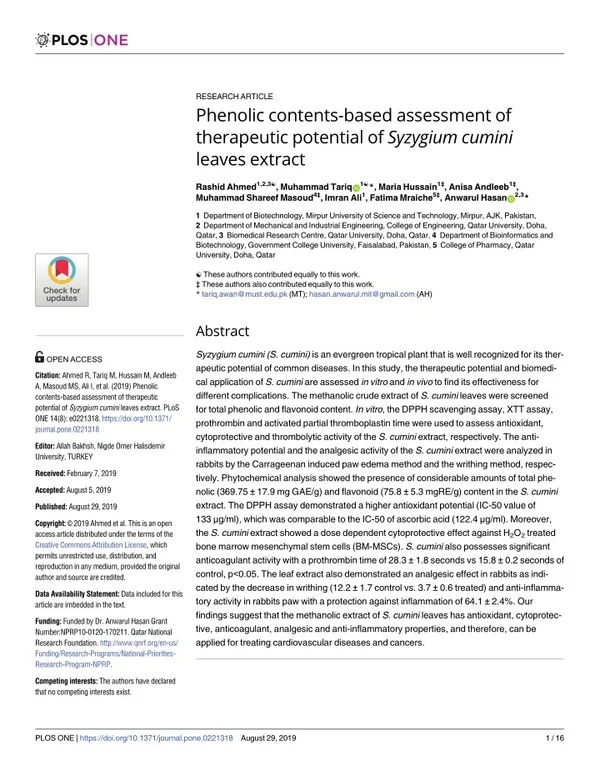
RESEARCH ARTICLE Phenolic contents-based assessment of therapeutic potential of Syzygium cumini leaves extract Rashid Ahmed1,2,3☯, Muhammad TariqID1☯*, Maria Hussain1‡, Anisa Andleeb1‡, Muhammad Shareef Masoud4‡, Imran Ali1, Fatima Mraiche5‡, Anwarul HasanID2,3* 1 Departmentof Biotechnology, Mirpur University of Science and Technology, Mirpur, AJK, Pakistan, 2 Departmentof Mechanical and Industrial Engineering, College of Engineering, Qatar University, Doha, Qatar, 3 Biomedical Research Centre, Qatar University, Doha, Qatar, 4 Department of Bioinformatics and Biotechnology, Government College University, Faisalabad, Pakistan, 5 College of Pharmacy, Qatar University, Doha, Qatar a1111111111 a1111111111 a1111111111 a1111111111 a1111111111 ☯ These authors contributed equally to this work. ‡ These authors also contributed equally to this work. * tariq.awan@must.edu.pk (MT); hasan.anwarul.mit@gmail.com (AH) Abstract Syzygium cumini (S. cumini) is an evergreen tropical plant that is well recognized for its ther- apeutic potential of common diseases. In this study, the therapeutic potential and biomedi- cal application of S. cumini are assessed in vitro and in vivo to find its effectiveness for different complications. The methanolic crude extract of S. cumini leaves were screened for total phenolic and flavonoid content. In vitro, the DPPH scavenging assay, XTT assay, prothrombin and activated partial thromboplastin time were used to assess antioxidant, cytoprotective and thrombolytic activity of the S. cumini extract, respectively. The anti- inflammatory potential and the analgesic activity of the S. cumini extract were analyzed in rabbits by the Carrageenan induced paw edema method and the writhing method, respec- tively. Phytochemical analysis showed the presence of considerable amounts of total phe- nolic (369.75 ± 17.9 mg GAE/g) and flavonoid (75.8 ± 5.3 mgRE/g) content in the S. cumini extract. The DPPH assay demonstrated a higher antioxidant potential (IC-50 value of 133 μg/ml), which was comparable to the IC-50 of ascorbic acid (122.4 μg/ml). Moreover, the S. cumini extract showed a dose dependent cytoprotective effect against H2O2treated bone marrow mesenchymal stem cells (BM-MSCs). S. cumini also possesses significant anticoagulant activity with a prothrombin time of 28.3 ± 1.8 seconds vs 15.8 ± 0.2 seconds of control, p<0.05. The leaf extract also demonstrated an analgesic effect in rabbits as indi- cated by the decrease in writhing (12.2 ± 1.7 control vs. 3.7 ± 0.6 treated) and anti-inflamma- tory activity in rabbits paw with a protection against inflammation of 64.1 ± 2.4%. Our findings suggest that the methanolic extract of S. cumini leaves has antioxidant, cytoprotec- tive, anticoagulant, analgesic and anti-inflammatory properties, and therefore, can be applied for treating cardiovascular diseases and cancers. OPEN ACCESS Citation:AhmedR,TariqM,HussainM,Andleeb A,MasoudMS,AliI,etal.(2019)Phenolic contents-basedassessmentoftherapeutic potentialofSyzygiumcuminileavesextract.PLoS ONE14(8):e0221318.https://doi.org/10.1371/ journal.pone.0221318 Editor:AllahBakhsh,NigdeOmerHalisdemir University,TURKEY Received:February7,2019 Accepted:August5,2019 Published:August29,2019 Copyright:©2019Ahmedetal.Thisisanopen accessarticledistributedunderthetermsofthe CreativeCommonsAttributionLicense,which permitsunrestricteduse,distribution,and reproductioninanymedium,providedtheoriginal authorandsourcearecredited. DataAvailabilityStatement:Dataincludedforthis articleareimbeddedinthetext. Funding:FundedbyDr.AnwarulHasanGrant Number:NPRP10-0120-170211.QatarNational ResearchFoundation.http://www.qnrf.org/en-us/ Funding/Research-Programs/National-Priorities- Research-Program-NPRP. Competinginterests: Theauthorshavedeclared thatnocompetinginterestsexist. PLOS ONE | https://doi.org/10.1371/journal.pone.0221318 August 29, 2019 1 / 16
Syzygiumcumini leaves extractstherapeutic potential Introduction Plants provide a large repertoire of phytochemicals such as polyphenols, flavonoids, caroten- oids and vitamins, which are active ingredients of therapeutic drugs in modern age [1]. Natural plant components are associated with minimal side effects as compared to synthetic drugs and as such have gained much interest. More than 25000 phytochemicals have been identified to date [2] including more than 8000 different types of polyphenols for their therapeutic potential [3]. The therapeutic potential of plants are often attributed to their high phenolic content [4]. Recently, several studies have been carried out to ascertain the therapeutic potential of phyto- chemicals especially polyphenols and flavonoids against a number of ailments [5]. Specifically, the search for anti-inflammatory, antioxidant, anticancer and hypoglycemic agents from vari- ous origins including the fruits, spices, vegetables, medicinal herbs and teas has attracted remarkable attention [6, 7]. Thus, screening of traditional natural plant-based products is a logical approach in drug discovery. Oxidative stress is one of main contributors of the pathophysiology of various pathological diseases [8]. Plants contain a diverse range of free radical scavenging molecules like terpenoids, phenolic compounds, vitamins and nitrogen compounds that have potent antioxidant activity [9]. Natural antioxidants have a variety of biochemical properties, including scavenging of free radicals, inhibition of reactive oxygen species (ROS) production and amendment of cellular redox potential. Inflammation stimulated in response to an infection has been associated with various diseases such as diabetes, cancer, atherosclerosis and hypertension [10, 11]. Non-ste- roidal anti-inflammatory drugs (NSAIDS) which are used for the treatment of inflammatory diseases are considered among the best-selling drugs worldwide despite the side effects associ- ated with their use. Various plants with anti-inflammatory effects are used as alternative for the treatment of inflammation and thousands of reports exist on the anti-inflammatory prop- erties of various plant tissue extracts [12]. Antidepressant drugs used as pain reliever in the cure of various chronic diseases have been traditionally obtained from plant based compounds [13]. There is a crucial need for active antithrombotic medicines to combat thrombotic dis- eases especially heart disease and cerebrovascular thrombosis [14]. Therefore, plant extracts can be used as alternative therapeutic agents for various medical issues due to the presence of diverse range of phytochemicals in them. Syzygium cumini (S. cumini) commonly known as black plum, growing extensively in dif- ferent agro-climatic countries possess several medicinal properties [6]. The extracts of various parts of S. cumini contains phytochemicals including tannins, anthocyanins, terpenes, flava- nols and aliphatic-acids [15]. All parts of S. cumini are rich in polyphenols [16]. Both fruit and flowers of S. cumini are enriched in anthocyanins as cyanidin, delphinidin, peonidin, pelargo- nidin, petunidin, and malvidin [17]. Anthocyanins show anti-carcinogenic properties such as inhibition of tumor formation, induction of cell-cycle arrest and induction of apoptosis to can- cer cells respectively [18]. The seeds of S. cumini contain rutin and quercetin while leaves have been reported to contain kaempferol, myricetin, quercetin and their glycosides. [19]. The plant has been reported to contain ellagic acid, triterpenoids, acetyl oleanolic acid, quercetin, iso- quercitin, myricetin and kaempferol [20]. S. cumini possesses hypoglycemic, antimicrobial, hypolipidemic, anti-allergic, anti-inflammatory, cardio-protective, hepato-protective and anti- neoplastic properties [15, 16]. The antioxidant, analgesic, anti-inflammatory and other metabolic related features of S. cumini have extensively been reported of fruit and seed extracts, however, few studies exist on the applicability of Syzygium cumini leaves. In this study, we report the assessment of the anti- oxidant, anti-proliferative, anti-coagulant, anti-inflammatory and analgesic potential of S. cumini leaves extracts. The methanolic extract Syzygium cumini leaves was obtained and PLOS ONE | https://doi.org/10.1371/journal.pone.0221318 August 29, 2019 2 / 16
Syzygiumcumini leaves extractstherapeutic potential screened for total phenolic and flavonoid content. In vitro assessment of the phenolic extracts for antioxidant, anticoagulant and cytoprotective activities were also investigated. In vivo stud- ies were conducted for anti-inflammatory and analgesic properties. Our findings demonstrate sufficient amount of phenolics and flavonoids in the leaf extracts of S. cumini and showed a remarkable level of antioxidant potential. The extracts of S. cumini demonstrated outstanding cytoprotective, anticoagulant activity and anti-inflammatory activities. Therefore, the present study suggests that S. cumini leaves extracts can be useful agents in therapeutic and biomedical applications, however, further studies will be needed to assess the molecular mechanism involved behind these activities on different kinds of cell lines and larger animals. Materials and methods Plant materials Fresh leaves of S. cumini were collected from the local area of Mirpur, Azad Kashmir Pakistan at coordinates 34.22˚N and 73.28˚E, in spring season and were authenticated by an expert bot- anist in the Department of Biotechnology, Mirpur University of Science and Technology (MUST) AJ&K. The voucher specimen (MUST-728) was deposited in Department of Biotech- nology. As this is not an endangered/protected species; there was no need to get approval for the use of leaves of S. cumini from the local environment protection department. Preparation of plant extract The fresh leaves were shade-dried and cleansed properly to remove any extraneous material. The dried leaves were ground into coarse powder. The powdered plant material (300 g) was then refluxed with methanol (900 ml) and kept in the dark for 3 to 5 days with occasional stir- ring and shaking. The mixture was filtered using a cotton plug followed by filtration through a Whatman filter paper no. 1. The filtrate was dried at 50˚C under reduced pressure, by rotary evaporator. The extract was preserved in an air-tight flask in a refrigerator as a crude extract. Determination of total phenolic and flavonoid content The total phenolic content was determined using the Folin-Ciocalteu (FC) reagent method with slight modifications [21]. The concentration of polyphenols of the plant sample were determined using a calibration curve of standard reference gallic acid. Methanolic solutions (0.5 mL) of standard reference gallic acid at concentrations of 12.5, 25, 50, 100, 200 and 400μg/ mL were added in 2.5 mL of 10% FC reagent and 2.5 mL of Na2CO3solution (7.5%) and kept at room temperature for 1 h. The absorbance was measured at 765 nm by using UV-visible spectrophotometer. Samples were prepared in triplicates for each analysis and the mean values were taken. The same procedure was followed for single concentration of plant sample (200 μg/ml). The total phenolic content was determined as mg of gallic acid equivalent/g of dry tissue extract (mgGAE/g) by using formula: TPC = (X x V)/m; where TPC is total phenolic content, X is the gallic acid concentration in mg/ml; V is the extract volume used in ml and m is the weight of tissue extract in grams. Total flavonoid content was assessed using spectrophotometric method with slight modifi- cations [22]. Briefly, 1 ml of sample solution was added in 1 ml of ethanolic solution of AlCl3 and 1.5 ml of 5% sodium acetate solution followed by incubation at room temperature for 2.5 h. The absorbance was measured at 440 nm with UV-visible spectrophotometer. Rutin was taken as the standard while the total flavonoid content in extract was stated in terms of rutin equivalent (RE) mg/g of extract. The concentration of leaves extracts for this assay was 200 μg/ ml. The experiment was carried out in triplicates. PLOS ONE | https://doi.org/10.1371/journal.pone.0221318 August 29, 2019 3 / 16
Syzygiumcumini leaves extractstherapeutic potential Antioxidant activity The scavenging ability of the methanol extracts was assessed using the 2,2-diphenyl-1-picryl- hydrazyl (DPPH) method adopted from a previous study [23]. 0.5 mM solution of DPPH (0.3 ml) was added to 0.5 ml of methanol extract at different concentrations (50–250 ug/ml) along with 3ml of absolute ethanol. The mixture was shaken strongly and placed in the dark for 60 min. The absorbance was measured against a blank at 517 nm. Ascorbic acid was used as a pos- itive control. Three replicates were taken, and the scavenging ability was estimated by using following equation: % Inhibition ¼Absorbance of Control ? Absorbance of Sample Absorbance of Control X 100 Anticoagulant activity The blood sampling was carried out from six healthy human donors voluntarily selected from Mirpur district of Azad Kashmir, Pakistan having no disease and taken no medicine for at least seven days prior to sampling. A written consent approved by the Research ethics commit- tee (REC) of Mirpur University of Science and Technology was taken from each participant prior to blood sampling. The samples were taken in centrifuge tubes having 400 μL of 3.2% sodium citrate to avoid blood clotting followed by centrifugation @ 3000 rpm at 5˚C for 15 min for plasma separation. Prothrombin time (PT) test. The anticoagulant activity of plant tissue extract was assessed by the prothrombin time (PT) test described earlier by Mao et al., 2009 [24]. Briefly, the PT test was performed using a commercially available PT reagent kit (Singapore Biosci- ences, Singapore). Eighty microlitre of plasma was mixed with 20 μL of plant tissue extracts at the concentration of 1 μg/μL and then incubated at 37˚C for 5 min followed by addition of 100 μL of pre-warmed thromboplastin reagent and the clotting time was recorded by a digital timer. Plasma without sample (with vehicle only) was used as control while Heparin was used as positive control. Activated partial thromboplastin time (APTT) test. The activity of leaves tissue extract in the contact activation pathway and common coagulation pathway was measured by the APTT test based on the previously described method [24]. The APTT test is similar to the one described earlier and used to measure PT test. In the APTT test, 100 μl of the APTT assay reagent (Cephaloplastin) was used. The reaction was carried out at 37˚C for 5 min. This was followed by incubation with 100 μl of 25 mM CaCl2and the coagulation time was recorded. Animal studies The cyto-protective activity of Syzygium cumini leaves extracts was performed on Bone mar- row mesenchymal stem cells (BM-MSCs) of rats. Two young healthy inbred Sprague–Dawley (SD) rats were purchased from National Institute of Health (NIH), Islamabad, Pakistan. The rats were kept under controlled conditions at 22 ± 2˚C and given standard diet. Six to eight months old male rabbits weighing 1 to 1.5 kg were purchased from NIH, Islam- abad, Pakistan. The rabbits were kept in separate cages at 22 ± 2˚C and were provided with the balanced healthy diet and free mobility. All procedures on rats and rabbits were performed according to National Institute of Health, USA Publication No. 18–23, 1985 which is com- monly used for the care and use of laboratory animals. Approval of all procedures and ethics for animal experimentation was sought from MUST Animal Care and Use Committee (MUS- T-ACUC) at Mirpur University of Science and Technology (MUST) through notification number MUST-2018-014. PLOS ONE | https://doi.org/10.1371/journal.pone.0221318 August 29, 2019 4 / 16
Syzygiumcumini leaves extractstherapeutic potential Bone marrow mesenchymal stem cells (BM-MSCs) culturing. BM-MSCs were har- vested from SD rats according to a previously reported protocol [25]. Briefly, the rats were sac- rificed by cervical dislocation. The epiphyses were removed and whole bone marrow was flushed out from tibia and femur. The resulting suspension of bone marrow cells was centri- fuged followed by re-suspension of cell pellet in Dulbecco’s modified Eagle’s medium (DMEM) enriched with 10% FBS and 1% antibiotic (100 μg/mL streptomycin and 100 U/mL penicillin). After harvesting from the bone marrow, the primary BM-MSCs were incubated with 5% humidified CO2at 37˚C. The cell culture media was changed on every 4thday. When cells reached 80% confluence, they were sub-cultured and at passage 3 BM-MSCs were used in subsequent experiment. XTT assay. The cytoprotective activity of S. cumini leaves extract was assessed by XTT assay [26]. BM-MSCs at passage 3 were trypsinized by using (1X Trypsin and EDTA). 1×10⁴ cells/well were plated in 96 well plates. The cells were placed in 5% CO2incubator at 37˚C by providing complete growth media containing 20% FBS (fetal bovine serum). At 80–90% con- fluency, the media was aspirated from the wells and BMSCs were washed twice with 1X PBS and treated with freshly prepared mixture of XTT. The plate was incubated in 5%CO2incuba- tor at 37˚C for 24 h. The absorbance of the formazan product was analyzed by an ELISA plate reader at 450 nm and a reference wavelength of 630 nm to obtain sample signal (OD450-OD630). The percentage cell viability was calculated by the formula given below; ð Þ ¼Absorbance of Sample Absorbance of ControlX 100 Cell Viability % Anti-Inflammatory assay. The anti-inflammatory activity of S. cumini leaves extracts was evaluated using carrageenan-induced oedema method (acute in vivo model) in the hind paws of rabbits [12]. Rabbits were divided into five experimental groups, each group containing six rabbits (n = 6) and fasted for 18 h prior to the experiment. Three groups were administered the plant extract at three different concentrations of 25, 50 and 100 mg per kilogram of body weight as a suspension in 0.1% sodium CMC as vehicle. The rabbits of group three and four were given Ibuprofen (100 mg/kg) and Indomethacin (50 mg/kg), respectively as standard drugs. After 1 h of drug administration, 1% carrageenan (100 μL) in normal saline solution was injected in the sub-plantar area of the right hind paw of each experimental rat. After 1 h, 2 h and 3 h of the carrageenan injection, the reduction in paw volume was analyzed using plethysmometer. The percentage protection was calculated using the formula; ð Þ ¼Reading of Control ? Reading of Sample Reading of Control X 100 Protection % Analgesic activity. The analgesic activity was assessed by the acetic acid method reported previously by Ramı ´rez et al. [12]. The animals were divided into 2 groups with 4 rabbits in each group. Control group rabbits were given saline solution while the treated group rabbits were given methanolic extract of S. cumini leaves at doses of 50 and 100 mg/kg dissolved in 5 ml saline solution and after 30 min 0.1% acetic acid was injected intra-peritoneal. The writhing (specific contractions of body) were observed randomly in rabbits and its frequency was counted for the next 20 min. Statistical analysis All the data collected was analyzed by one-way analysis of variance, and differences among the means of groups by an unpaired, two-sided Student’s t-test. All the graphs were plotted in Microsoft Excel 2010 and OriginPro 2016. The values were calculated for their Mean and PLOS ONE | https://doi.org/10.1371/journal.pone.0221318 August 29, 2019 5 / 16
Syzygiumcumini leaves extractstherapeutic potential Standard Error of Mean (Mean ± SEM). The unpaired t-test was used to calculate p-value for each group to measure the degree of change occurring in parameters observed, for control group and test group as well. A p-value � 0.05 was considered as significant value. Results The therapeutic potential of S. cumini was evaluated by various assays for the determination of phenolic c and flavonoid contents. Further studies investigated the antioxidant, anti-coagula- tion, anti-inflammatory and analgesic efficacy as demonstrated in Fig 1. The results obtained from various assays both in vitro and in vivo showed a significant medicinal value of S. cumini methanolic leaf extracts. Fig 1. Graphical representation of experimental process for the whole study. https://doi.org/10.1371/journal.pone.0221318.g001 PLOS ONE | https://doi.org/10.1371/journal.pone.0221318 August 29, 2019 6 / 16
Syzygiumcumini leaves extractstherapeutic potential Total phenolic and flavonoid content Total phenolic contents of S. cumini leaf extract as obtained by spectrophotometric method using Folin-Ciocalteu reagent are shown in Table 1. The linear equation obtained based on cal- ibration curve of gallic acid was; Y = 0.004x + 0.1742 (R2= 0.9931). The total phenolic contents measured for methanolic extract of leaves of S. cumini was 369.75 ± 17.9 mg GAE/g of plant extract. Total flavonoid content in S. cumini leaf extract was determined by spectrophotometric method using Rutin as standard. The linear equation obtained from the calibration curve of rutin was; Y = 0.0032x + 0.0575 (R2= 0.9851). The total flavonoid contents of S. cumini leaf methanolic extract calculated from the above equation was 75.8 ± 5.3 mgRE/g of plant extract. The presence of high content of phenolics and flavonoids in the leaves extract of S. cumini can be associated with the improved antioxidant, cytoprotective, anti-coagulant, anti-inflamma- tory and analgesic properties which are vital to reduce the risk from various diseases and offer multiple other health benefits due to their bioactivity and powerful antioxidant properties. Antioxidant activity The scavenging activity of leaves extracts and ascorbic acid was increased in a dose-dependent manner as shown in Fig 2. At concentrations of 50–250 μg/ml, the scavenging activities range of ascorbic acid and plant extract were 22 ± 2.3–89 ± 3.8% and 15 ± 4.5–92 ± 5.2% respectively. The IC-50 values were 122.4 μg/ml and 133 μg/ml for ascorbic acid and plant extract, respec- tively. Thus, the results indicated that the S. cumini leaves possess a high scavenging activity. Anticoagulant activity The S. cumini leaves extracts had significantly higher pro-thrombin time (28.3 ± 1.8 seconds) as compared to normal (15.8 ± 0.2 seconds) as shown in the Fig 3A (p-value < 0.05). The PT of control was 67.2 ± 3.5 seconds. Thus, the results indicated that S. cumini leaves extracts pos- sess significant anti-coagulant activity. The activated partial thromboplastin time for methanolic crude extract of S. cumini was assessed by using APTT assay reagent and. the results are shown in Fig 3B. The results depicted delayed APTT in plant sample (57.3 ± 2.2 seconds) as compared to normal (43.3 ± 3.1 seconds) while the APTT of control was 105 ± 5.1 seconds (p-value < 0.05). Cytoprotective activity The cytoprotective activity of leaves extracts of S. cumini on BM-MSCs obtained by the XTT assay are shown in Fig 4. BM-MSCs treated with hydrogen peroxide (H2O2) in the presence of leave extracts of S. cumini at concentration of 1 mg/ml and 5 mg/ml resulted in a concentra- tion-dependent cytoprotective response (84.5 ± 2.4% at 1 mg/ml and 91 ± 2.1% at 5 mg/ml vs. Table 1. Total phenolic contents (TPC) and total flavonoid contents (TFC) of Syzygium leaves extract. Groups Linear regression equation Y = 0.004X + 0.1742 Mean Absorbance of Plant Extract solution (Y) 0.2482 ± 0.0036 Concentration of GAE in Plant sample (X) 18.5 ± 0.9 Total contents calculated from equation = (X x V)/m 369.75 ± 17.9 Total Phenolic Content (TPC) mgGAE/g 0.0696 ± 0.0009 3.79 ± 0.265 75.8 ± 5.3 Total Flavonoid Content (TFC) mgRE/g Y = 0.0032X+ 0.0575 https://doi.org/10.1371/journal.pone.0221318.t001 PLOS ONE | https://doi.org/10.1371/journal.pone.0221318 August 29, 2019 7 / 16
Syzygiumcumini leaves extractstherapeutic potential Fig 2. Antioxidant activity (DPPH radical scavenging activity) of S. cumini leaves extract and standard ascorbic acid. Each data point represents the mean of three experiments with standard error of the mean (Mean±SEM, n = 3). https://doi.org/10.1371/journal.pone.0221318.g002 62.6 ± 3.5% H2O2group) (Fig 4). Results indicated that with increasing concentration of plant samples, the cytoprotective activity was also increased. Anti-inflammatory assay The results of anti-inflammatory activity of methanolic crude extracts of S. cumini leaves deter- mined by carrageenan-induced paw edema model of inflammation are shown in Fig 5. The results showed that the anti-inflammatory effect of the S. cumini was dose dependent as it increased from 52.8 ± 1.5% at 25 mg/kg to 64.1 ± 2.4 and 75.2 ± 1.9% for 25, 50 and 100 mg/kg respectively after 3 hr of carrageenan injection as shown in Fig 5. The results showed that leaves extract had higher anti-inflammatory potential (64.1 ± 2.4%) at 50 mg/kg as compared PLOS ONE | https://doi.org/10.1371/journal.pone.0221318 August 29, 2019 8 / 16
Syzygiumcumini leaves extractstherapeutic potential Fig 3. Anticoagulant activity. (a) Clot lysis by Prothrombin time (PT) assay in vitro, clotting time of S. cumini leaves extract was higher than normal but lower than control. (b) Activated partial thromboplastin time (APTT) assay in vitro. All readings are taken in triplicates and values are expressed as Mean±SEM. https://doi.org/10.1371/journal.pone.0221318.g003 to standard COX-1 inhibitor Ibuprofen (59.9 ± 2.3%) and slightly lower compared to selective COX-1 and COX-2 inhibitor Indomethacin (83 ± 3.1%) after 3 h of induction of carrageenan. This considerable amount of anti-inflammatory activity as shown by leaves extract of S. cumini could play an important role in providing protection against various diseases that have high prevalence within populations such as rheumatoid arthritis, atherosclerosis and asthma. Analgesic activity The analgesic activity of S. cumini leaves extract assessed by acetic acid induced writhing method is shown in Fig 6. The results show that the number of writhings resulted by the S. cumini leaves extracts treated group were 5.2 ± 0.9 and 3.7 ± 0.6 at the concentration of 50 and 100 mg/kg body weight, respectively. The writhing made by the control group was 12.2 ± 1.7 as shown in Fig 6. The administration of the methanolic leaves extract of S. cumini has signifi- cantly inhibited writhing response in animals in a dose dependent manner. Discussions The phytochemical studies of S. cumini revealed the presence of saponins, carbohydrates, tan- nins, terpenes, sterols, volatile oil, resins, flavonoids, phlobatanins and balsam in the leaves and stem bark [27]. Phenols are important plant components due to their radical scavenging activity. The scavenging activity of phenols is attributed to their hydroxyl groups [28]. The phenolic content in the plants may directly contribute to the antioxidative activity. A previous study has suggested that polyphenolic compounds might have some inhibitory effects on carci- nogenesis and mutagenesis in humans [29]. The leaves of S. cumini have been reported to have other bioactive compounds like gallic acid, citric acid, carotenoids, mallic acid, alkaloids and polyphenols, which are known to be effective for medicinal systems [3]. Methanolic extract of S. cumini leaves in the present study demonstrated good phenolic and flavonoid contents. When plant components are proposed for use in clinical applications, taking their potential toxicity into consideration is also crucial [30]. The DPPH free radical is known as a stable free radical and considered as a widely used method for assessing free radical-scavenging potential PLOS ONE | https://doi.org/10.1371/journal.pone.0221318 August 29, 2019 9 / 16
Syzygiumcumini leaves extractstherapeutic potential Fig 4. Cytotoxicity evaluation of S. cumini leaves extract by XTT assay on bone marrow derived mesenchymal stem cells (BM-MSCs). Cells were treated with plant extract at concentration of 1 mg/ml and 5 mg/ml for 24 h. S. cumini leaves extracts showed significant cytoprotective activity at increased dose of extract. Data is expressed as Mean ± SEM (n = 3). https://doi.org/10.1371/journal.pone.0221318.g004 of antioxidants. The powerful antioxidant property demonstrated by the tissue extracts of S. cumini was in fact due to high content of phenolics and flavonoids components [31]. Various pathologic situations generate free radicals including diabetes where inflammation is facili- tated by neutrophils, macrophages and leukocytes through production of oxidative species [32]. The antioxidant results of the present study were supported by the previous work by Ruan et al. [6]. Therefore, the strong antioxidant and anti-inflammatory activities observed in this study might be due to the presence of high phenolic compounds in the extracts as dis- played in Table 1. To the best of our knowledge, no scientific study has so far reported the anticoagulant potential of methanolic extract of S. cumini leaves. This study reported is the first study to demonstrate the significant anticoagulant activity of methanolic extract of S. cumini leaves. Anticoagulation therapy rely on clot lysis for opening a blocked artery and to avoid permanent PLOS ONE | https://doi.org/10.1371/journal.pone.0221318 August 29, 2019 10 / 16
Syzygiumcumini leaves extractstherapeutic potential Fig 5. Anti-inflammatory activity of S. cumini leaves extract on carrageenan induced paw edema. Data is expressed as Mean ± SEM (n = 3). https://doi.org/10.1371/journal.pone.0221318.g005 damage to the related tissues which is important for the treatment of clot-related diseases including thromboembolic strokes, pulmonary embolism, myocardial infarction and throm- bosis [30]. In present study, the thrombolytic activity of S. cumini leaves extract was measured and compared with control. The experimental results showed significantly higher clot disrup- tion activity by S. cumini leaves extract as compared to control. Anticoagulant effect of the methanolic extract is promising which suggests its potential use in thromboembolic disorders. The cancer-protective effect of fruits and vegetables are related to their antioxidant activities which prevent DNA damage by scavenging free radicals. S. cumini reduced the tumor occur- rence, tumor load and increasing level of gastric carcinomas [33]. It was reported that adminis- tration of the S. cumini extract (25 mg/kg body weight/day) inhibited benzo-a-pyrene- induced forestomach carcinogenesis [34]. Previously, the S. cumini seed extract has been PLOS ONE | https://doi.org/10.1371/journal.pone.0221318 August 29, 2019 11 / 16
Syzygiumcumini leaves extractstherapeutic potential Fig 6. Analgesic effects of methanol extract of S. cumini leaves on acetic acid-induced writhing in rabbits. Values are taken in triplicates and expressed as Mean ± SEM (n = 3). https://doi.org/10.1371/journal.pone.0221318.g006 reported to have anti-proliferative effects, which may be attributed to the high content of poly- phenolics, flavonoids, quercetin, tannins and ellagitannins [33]. In the present study S. cumini leaves extract decreased the viability of BMSSCs in vitro. Significant cyto-protective activity of leaves extracts was observed at a concentration of 5 mg/ml as compared to those at lower con- centration of 1 mg/ml. Thus, the earlier in vivo reports support our results. The carrageenan induced model of inflammation has been widely used to evaluate anti- inflammatory potential of plant species in animal models. The earlier studies on ethanolic extracts [35] and methanolic extracts by [36] of the bark of S. cumini demonstrated that S. cumini extracts have strong anti-inflammatory properties. Another study evaluated the anti- PLOS ONE | https://doi.org/10.1371/journal.pone.0221318 August 29, 2019 12 / 16
Syzygiumcumini leaves extractstherapeutic potential inflammatory activity of methanol and ethyl acetate extracts of S. cumini seed in wistar rats using the carrageenan induced inflammation model, at the concentration of 200 and 400 mg/ kg [37]. These studies suggested that both the bark and seed extracts of S. cumini have signifi- cant anti-inflammatory properties. These findings support our findings, which demonstrate the anti-inflammatory activity of the methanolic extract of S. cumini leaves using the carra- geenan induced paw oedema model. Acetic acid induced writhing response is an efficient method to assess peripherally acting analgesics [38]. Ayyanar and Subash-Babu reported that S. cumini leaves are rich in quercetin, myricetin, triterpenoids, acetylated flavonol glycosides, and tannin. These chemical compo- nents may be related to and act synergistically with the analgesic profile of S. cumini leaves extracts [39]. A recent study revealed that quercetin inhibited NO synthase in rat skeletal mus- cle [40]. The results of analgesic activity from the present study are in accordance with the pre- viously reported work on S. cumini leaves antinociceptive activity on rodents [41]. Therefore, it is possible that the methanolic leaves extract of S. cumini may exert its peripheral analgesic action by interrupting the production, release or provoking the action of pain mediators and by inhibiting the local reaction caused by the pain at the target sites which result in significant analgesic effect. These bioactivities of S. cumini leaves extract can be linked to rich phenolic phytochemicals present in the extract. Conclusions In the present work, the therapeutic potential of the leaves extracts of S. cumini, an evergreen tropical plant, is assessed through different bioassays in vitro and in vivo for its potential thera- peutic and biomedical applications. The experimental work confirmed that a large amount of phenolics and flavonoids is embedded in the S. cumini tissues thus confirming the therapeutic usefulness of the parental plant. The manifestation of powerful antioxidant activity of S. cumini leaves extract can be related to the phenolic content present in the tissue extracts, which can provide protection from oxidative damages caused by free radicals and thus can prevent can- cers. Similarly, the results obtained during analysis of anti-inflammatory activity of leaves extracts verified the beneficial effects by the traditional use of S. cumini plant extracts in the inflammation. Due to its significant anti-inflammatory potential, S. cumini leaves extracts have the ability to be used as therapeutic in various inflammatory conditions such as asthma, rheu- matoid arthritis and atherosclerosis. Moreover, the S. cumini leaves extract showed significant analgesic activity, cytoprotective and anticoagulant activity which might be due to diverse range of bioactive polyphenols present in it. The results of the study suggest that the methanolic extract of S. cumini leaves can be used as a supplementary or alternative herbal remedy for the treatment of inflammatory and blood disorders. The remarkable anticoagulant activity as observed during present work deserves further investigation involving constituents of the methanolic extract of S. cumini leaves that can be a good platform for the development of new class of anticoagulant drugs. Acknowledgments This article was made possible by the NPRP10-0120-170211 grant funded by Qatar National Research Fund (a part of Qatar Foundation). The statements made here are solely responsibil- ity of authors. The authors also thankfully acknowledge the Qatar National Library for provid- ing the funding for the publication of this study, and Mirpur University of Science and Technology (MUST), Mirpur, AJK, Pakistan for providing their facilities needed for comple- tion of the current study. PLOS ONE | https://doi.org/10.1371/journal.pone.0221318 August 29, 2019 13 / 16
Syzygiumcumini leaves extractstherapeutic potential Author Contributions Conceptualization: Muhammad Tariq, Imran Ali. Data curation: Rashid Ahmed, Maria Hussain. Formal analysis: Rashid Ahmed, Muhammad Shareef Masoud. Funding acquisition: Anwarul Hasan. Investigation: Rashid Ahmed, Muhammad Shareef Masoud. Methodology: Muhammad Tariq. Project administration: Muhammad Tariq. Supervision: Muhammad Tariq, Anwarul Hasan. Visualization: Anisa Andleeb. Writing – original draft: Rashid Ahmed. Writing – review & editing: Anisa Andleeb, Imran Ali, Fatima Mraiche, Anwarul Hasan. References 1. Newman DJ, Cragg GM. Natural products as sources of new drugs over the last 25 years. Journal of natural products. 2007; 70(3):461–77. https://doi.org/10.1021/np068054v PMID: 17309302 Acosta-Estrada BA, Gutie ´rrez-Uribe JA, Serna-Saldı ´var SO. Bound phenolics in foods, a review. Food chemistry. 2014; 152:46–55.https://doi.org/10.1016/j.foodchem.2013.11.093 PMID: 24444905 2. 3. Patel PR, Rao TR. Antibacterial activity of underutilized fruits of Jamun (Syzygium cumini L. Skeels). Int J Curr Pharmac Res. 2012; 4:36–9. 4. You Y, Duan X, Wei X, Su X, Zhao M, Sun J, et al. Identificationof Major Phenolic Compounds of Chi- nese Water Chestnut and their Antioxidant Activity. Molecules.2007; 12(4):842–52. https://doi.org/10. 3390/12040842 PMID: 17851436 Aasim M, Bakhsh A, Sameeullah M, Karataş M, Khawar KM. Aquatic Plants as Human Food. Global Perspectives on Underutilized Crops: Springer; 2018. p. 165–87. 5. 6. Ruan ZP, Zhang LL, Lin YM. Evaluation of the antioxidant activity of Syzygiumcumini leaves. Mole- cules. 2008; 13(10):2545–56. https://doi.org/10.3390/molecules13102545 PMID: 18927517 7. Ahmed R, Tariq M, Ahmad IS, Fouly H, Hasan A, Kushad MJJoFQ. Poly (lactic-co-glycolic acid) Nano- particles Loaded with Callistemon citrinus Phenolics Exhibited Anticancer Properties against Three Breast Cancer Cell Lines. 2019;2019. 8. Kaneria M, Baravalia Y, Vaghasiya Y, Chanda S. Determination of antibacterial and antioxidant poten- tial of some medicinal plants from Saurashtra region, India. Indian journal of pharmaceutical sciences. 2009; 71(4):406. https://doi.org/10.4103/0250-474X.57289 PMID: 20502546 9. Cai Y, Sun M, Corke H. Antioxidant activity of betalains from plants of the Amaranthaceae. Journal of Agricultural and Food Chemistry. 2003; 51(8):2288–94. https://doi.org/10.1021/jf030045u PMID: 12670172 Schmid-Scho ¨nbein GW. Analysis of inflammation. Annu Rev Biomed Eng. 2006; 8:93–151. https://doi. org/10.1146/annurev.bioeng.8.061505.095708 PMID: 16834553 10. 11. Ahmed R, Tariq M, Ali I, Asghar R, Khanam PN, Augustine R, et al. Novel electrospun chitosan/polyvi- nyl alcohol/zinc oxide nanofibrous mats with antibacterial and antioxidant properties for diabetic wound healing. 2018; 120:385–93. Ramı ´rez-Cisneros M, Rios MY, De ´ciga-Campos M, Aguilar-Guadarrama A. Phytochemical study and anti-inflammatory, antidiabetic and free radical scavenger evaluations of Krameria pauciflora methanol extract. Molecules. 2012; 17(1):861–72. https://doi.org/10.3390/molecules17010861 PMID: 22252502 12. 13. Shah M, Parveen Z, Khan MR. Evaluation of antioxidant, anti-inflammatory, analgesic and antipyretic activities of the stem bark of Sapindus mukorossi. BMC complementary and alternative medicine. 2017; 17(1):526. https://doi.org/10.1186/s12906-017-2042-3 PMID: 29221478 14. Xie P, Zhang Y, Wang X, Wei J, Kang W. Antithrombotic effect and mechanismof Rubus spp. Black- berry. Food & function. 2017; 8(5):2000–12. PLOS ONE | https://doi.org/10.1371/journal.pone.0221318 August 29, 2019 14 / 16
Syzygiumcumini leaves extractstherapeutic potential 15. Baliga MS, Bhat HP, Baliga BRV, Wilson R, Palatty PL. Phytochemistry, traditional uses and pharma- cology of Eugenia jambolana Lam.(black plum): a review. Food Research International. 2011; 44 (7):1776–89. 16. Srivastava S, Chandra D. Pharmacological potentials of Syzygiumcumini: a review. Journal of the Sci- ence of Food and Agriculture. 2013; 93(9):2084–93. https://doi.org/10.1002/jsfa.6111 PMID: 23460190 17. Schulz M, Borges GdSC, Gonzaga LV, Costa ACO, Fett R. Juc ¸ara fruit (Euterpe edulis Mart.): Sustain- able exploitation of a source of bioactive compounds. Food Research International. 2016; 89:14–26. https://doi.org/10.1016/j.foodres.2016.07.027 PMID: 28460899 18. Aqil F, Gupta A, Munagala R, Jeyabalan J, Kausar H, Sharma RJ, et al. Antioxidant and antiproliferative activities of anthocyanin/ellagitannin-enriched extracts from Syzygium cumini L.(Jamun, the Indian Blackberry). Nutrition and cancer. 2012; 64(3):428–38. https://doi.org/10.1080/01635581.2012.657766 PMID: 22420901 19. Chagas VT, Franc ¸a LM, Malik S, Paes AMdA. Syzygiumcumini (L.) skeels: a prominent source of bio- active molecules against cardiometabolic diseases. Frontiers in pharmacology. 2015; 6:259. https://doi. org/10.3389/fphar.2015.00259 PMID: 26578965 20. Rastogi RP, Mehotra B. Compendium of Indian medicinal plants: volume 1. 1960–1969.Drug research Perspectives. 1990; 10. SingletonVL,OrthoferR, Lamuela-Ravento ´s RM. [14]Analysisof total phenols and otheroxidation sub- strates and antioxidants by means of folin-ciocalteu reagent. Methods in enzymology. 299: Elsevier; 1999. p. 152–78. 21. 22. Quettier-Deleu C, Gressier B, Vasseur J, Dine T, Brunet C, Luyckx M, et al. Phenolic compounds and antioxidant activities of buckwheat (Fagopyrumesculentum Moench) hulls and flour. Journal of ethno- pharmacology. 2000; 72(1–2):35–42. PMID: 10967451 23. Masood N, Ahmed R, Tariq M, Ahmed Z, Masoud MS, Ali I, et al. Silver nanoparticle impregnated chito- san-PEG hydrogel enhances wound healing in diabetes induced rabbits. International journal of phar- maceutics. 2019; 559:23–36. https://doi.org/10.1016/j.ijpharm.2019.01.019 PMID: 30668991 24. Mao W, Li H, Li Y, Zhang H, Qi X, Sun H, et al. Chemical characteristic and anticoagulant activity of the sulfated polysaccharide isolated from Monostroma latissimum (Chlorophyta). International Journal of Biological Macromolecules. 2009; 44(1):70–4. https://doi.org/10.1016/j.ijbiomac.2008.10.003 PMID: 19007806 25. Tariq M, Masoud MS, Mehmood A, Khan SN, Riazuddin S. Stromal cell derived factor-1alpha protects stem cell derived insulin-producing cells from glucotoxicityunder high glucose conditions in-vitro and ameliorates drug induced diabetes in rats. Journal of translational medicine. 2013; 11(1):115. 26. Sharma R, Kishore N, Hussein A, Lall N. Antibacterial and anti-inflammatory effects of Syzygiumjam- bos L.(Alston) and isolated compoundson acne vulgaris. BMC complementary and alternative medi- cine. 2013; 13(1):292. 27. Ugbabe G, Ezeunala M, Edmond I, Apev J, Salawu O. Preliminary phytochemical, antimicrobial and acute toxicity studies of the stem, bark and the leaves of a cultivated Syzygium cumini Linn.(Family: Myrtaceae) in Nigeria. African Journal of Biotechnology. 2010; 9(41):6943–747. Djipa CD, Delme ´e M, Quetin-Leclercq J. Antimicrobial activity of bark extracts of Syzygiumjambos (L.) Alston (Myrtaceae). Journal of Ethnopharmacology. 2000; 71(1–2):307–13. PMID: 10904178 28. 29. Xie W, Du L. Diabetes is an inflammatory disease: evidence from traditional Chinese medicines. Diabe- tes, Obesity and Metabolism. 2011; 13(4):289–301. https://doi.org/10.1111/j.1463-1326.2010.01336.x PMID: 21205111 30. Hossain MS, Reza AA, Rahaman MM, Nasrin MS, Rahat MRU, Islam MR, et al. Evaluation of morning glory (Jacquemontia tamnifolia (L.) Griseb) leaves for antioxidant, antinociceptive, anticoagulant and cytotoxic activities. Journal of basic and clinical physiology and pharmacology. 2018. 31. Bhatia I, Bajaj K. Chemical constituents of the seeds and bark of Syzygium cumini. Planta Medica. 1975; 28(08):346–52. 32. Parmar J, Sharma P, Verma P, Goyal P. Chemopreventive action of Syzygiumcumini on DMBA- induced skin papillomagenesis in mice. Asian pacific journal of cancer prevention. 2010; 11(1):261–5. PMID: 20593968 33. Swami SB, Thakor NSJ, Patil MM, Haldankar PM. Jamun (Syzygium cumini (L.)): a review of its food and medicinal uses. Food and Nutrition Sciences. 2012; 3(08):1100. 34. Parmar J, Sharma P, Verma P, Goyal P. Chemopreventive action of Syzygiumcumini on DMBA- induced skin papillomagenesis in mice. Asian Pac J Cancer Prev. 2010; 11(1):261–5. PMID: 20593968 35. Muruganandan S, Srinivasan K, Chandra S, Tandan S, Lal J, Raviprakash V. Anti-inflammatory activity of Syzygiumcumini bark. Fitoterapia. 2001; 72(4):369–75. PMID: 11395258 PLOS ONE | https://doi.org/10.1371/journal.pone.0221318 August 29, 2019 15 / 16
Syzygiumcumini leaves extractstherapeutic potential 36. Modi D, Patel J, Shah B, Nayak B. Antiinflammatory activity of seeds of Syzygiumcumini Linn. Journal of Pharmaceutical Education and Research. 2010; 1(1):68. 37. Kumar A, Ilavarasan R, Jayachandran T, Deecaraman M, Kumar RM, Aravindan P, et al. Anti-inflam- matory activity of Syzygiumcumini seed. African Journal of Biotechnology. 2008; 7(8). 38. Mollika S, Islam N, Parvin N, Kabir A, Sayem M, Luthfunnesa SR. Evaluation of Analgesic, Anti-Inflam- matory and CNS Activities of the Methanolic Extract of Syzygium samarangense Leave. Global J Phar- macol. 2014; 8(1):39–s46. 39. Ayyanar M, Subash-Babu P. Syzygium cumini (L.) Skeels: A review of its phytochemical constituents and traditional uses. Asian Pacific journal of tropical biomedicine. 2012; 2(3):240–6. https://doi.org/10. 1016/S2221-1691(12)60050-1 PMID: 23569906 Anhê GF, Okamoto MM, Kinote A, Sollon C, Lellis-Santos C, Anhê FF, et al. Quercetin decreases inflammatory response and increases insulin action in skeletal muscle of ob/ob mice and in L6 myo- tubes. European journal of pharmacology. 2012; 689(1–3):285–93. https://doi.org/10.1016/j.ejphar. 2012.06.007 PMID: 22713545 40. 41. Quintans JS, Brito RG, Aquino PGV, Franc ¸a PH, Siqueira-Lima PS, Santana AE, et al. Antinociceptive activity of Syzygiumcumini leaves ethanol extract on orofacial nociception protocols in rodents. Phar- maceutical biology. 2014; 52(6):762–6. https://doi.org/10.3109/13880209.2013.870582 PMID: 24559393 PLOS ONE | https://doi.org/10.1371/journal.pone.0221318 August 29, 2019 16 / 16