Web3 Developer vs Blockchain Developer : Key Differences
A professional Web3 developer knows the notion of Web3 - meaning they must be a Web3 specialist, is proficient in important computer languages, have Web3 certification, and have the proper tech stack to support their development task. Continue Reading...<br><br>Visit: https://www.blockchain-council.org/certifications/certified-web3-expert/

Web3 Developer vs Blockchain Developer : Key Differences
E N D
Presentation Transcript
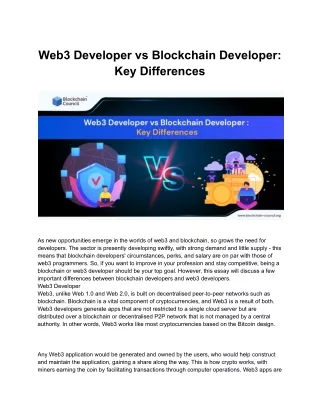
Web3 Developer vs Blockchain Developer: Key Differences As new opportunities emerge in the worlds of web3 and blockchain, so grows the need for developers. The sector is presently developing swiftly, with strong demand and little supply - this means that blockchain developers' circumstances, perks, and salary are on par with those of web3 programmers. So, if you want to improve in your profession and stay competitive, being a blockchain or web3 developer should be your top goal. However, this essay will discuss a few important differences between blockchain developers and web3 developers. Web3 Developer Web3, unlike Web 1.0 and Web 2.0, is built on decentralised peer-to-peer networks such as blockchain. Blockchain is a vital component of cryptocurrencies, and Web3 is a result of both. Web3 developers generate apps that are not restricted to a single cloud server but are distributed over a blockchain or decentralised P2P network that is not managed by a central authority. In other words, Web3 works like most cryptocurrencies based on the Bitcoin design. Any Web3 application would be generated and owned by the users, who would help construct and maintain the application, gaining a share along the way. This is how crypto works, with miners earning the coin by facilitating transactions through computer operations. Web3 apps are
known as dApps, which stand for decentralised applications. This word will be used more regularly in the coming years. A professional Web3 developer knows the notion of Web3 - meaning they must be a Web3 specialist, is proficient in important computer languages, have Web3 course, and have the proper tech stack to support their development task. What Technology Stack Do Web3 Developers Employ? The tech stack, commonly known as the developer stack, refers to the technologies or tools at which the developer utilises and excels. The developer must leverage the following tech stack for Web3: Crypto Wallets: If you've ever toyed with bitcoin, you've likely heard of a crypto wallet. It is a digital or physical wallet that stores your bitcoin. A wallet is necessary to support transactions in Web3 apps. Web3 Sdks And Dapps: Web3 SDKs, or modules, are necessary for the Web3 creation of any dApp. These modules enable interaction with the blockchain, such as Bitcoin, and transaction processing. Nodes: Nodes build the blockchain and keep a copy of it. Because the application's communication with the blockchain depends on these nodes, they are also known as Web3 providers. The dApp cannot communicate with the smart contracts without these nodes. Smart Contracts: Smart contracts are bits of code that reside on the blockchain in cryptocurrencies. These cannot be updated or modified since they are written in solidity. This code is performed when the essential circumstances are satisfied. When blockchain participants confirm an outcome, this automates the procedure. These smart contracts, which Ethereum pioneered, also contributed to Ethereum's transaction speed advantage over Bitcoin. Web3 Developers Salary The typical Web3 developer compensation is between $100k and $152k per year. Salary ranges are defined by technology, the programming language used, years of work experience, geography, and experience. Web3 programming is hard, which is why a developer must be a Web3 expert and have a Web3 certification to be accepted or stand out. Blockchain Developer Building, maintaining, and developing blockchain systems and applications are all part of blockchain development. Overall, a blockchain developer strives to solve difficulties and provide opportunities by exploiting the unique qualities of blockchain technology. The smart contract is
an example of creative blockchain development. Smart contracts, like traditional contracts, are written agreements between two parties. They are programmes saved on a blockchain. These programmes are only activated when both parties agree to the terms and conditions. This automatic compliance guarantees that a contract is carried out accurately in real-time. Comparing smart contracts to smart parking is a fantastic technique to grasping their worth. You enter the right payment and acquire the parking validation that corresponds to it. Because the contract is established, no third-party intervention, such as a cashier, is required. What Is The Role Of A Blockchain Developer? In a nutshell, a blockchain developer is a type of software engineer who specialises in blockchain technology. Software and system developers programme, construct, and test systems and software. There are two categories of blockchain developers: Core blockchain developer. The structure of blockchain systems is developed and maintained by key blockchain developers. They design protocols, create security patterns, and manage the network. Blockchain software developer. Blockchain software developers produce programmes that run on current blockchain technologies. The developers are in responsible of front-end and back-end programming, design, and upkeep. Keep in mind that before being branded a blockchain expert, a blockchain developer must have undergone some blockchain technology training and held blockchain certification. A blockchain developer has certain jobs and obligations. As a blockchain developer, you must concentrate on the resilience of the network security protocols utilised in the peer-to-peer network. Other roles include exploring and upgrading the blockchain architecture and building new applications. A blockchain developer also must assure that the activities are encrypted. Blockchain Developers Salary In the United States, the typical blockchain developer's yearly pay is $143,000 per year, and the hourly compensation is $73.33 per hour. Entry-level earnings begin at $121,875 per year, with most experienced experts earning up to $176,325 per year. Blockchain developers are in great demand since they deal employing cutting-edge technologies. As a result, there are many work prospects in this area. The US Bureau of Labor Statistics (BLS) forecasts a 22% gain in
software development jobs between 2020 and 2030. According to projections, the blockchain sector would be valued more than $39 billion by 2025. Conclusion Becoming a blockchain or Web3 developer is difficult, but it is feasible if you keep the correct mental attitude, work ethic, and desire to study more. We are experiencing a burgeoning business with much to be taught, and possibilities are all around us: from how we work, engage with one another, and utilise the internet. Web3 and blockchain development leverage almost same coding languages, experience, software engineering, and certification. The salary range is approximately the same for blockchain and Web3 engineers, among many other things. Finally, because there aren't many distinctions between them, you'll have to pick which is preferable.