Web3 vs DeFi : Explained
E N D
Presentation Transcript
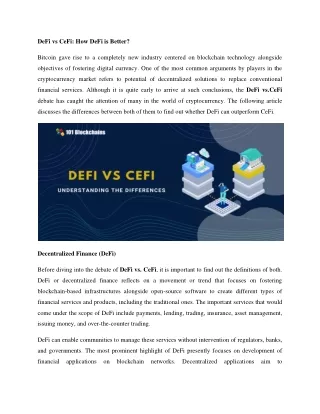
Web3 vs DeFi : Explained In the cryptosphere, DeFi and Web3 are hot subjects. Several individuals believe Web3 permits the creation of a new Internet that can overcome the inefficiencies that Web1 and Web2 still suffer from. The creation of numerous protocols to provide accessibility to a more open, transparent, and permissionless financial system. Even though Web3, the new paradigm has in various ways served as the cornerstone for a new decentralized financial system. The phrase decentralized finance is widely used to describe the idea. Describe Web3 The Internet's next phase, Web 3.0, is rapidly approaching. Within two years, Web3 training will have reached its full maturity. It has already started to spread out. Blockchain technology is Web 3.0's main motivator. A blockchain represents the same technology that powers Bitcoin. Instead of a single server, it uses a decentralized ledger system that simultaneously spreads data among thousands of machines. More data may be shared and stored. As a result, they are making it more effective and available to anybody who needs it.
Explain Defi Decentralized finance, often known as DeFi, is a cutting-edge concept in banking and finance. It depends on peer-to-peer transactions made accessible by blockchain technology. DeFi dispenses with traditional financial intermediaries like banks and brokers in favor of trust-less banking through blockchain. By providing investors the chance to lend money peer-to-peer and earn greater returns. Those offered in conventional bank accounts, DeFi developer aims to help investors get to be the bank. Investors may send money quickly and easily to any location in the world. They can manage their money without paying traditional banking costs by using digital wallets. Differentiating Web3 From Defi Decentralized finance is Web3 development approach to a more accessible financial system. It forms the basis of Web3 certification utilization of blockchain technology to create a more equitable internet. DeFi training is quickly evolving into a new paradigm that makes it possible for new kinds of value and usefulness. These aren't present in the conventional financial system. DeFi developers enable financial utility in several ways using smart contract technology. Many of these systems enable users to manage their money in a non-custodial manner using a DeFi bitcoin wallet. Let's get further into a few of them: Independent Exchanges A decentralized exchange is a peer-to-peer market area where buyers and sellers of cryptocurrencies can communicate. DeFi certifications are non-custodial, as opposed to centralized exchanges, meaning that users retain custody of their secret information during the transaction. DEXs use smart contracts to execute themselves under predetermined conditions and record each transaction on the blockchain without a central authority.
Defi: Staking, Lending, And Borrowing Perhaps the most typical use for DeFi certification is multifunctional peer-to-peer money marketplaces, which host a range of goods and services. By enabling users to borrow, lend, and wager on cryptocurrencies. Through various forms of collectivized liquidity pools, decentralized money markets add liquidity to the protocol. DeFi loan markets are still developing as additional capital deployment, and investment strategies are often applied. Unfungible Tokens NFTs are cryptographic assets that may represent anything, including business cards, artwork, and specialized access permits. They are immutable and verifiable. One of the largest markets for DeFi is NFTs, which have continued to increase their market share. These resources are frequently used on blockchain platforms that employ play-to-earn mechanisms to compensate players for their in-game actions. Comparison Of Defi And Web3 Features Even though blockchain and Web3 are unrelated to decentralized finance, they have many of the same features. They most prominently use decentralized systems that are: Unrestricted And Public The DeFi and Web3 crypto initiatives aim to be open, permissive, and egalitarian. Users can access the network without authorization from a central authority, known as permission lessness. Anyone may join open, public blockchain networks because of the way they function. With the help of this capability, users may easily access their cryptocurrency wallet and other network-specific infrastructure from their laptops or smartphone. Decentralized Decentralization in the context of blockchain refers to the network's independence from the control of a centralized middleman. It is often demonstrated by a widely dispersed worldwide network of nodes that power the network's functioning.
Programmable Software developers that can program can create network architecture that can handle an almost infinite number of use-case-specific iterations. Smart contracts, which enable users to do specified actions in real-time without an intermediary, are often used to achieve this. Some of these activities include fulfilling preset contractual obligations, exchanging value and data, and other on-chain procedures. Conclusion In Web 3.0, it's anticipated that several technologies will come together, including DeFi training and blockchain, for improved data ownership and governance. AI and contextualized analytics' capacity to sift through and assess information. It can result in more outcome variables, hyper-personalized consumer experiences, and improved decision-making.