Solar Panel Kit Complete Buyers Guide
Discover practical insights about choosing the right solar panel kit for homes, RVs, businesses, and off-grid living. Learn how solar solutions can support efficient and sustainable energy usage.

Solar Panel Kit Complete Buyers Guide
E N D
Presentation Transcript
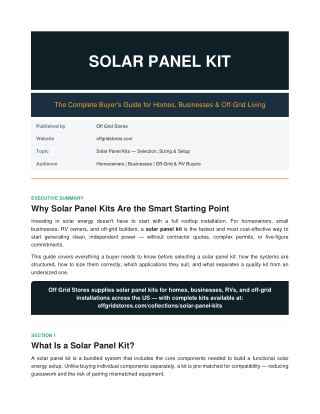
SOLAR PANEL KIT The Complete Buyer's Guide for Homes, Businesses & Off-Grid Living Off Grid Stores Published by offgridstores.com Website Solar Panel Kits — Selection, Sizing & Setup Topic Homeowners | Businesses | Off-Grid & RV Buyers Audience EXECUTIVE SUMMARY Why Solar Panel Kits Are the Smart Starting Point Investing in solar energy doesn't have to start with a full rooftop installation. For homeowners, small businesses, RV owners, and off-grid builders, a solar panel kit is the fastest and most cost-effective way to start generating clean, independent power — without contractor quotes, complex permits, or five-figure commitments. This guide covers everything a buyer needs to know before selecting a solar panel kit: how the systems are structured, how to size them correctly, which applications they suit, and what separates a quality kit from an undersized one. Off Grid Stores supplies solar panel kits for homes, businesses, RVs, and off-grid installations across the US — with complete kits available at: offgridstores.com/collections/solar-panel-kits SECTION 1 What Is a Solar Panel Kit? A solar panel kit is a bundled system that includes the core components needed to build a functional solar energy setup. Unlike buying individual components separately, a kit is pre-matched for compatibility — reducing guesswork and the risk of pairing mismatched equipment.
Standard components included in a solar panel kit: • Solar panels (monocrystalline or polycrystalline) • Charge controller (PWM or MPPT depending on kit tier) • Inverter (in full system kits) — converts DC to usable AC power • Mounting hardware and frame components • Wiring, connectors, and MC4 cables • Batteries (in complete off-grid kits) Entry-level kits may include only panels and a charge controller — suitable for buyers who already have batteries and an inverter. Complete kits include every component for a ready-to-install system. Solar Panel Kit Types at a Glance Kit Type Includes Best For Starter Kit Panels + Charge Controller Adding to an existing battery/inverter system Foldable panels + controller + carry case Portable Kit Camping, van life, temporary power Full system incl. batteries + inverter Off-Grid Kit Cabins, tiny homes, RVs, remote sites Panels + grid-tie inverter (no batteries) Grid-Tie Kit Home rooftop — reducing electricity bill Full system + grid connection capability Hybrid Kit Homes wanting solar + grid backup SECTION 2 Who Buys Solar Panel Kits — and Why Homeowners Rising electricity bills are the primary driver. A solar panel kit allows homeowners to offset grid consumption without a full rooftop installation contract. Many start with a smaller kit — 400W to 1000W — to power specific high-consumption circuits (water heating, HVAC supplementation, appliances) and expand over time. Small Businesses Commercial solar panel kits are increasingly used by small businesses — warehouses, farms, food trucks, market stalls, and remote job sites — to reduce operating costs and ensure power availability in locations where grid access is expensive or unreliable. Off Grid Stores supplies commercial-scale kits suitable for higher wattage requirements. RV and Van Life Community
Mobile solar panel kits for RVs are one of the fastest-growing product categories in off-grid retail. A typical RV solar kit (200W–600W) handles lighting, phone and laptop charging, a 12V compressor fridge, and a small fan — eliminating dependence on campground hookups. Off-Grid Homesteaders and Tiny Home Owners For permanent off-grid living, a solar panel kit forms the foundation of the entire energy system. These buyers typically need larger kits — 2kW to 10kW — with battery storage, MPPT charge controllers, and a hybrid or off-grid inverter. Complete system kits serve this segment directly. Emergency Preparedness Increasingly, homeowners in hurricane, wildfire, and winter storm zones are purchasing solar panel kits as backup power infrastructure — particularly portable kits that can be deployed quickly when grid power fails. SECTION 3 How to Size a Solar Panel Kit: The Right Method Incorrect sizing is the single most common mistake in solar panel kit purchases. Most buyers underestimate their load and overestimate how much power their panels will generate in real-world conditions. Here is the correct approach: Step 1: Calculate Daily Energy Consumption (Wh/day) List every device you plan to run. Multiply each device's wattage by the hours per day it runs. Add all values together. This is your daily watt-hour (Wh) requirement. Device Watts Hours/Day Wh/Day LED Lighting (4 bulbs) 40W 5 hrs 200 Wh Laptop 65W 6 hrs 390 Wh 12V Compressor Fridge 45W 12 hrs 540 Wh Phone + Tablet Charging 30W 3 hrs 90 Wh Small Fan 35W 8 hrs 280 Wh <b>Daily Total</b> <b>1,500 Wh</b> Step 2: Account for Real-World Solar Production Solar panels don't produce rated wattage all day. Peak sun hours — the hours per day when sunlight intensity is sufficient for full rated output — average 4–5 hours across most of the US. Apply a 75–80% system efficiency factor to account for losses in wiring, charge controller, and inverter. Step 3: Calculate Required Panel Wattage Formula: Required Wattage = Daily Wh needed / (Peak sun hours x 0.75)
Using the example above: 1,500 Wh / (4.5 hrs x 0.75) = 444W of solar panel capacity. Round up to the nearest standard kit size — in this case, a 500W solar panel kit is the appropriate starting point. Rule of thumb: Always size your solar panel kit 20-30% larger than your calculation. Cloudy days, shading, seasonal variation, and future load additions all reduce effective output. SECTION 4 MPPT vs PWM Charge Controllers: What Your Kit Should Include The charge controller in your solar panel kit regulates power flow from panels to batteries. The type of controller significantly affects system efficiency — and is often where budget kits cut corners. Feature PWM Controller MPPT Controller 70–75% 93–97% Efficiency Small kits (<200W) Kits 200W and above Best for Must match battery Any voltage panel Panel voltage Lower Higher (worth it) Cost Standard Better (adjusts Vmp) Performance in cold Entry-level only Yes — for all serious builds Recommended For any solar panel kit above 200W, MPPT is strongly recommended. The efficiency gain typically pays back the price difference within the first year of operation. SECTION 5 Battery Compatibility: What Works With Solar Panel Kits Most solar panel kits are compatible with multiple battery types. Battery selection affects storage capacity, lifespan, depth of discharge, and total system cost. Battery Type Cycle Life Usable DoD Weight Best For Flooded Lead-Acid 300-500 50% Heavy Budget builds, stationary AGM / Gel 400-600 50% Heavy RV, marine, no-maintenance Lithium Iron (LiFePO4) 3,000-5,000 80-90% Light Off-grid, RV, long-term
Lithium NMC 500-1,000 80% Lightest Portable kits, EVs * LiFePO4 row highlighted — recommended choice for most solar panel kit builds. SECTION 6 Solar Panel Kit Applications by Use Case Residential — Partial Home Power A 1,000W–3,000W solar panel kit offsets significant electricity consumption for an average US home. Typically paired with a battery bank for evening use and a hybrid inverter for optional grid connection. ROI on residential solar kits ranges from 5–8 years depending on local electricity rates and sun hours. Residential — Full Off-Grid Home Complete off-grid solar kits from 4kW to 10kW+ serve homes not connected to the grid. System design prioritizes battery storage capacity and backup days — typically 2–4 days of autonomy during low-sun periods. RV and Motorhome RV solar panel kits (100W–600W) are designed for roof mounting with flexible or rigid panels depending on roof curvature. Most RV kits are 12V systems. Key consideration: roof space limits panel count, so high-efficiency monocrystalline panels maximize output per square foot. Camping and Overlanding Portable solar panel kits for camping are lightweight, foldable, and designed for quick deployment. Typically 60W–200W, paired with a portable power station. Ideal for charging phones, laptops, cameras, and running LED lighting. Remote Cabin / Tiny Home Off-grid kits for cabins and tiny homes prioritize system completeness and low maintenance. LiFePO4 battery storage, MPPT charge controllers, and 1,500W–3,000W inverter-charger combos are standard in this application. Small Business and Farm Agricultural and commercial solar panel kits power water pumps, refrigeration, lighting, and machinery on farms and rural businesses. Commercial kits above 5kW are available for larger energy requirements. SECTION 7 Solar Panel Kit Buying Checklist Verify these points before finalizing any solar panel kit purchase: • Total wattage covers calculated daily load with 20–30% headroom • Charge controller type: MPPT for kits 200W and above
• Battery type and capacity sized for 1–2 days of autonomy minimum • Inverter included and rated for your largest continuous AC load • Panel type: monocrystalline for limited roof/mounting space • Mounting hardware compatible with your surface (roof, ground, RV) • MC4 connectors and wiring gauge appropriate for system voltage and current • Warranty: panels (10–25 year), inverter (2–5 year), battery (2–10 year) • Brand support and documentation availability in the US SECTION 8 Where to Buy Solar Panel Kits in the US Off Grid Stores is a US-based e-commerce retailer specializing in solar energy equipment for residential, commercial, and off-grid applications. The company supplies solar panel kits across all capacity ranges — from portable 100W kits to complete 10kW off-grid home systems. Product categories available include portable solar panel kits, RV solar kits, off-grid complete system kits, and individual components for custom builds. All kits are listed with full specifications, compatible component details, and application guidance. Off Grid Stores does not provide installation services — the business model is focused on supplying quality equipment to buyers who install themselves or hire a local electrician. This keeps costs lower than turnkey solar providers while giving buyers full control over their system design. Browse the complete solar panel kit collection at Off Grid Stores: offgridstores.com/collections/solar-panel-kits This document is published by Off Grid Stores for informational purposes. All product details, specifications, and availability are subject to change. Visit offgridstores.com for current pricing and inventory. offgridstores.com/collections/solar-panel-kits