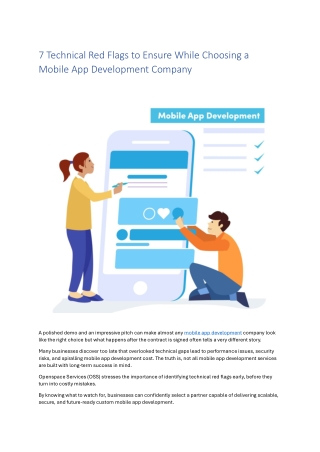
7 Technical Red Flags to Ensure While Choosing a Mobile App Development Company
0 likes | 1 Vues
A polished demo and an impressive pitch can make almost any mobile app development company look like the right choice but what happens after the contract is signed often tells a very different story.<br>Many businesses discover too late that overlooked technical gaps lead to performance issues, security risks, and spiralling mobile app development cost. The truth is, not all mobile app development services are built with long-term success in mind.<br>Openspace Services (OSS) stresses the importance of identifying technical red flags early, before they turn into costly mistakes.<br>


7 Technical Red Flags to Ensure While Choosing a Mobile App Development Company
E N D
Presentation Transcript
7 Technical Red Flags to Ensure While Choosing a Mobile App Development Company A polished demo and an impressive pitch can make almost any mobile app development company look like the right choice but what happens after the contract is signed often tells a very different story. Many businesses discover too late that overlooked technical gaps lead to performance issues, security risks, and spiralling mobile app development cost. The truth is, not all mobile app development services are built with long-term success in mind. Openspace Services (OSS) stresses the importance of identifying technical red flags early, before they turn into costly mistakes. By knowing what to watch for, businesses can confidently select a partner capable of delivering scalable, secure, and future-ready custom mobile app development.
1. No Clear Development Framework or Workflow One of the first warning signs appears when a company cannot clearly explain how an idea becomes a fully functioning app. A dependable mobile app development company should outline each phase from discovery and UI/UX design to development, testing, and deployment. Vague timelines or loosely defined milestones often signal rushed execution and inconsistent quality. OSS believes structured workflows are essential for maintaining control, transparency, and accountability throughout the development lifecycle. 2. Technology Decisions Driven by Convenience, Not Strategy When every project is pushed toward the same framework or tech stack, it usually reflects developer comfort rather than client needs. Different applications demand different approaches based on performance, scalability, and future upgrades. High-quality mobile app development services are grounded in strategic technology selection, ensuring the final product aligns with business goals instead of short-term development ease. 3. Little to No Focus on Scalable Architecture Many apps work well at launch but struggle as user adoption grows. A major red flag is when conversations barely touch on backend architecture, APIs, or scalability planning. Without a solid foundation, even small feature updates can become expensive and time-consuming. OSS highlights that thoughtful architecture planning during custom mobile app development prevents technical debt and keeps long-term maintenance costs under control. 4. Security Treated as an Afterthought Security gaps can damage user trust and expose businesses to compliance risks. If a company cannot clearly explain how they handle data protection, authentication, or secure APIs, it signals a lack of technical maturity. A reliable mobile app development company in USA or globally should follow established security standards and integrate security measures throughout the development process not just at the end. 5. Weak or Inconsistent Quality Assurance Practices Testing should never be optional or rushed. A company that limits QA to basic functionality checks often releases apps filled with bugs and performance issues. Strong mobile app development services include continuous testing across devices, operating systems, and real-world scenarios. OSS views quality assurance as a continuous discipline that safeguards user experience and brand credibility.
6. Unrealistic Pricing with No Cost Transparency An unusually low quote may seem appealing but often hides future expenses. When a vendor cannot clearly break down costs across features, integrations, testing, and post-launch support, budget overruns are almost inevitable. Understanding how scope and complexity influence mobile app development cost is essential for realistic planning and long-term success. 7. No Long-Term Support or Optimization Plan Launching an app is only the beginning. A lack of clear post-launch support, monitoring, and update strategy is a serious technical red flag. Operating system updates, performance optimization, and user feedback require ongoing attention. OSS emphasizes long-term partnerships where maintenance and evolution are built into the development strategy, not treated as an afterthought. Final Thoughts Choosing the right mobile app development company is less about flashy presentations and more about technical depth, transparency, and long-term thinking. By recognising these red flags early, businesses can avoid costly rework, security risks, and scalability challenges. Openspace Services (OSS) encourages organizations to evaluate partners based on how they plan, build, and support apps beyond the launch phase. For businesses seeking dependable, future-ready mobile app development services backed by strategic insight and technical excellence, OSS offers a partnership focused on sustainable growth. Connect with OSS to start building an app designed to perform, scale, and endure.


![[PDF] Free Download Red Mist By Patricia Cornwell](https://cdn4.slideserve.com/8153035/slide1-dt.jpg)
![[PDF] Free Download Red Alert By Elise Noble](https://cdn4.slideserve.com/8177835/slide1-dt.jpg)
![[PDF] Free Download The Red By Tiffany Reisz](https://cdn4.slideserve.com/8188015/slide1-dt.jpg)

![[PDF] Free Download La red púrpura By Carmen Mola](https://cdn4.slideserve.com/8345570/slide1-dt.jpg)