Miller & Company LLP
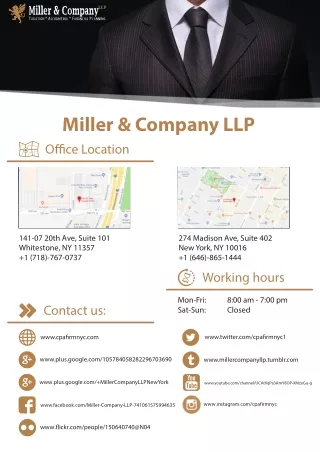
Licensed in New York, the professionals at Miller & Company have served top-tier Manhattan clients since 1997.They exceed your every expectation with full-service dedication to your financial needs. They spend time with you before delivering customize accounting strategies that improve your life and facilitate your lifestyle. Miller & Company serves New Yorku2019s elite with distinction, professionalism and responsiveness. Miller & Company leads the industry in customized, personal accounting services, delivering world class consulting, compliance and tax services. The accounting team focuses solely on your financial goals and desired outcomes. Totally invested in your success, they work with your business as if it were their own. Contact Miller & Company for tax services and QuickBooks accounting. Miller & Company caters to high net-worth individuals and thriving businesses that need a personal touch and an analytical eye. If that describes you, call Miller&Company LLP on 718-767-0737 for innovative accounting and strategic services such as: Strategic business planning Business consulting Certified audits Tax audits Audited financial statements Corporate and personal tax preparation Tax representation Bookkeeping Working Hours: Monday - Friday: 9:00 am - 7:00 pm; Saturday: 9:00 am - 4:00 pm, Sunday: Closed Payment: cash, check, credit cards. Miller & Company LLP Queens, NYC 141-07 20th Ave, Suite 101, Whitestone, NY 11357 718-767-0737 Miller & Company LLP: CPA of NYC Midtown Manhattan, NY 274 Madison Ave, Suite 402, New York, NY 10016 (646)-865-1444 Manhattan, NYC 18 East 48th Street, #1001 New York, NY 10017 (646) 367-3726 Washington, DC 700 Pennsylvania Ave, SE, Ste 2050 Washington, DC 20003 (202) 547-9004 Miller & Company CPAs: Tax Accountants Sarasota, Florida 2831 Ringling Boulevard, #204B Sarasota, FL 34237 (941) 366-5646 Keywords: accountant nyc, cpa firms in nyc, manhattan cpa, cpa manhattan, best accountants nyc, manhattan cpa firm, manhattan accounting firms, best small business accountant, best cpa firm, best tax accountant, tax accountant manhattan, tax cpa manhattan, top nyc accounting firm, midtown manhattan cpa firm, accounting firms in manhattan, best cpa firms, irs payment plan, tax preparation, retirement planning, tax lien, deferred tax asset, tax levy, tax audit, small business accountants, tax planning, federal tax lien, audited financial statements, payroll accounting, small business bookkeeping, cash flow management, tax resolution services, business consulting nyc, irs audit triggers, expatriate tax, international tax accountant, forensic accounting nyc, qualified domestic trust, business registration nyc, certified audit, tax representation, pension audits, financial statement review, international tax planning, international tax consultant, irs innocent spouse, accounting services nyc, strategic planning nyc, business accounting nyc, cpa self employed manhattan, high net worth retirement planning
30 views • 1 slides










![[EbooK Epub] The Book on Advanced Tax Strategies: Cracking the Code for Savvy Real Estate Investors Full](https://cdn5.slideserve.com/11103540/slide1-dt.jpg)
![Free [download] [epub]^^ The Inheritance Games (The Inheritance Games #1) EPUB](https://cdn5.slideserve.com/11167295/free-download-epub-the-inheritance-games-dt.jpg)